

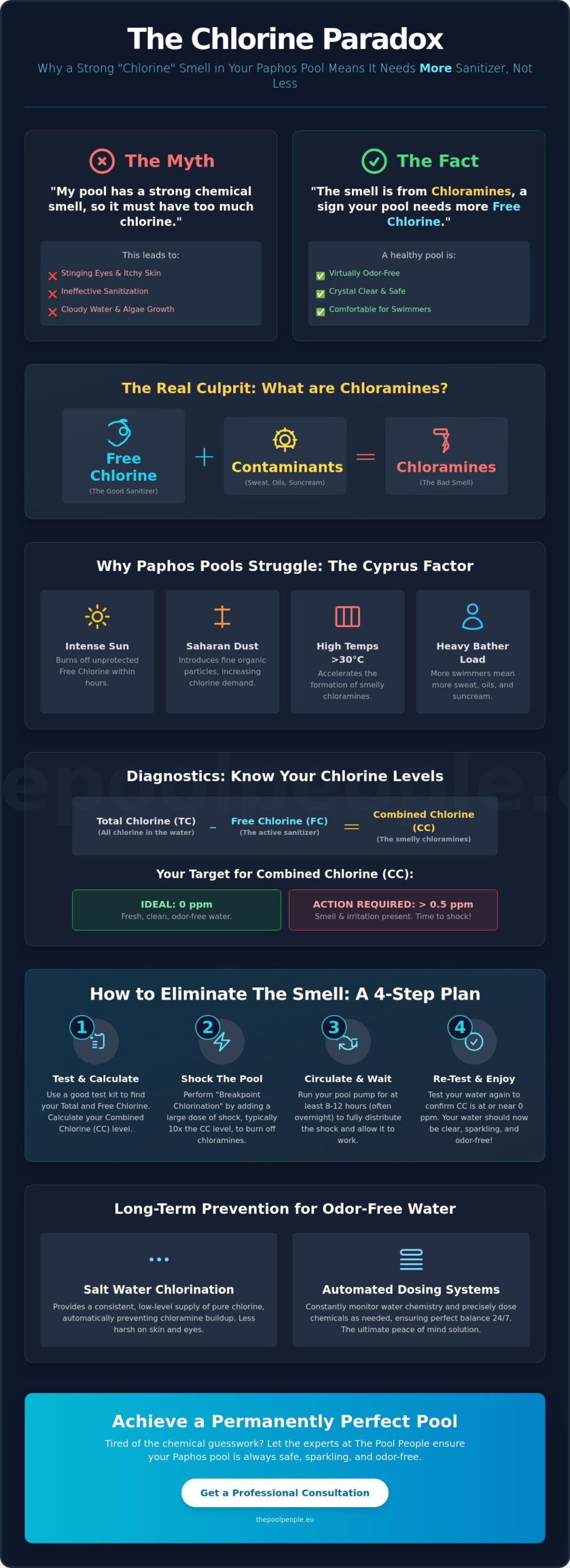
That strong, stinging “chlorine” scent coming from your Paphos pool doesn’t actually mean there’s too much chlorine in the water; it usually means there is far too little. It’s incredibly frustrating when you step out into the Cyprus heat for a refreshing dip, only to be met by an acrid odour that leaves your eyes stinging and your skin feeling itchy. You’ve balanced the chemicals and cleaned the filters, yet the smell persists, making you feel hesitant to invite guests over for a swim. We understand the confusion that comes with conflicting chemical readings and the desire for a truly inviting outdoor space.
We’re here to help you master the art of reducing chlorine smell in pool Paphos systems by explaining the “Chlorine Paradox” and how to fix it for good. You’ll learn the exact procedural steps to eliminate irritating chloramines and restore your water’s crystal-clear brilliance. This guide provides a clear plan to neutralise odours today while ensuring your facility remains compliant with the Swimming Pools Law of 2025. By the end of this article, you’ll have the professional knowledge needed to maintain a safe, odour-free environment that offers total peace of mind for you and your guests.
Key Takeaways
- Understand the “Chlorine Paradox” and why a strong chemical odour actually indicates a lack of sanitising power in your water.
- Discover how the intense Paphos sun and Saharan dust accelerate the formation of chloramines, presenting a unique challenge for reducing the chlorine smell in Paphos pools.
- Learn how to calculate your pool’s “Combined Chlorine” level to identify exactly when your water has become a health irritant.
- Master the “Breakpoint Chlorination” technique to effectively burn off organic waste and restore crystal-clear brilliance to your swimming environment.
- Explore how upgrading to salt water chlorination or automated dosing systems can provide long-term, stress-free maintenance and total peace of mind.
Identifying the Source: The Chlorine Smell Paradox
Most pool owners in Paphos believe that a strong chemical odour is a clear sign of an over-chlorinated pool. This is the “Chlorine Smell Paradox.” In reality, that unmistakable pungent scent indicates that your pool is actually starving for sanitiser. When people talk about reducing chlorine smell in pool Paphos environments, they aren’t looking to lower the chlorine levels, but rather to eliminate the chemical byproducts that cause the irritation. A properly balanced pool should have almost no smell at all. The presence of a heavy scent is a cry for help from your water.
When you experience stinging eyes, itchy skin, or notice your swimwear fading prematurely, your instinct might be to stop adding chemicals. This common misconception leads to a cycle of poor water quality. The “pool smell” signals that the chlorine you’ve added is no longer “free” to kill bacteria but has instead become “combined” with contaminants. Understanding the nuances of pool water chemistry is essential for any owner who wants to maintain a safe and inviting swimming environment. If you can smell the chlorine, it isn’t doing its job.
What are Chloramines Exactly?
Chloramines, often referred to as “combined chlorine,” form when free chlorine reacts with organic nitrogen compounds. In the heat of the Paphos summer, these compounds enter the water through swimmer waste like sweat, body oils, and even suncream. Instead of destroying these pollutants, the chlorine becomes locked in a weak chemical bond. These chloramines are the true source of the “chlorine smell.” A healthy, well-maintained pool smells fresh, almost like nothing at all. Conversely, a pool laden with chloramines is not just an aesthetic nuisance; it’s a safety concern. Chloramines are significantly less effective at killing pathogens, leaving your water vulnerable to bacteria and algae growth despite what your test kit might suggest.
The “Peace of Mind” Inspection
We always encourage our clients to trust their senses as their first diagnostic tool. If you can smell the pool before you even reach the water’s edge, it is time for an immediate chemical intervention. Waiting too long allows these combined compounds to build up, eventually leading to cloudy water or a full-scale algae bloom. While home testing is a great start, achieving total clarity often requires a deeper understanding of pool water chemistry. Professional management ensures that your free chlorine levels stay ahead of the organic load, preventing the formation of chloramines before they ever become a problem. This proactive approach is essential for reducing chlorine smell in pool Paphos residential systems, providing the long-term health and safety your family deserves.
Why Paphos Pools Struggle with Odours: The Cyprus Factor
The Mediterranean climate is beautiful, but it presents a unique set of challenges for pool owners. In Paphos, the intense sun can strip free chlorine from an unprotected pool in just a few hours. When water temperatures climb above 30°C during July and August, the chemistry of pool smell shifts rapidly. High heat acts as a catalyst, accelerating the reaction between chlorine and organic matter. This process leads to the rapid formation of chloramines, which are the primary hurdle in reducing chlorine smell in pool Paphos residents face every summer.
It isn’t just the heat that causes issues; environmental factors play a significant role. Paphos frequently experiences Saharan dust events, which introduce fine organic particles and minerals into the water. This environmental load, combined with the heavy use of suncream and natural sweat from swimmers, creates a perfect storm for chemical imbalances. Communal pools in high-density residential areas like Peyia or Kato Paphos are particularly vulnerable. With multiple families using the same water, the bather load often exceeds the capacity of a standard manual dosing routine, leading to that sharp, irritating odour that guests often mistake for too much chlorine.
The Impact of the Mediterranean Sun
Cyanuric Acid (CYA) acts as a stabiliser, essentially serving as a sunscreen for your chlorine. However, many owners in Cyprus fall into the “over-stabilisation” trap. Most chlorine pucks sold in local shops contain CYA. As these pucks dissolve, the stabiliser levels rise and never evaporate. Once CYA levels exceed 100ppm, the chlorine becomes “locked” and cannot sanitise effectively. To ensure your water remains safe, we recommend testing your levels during the peak afternoon heat. If you are struggling with persistent chemical imbalances, our professional chemical analysis can help identify if a partial drain and refill is necessary to reset your stabiliser levels.
Bather Load and Organic Waste
During the Paphos holiday season, bather load peaks as villas and apartments fill with guests. Each person brings oils, perfumes, and nitrogen-rich waste into the pool. A simple habit like showering before entry can reduce the organic load by up to 50 percent. This small step significantly lowers the demand on your sanitiser and prevents the formation of smelly combined chlorine. Managing these fluctuations is a core part of effective pool maintenance in Paphos, ensuring the water stays crystal clear and inviting even during periods of heavy usage.
Testing and Diagnostics: Free vs. Total Chlorine
Moving from sensory observation to scientific measurement is the first step toward a healthy swimming environment. To master the process of reducing chlorine smell in pool Paphos systems, you must understand the relationship between three distinct readings: Free Chlorine, Total Chlorine, and Combined Chlorine. Free Chlorine represents the active sanitiser available to kill bacteria. Total Chlorine is the sum of all chlorine in the water. The difference between these two figures reveals the Combined Chlorine, which represents the waste products causing that pungent odour. You can calculate this using a simple formula: Total Chlorine minus Free Chlorine equals Combined Chlorine.
A healthy pool should ideally have a Combined Chlorine reading of 0.0ppm. Any reading above 0.2ppm is an immediate signal that your water requires treatment. At this level, the sanitiser is overwhelmed by organic waste, and the irritation to eyes and skin begins to manifest. However, these precise measurements are impossible to capture with basic “yellow/red” OTO test kits, which only measure total levels. Professional DPD (Diethyl-p-phenylenediamine) kits are essential because they use specific reagents to isolate free and total readings, giving you the data needed to take accurate corrective action.
Your chlorine is only as effective as your pH balance allows. Even if your levels are technically high, a pH above 8.0 makes chlorine “lazy,” reducing its killing power by up to 80 percent. For the best results in the Cyprus climate, aim for a pH range of 7.2 to 7.6. This balance ensures your sanitiser remains aggressive against contaminants while remaining gentle on your skin and pool equipment.
Choosing the Right Test Kit in Paphos
While test strips offer a quick snapshot, they often lack the precision required for complex chemical troubleshooting. We recommend liquid reagent or tablet-based DPD kits for property owners in the Paphos district. These professional-grade tools are widely available at specialist pool shops in the Mesogi industrial area or via local suppliers in Kato Paphos. Investing in accurate reagents ensures you aren’t guessing with your family’s safety or wasting money on unnecessary chemicals.
Interpreting Your Results
Maintaining water quality in 2026 requires adhering to a specific “Ideal Range” checklist. Your total alkalinity should sit between 80 and 120ppm to prevent pH “bounce.” If alkalinity is too high, it can mask chemical imbalances, making it difficult to adjust your pH effectively. These technical checks are a standard component of a professional pool safety audit, which helps property owners stay compliant with the latest Cyprus regulations while ensuring total peace of mind for every swimmer.
How to Eliminate Chlorine Smell: A Step-by-Step Recovery Plan
Once you have identified a combined chlorine issue through accurate testing, the only professional way to resolve it is through “Breakpoint Chlorination.” This process involves adding a calculated, significant dose of chlorine to the water to physically break the chemical bonds of the chloramines. This procedural approach is the definitive method for reducing chlorine smell in pool Paphos facilities, ensuring the water returns to a safe and fresh state. Following a logical sequence is vital to ensure the treatment works the first time without wasting expensive chemicals.
The recovery plan follows four critical steps:
- Step 1: Calculate the Shock Dose. You must determine the exact amount of chlorine needed to reach the breakpoint. Adding too little will actually increase the concentration of chloramines, making the smell worse.
- Step 2: Balance the pH. Before adding any sanitiser, ensure your pH is between 7.2 and 7.4. If your pH is at 8.0, your shock treatment will be roughly 50 percent less effective, leading to a failed recovery.
- Step 3: Apply at Dusk. The Paphos sun is a natural enemy of chlorine. Applying your treatment after sunset ensures the chemical remains in the water long enough to complete the oxidation process without being destroyed by UV rays.
- Step 4: Continuous Filtration. Run your filtration system for at least 24 hours. This constant circulation ensures the shock dose reaches every corner of the pool and allows the filter to scrub out the neutralised organic waste.
The Breakpoint Chlorination Formula
The “10x Rule” is the industry standard for successful water recovery. To reach the breakpoint, you must raise your Free Chlorine level to ten times the amount of your Combined Chlorine reading. For example, if your test shows 0.5ppm of Combined Chlorine, you need to hit a target of 5.0ppm of Free Chlorine. For a standard 10m x 5m Paphos pool with a volume of approximately 75 to 80 cubic metres, this often requires several kilograms of high-quality shock granules. Precision is key here; guessing the dosage often leads to persistent odours and cloudy water.
Optimising Filtration and Circulation
Your filtration system acts as the mechanical partner to your chemical treatment. After a heavy shock, the dead organic matter stays suspended in the water until it is trapped by the filter media. We highly recommend backwashing your filter immediately after the 24-hour circulation period to flush these contaminants out of the system. While sand is common, many Paphos homeowners are switching to activated glass media (AFM), which provides superior filtration and reduces the risk of future chloramine buildup. Investing in essential pool equipment upgrades like variable speed pumps can also dramatically improve water turnover and chemical distribution. If your water remains stubborn despite these steps, contact our team for a professional water recovery service to restore your pool’s peace of mind.
Long-Term Prevention: Maintaining Odour-Free Water
After successfully resetting your water through breakpoint chlorination, the focus must shift toward preventing the return of combined chlorine. Maintaining a consistent sanitiser level is the most effective strategy for reducing chlorine smell in pool Paphos environments. Manual dosing often results in a “rollercoaster” of chemical levels, where periods of low chlorine allow organic waste to accumulate. This cycle leads right back to the pungent odours and skin irritation you’ve worked so hard to eliminate. Systemic stability is the only way to ensure your pool remains a source of relaxation rather than a maintenance burden.
Implementing automated dosing systems or upgrading your hardware can remove the human error factor from the equation. These systems monitor your water chemistry in real-time, delivering precise amounts of sanitiser exactly when needed. This constant regulation prevents the “peaks and valleys” that allow chloramines to take hold. When your pool chemistry is managed with technical precision, you achieve the “set it and forget it” reliability that every property owner desires.
Upgrading to Salt Water Systems
A common misconception among Paphos property owners is that salt water pools are entirely chlorine-free. In reality, a salt water chlorination system uses an electrolytic cell to convert dissolved salt into pure, active chlorine. The primary advantage lies in the delivery method. As water passes through the cell, it receives a constant, low-level “micro-shock” that instantly burns off organic contaminants before they can bond into smelly chloramines. This results in water that feels incredibly soft on the skin and smells completely fresh. For rental villas in high-demand areas like Coral Bay or Sea Caves, the return on investment is significant; guests enjoy a superior swimming experience without the eye sting typical of traditional manual dosing.
The Value of Professional CPO Maintenance
Consistency is the foundation of water safety and long-term value. Our team at The Pool People consists of PHTA/NSPF Certified Pool Operators (CPO), which is the definitive international standard for the industry. This certification ensures that our technicians understand the complex relationship between bather load, temperature, and chemical demand. Professional-grade chemicals also play a vital role in this process. Unlike “supermarket” alternatives that often contain high levels of fillers and excess stabilisers, our professional sanitisers provide predictable results and protect your pool’s liner and mechanical equipment from premature wear.
By shifting to a scheduled maintenance contract, you remove the guesswork and stress from your lifestyle. We provide the technical expertise and high-level care required to keep your water inviting and crystal clear year-round, regardless of the Paphos heat. For total peace of mind and a permanent solution to chemical imbalances, contact The Pool People for a comprehensive water audit and let us restore the excellence your investment deserves.
Achieving Crystal Clear Results for Your Cyprus Pool
Mastering the chemical balance of your water is about more than just comfort; it’s about the safety and longevity of your investment. We’ve explored how the “Chlorine Paradox” often leads to misunderstandings, where a strong scent actually signals a need for a professional shock treatment. By following the breakpoint chlorination steps outlined above, you can successfully navigate the unique challenges of the Paphos heat and Saharan dust. The ultimate goal is a swimming environment that is inviting, odour-free, and perfectly balanced for your family.
If you’re tired of the guesswork and want to ensure your facility remains compliant with the latest 2025 regulations, our team is ready to help. With over 20 years of experience in Cyprus, The Pool People are the definitive experts in salt water conversions and leak detection. Our PHTA/NSPF Certified Pool Operators provide the technical depth required for effective and lasting results in reducing chlorine smell in pool Paphos homes. Take the first step toward a stress-free summer today. Get a Professional Pool Water Audit in Paphos to restore your peace of mind and enjoy excellence in every swim.
Frequently Asked Questions
Why does my pool smell like chlorine but the test shows low chlorine?
That pungent scent is caused by chloramines, which form when your free chlorine is depleted by organic waste. When your test shows low free chlorine despite the smell, it confirms that your sanitiser is “locked up” and unable to clean the water. This is a primary indicator that you need to begin the process of reducing chlorine smell in pool paphos systems through breakpoint chlorination to restore water health.
Is it safe to swim in a pool that smells strongly of chemicals?
It’s generally not advisable to swim in a pool with a strong chemical odour, as it indicates the presence of irritating chloramines. These compounds are known to cause respiratory issues, red eyes, and skin rashes, especially in children. A strong smell suggests the water isn’t effectively sanitised, which could expose swimmers to harmful bacteria. We recommend waiting until the water is properly balanced and the odour has dissipated.
How long should I wait to swim after shocking my pool?
You should wait until your free chlorine levels have returned to the safe range of 1.0 to 4.0 ppm before entering the water. Depending on the strength of the shock treatment and the intensity of the Paphos sun, this typically takes about 24 hours. Always use a professional DPD test kit to verify the levels rather than guessing, as high chlorine concentrations can bleach swimwear and irritate the skin.
Can I use non-chlorine shock to get rid of the smell?
Non-chlorine shock, such as potassium monopersulfate, is an excellent tool for oxidising organic waste without increasing your chlorine levels. It’s particularly useful for maintenance because you can often swim just 15 minutes after application. However, remember that non-chlorine shock doesn’t kill bacteria; it simply helps prevent the formation of smelly chloramines by burning off bather waste. It’s a preventative measure rather than a total sanitisation solution.
Why do my eyes sting in the pool even if the chlorine level is “normal”?
Stinging eyes are usually a result of improper pH levels or high combined chlorine, rather than the free chlorine itself. If your pH drifts outside the 7.2 to 7.6 range, the water becomes aggressive, causing physical discomfort. We recommend a full chemical audit to ensure your alkalinity and pH are balanced, as this allows your sanitiser to work efficiently without causing irritation to sensitive membranes.
Does Saharan dust affect the chlorine smell in Paphos pools?
Saharan dust is a significant factor in Paphos, as it deposits fine minerals and organic matter directly into your water. This sudden spike in contaminants consumes your free chlorine almost instantly, leading to the rapid development of chloramines and that distinct chemical odour. Regular backwashing and increased sanitisation are essential during these weather events to maintain water clarity and prevent the water from turning dull or smelly.
How often should I shock my pool during a Cyprus summer?
We recommend a preventative shock treatment once a week during the peak Cyprus summer to handle the high bather load and intense heat. If you’ve had a pool party or a Saharan dust event, an additional treatment may be necessary to stay ahead of organic contaminants. This regular maintenance schedule prevents the “chlorine paradox” from occurring and keeps your water in a state of constant excellence and safety.
Will a salt water system completely eliminate the chlorine smell?
A salt water chlorination system is the most effective way of reducing chlorine smell in pool paphos homes because it provides a constant, automated supply of sanitiser. By eliminating the manual dosing cycle, you prevent the organic buildup that leads to chloramine formation. While these systems still use chlorine, the levels are kept stable and low, resulting in water that is gentle on the eyes and completely fresh to the scent.


Leave A Comment