

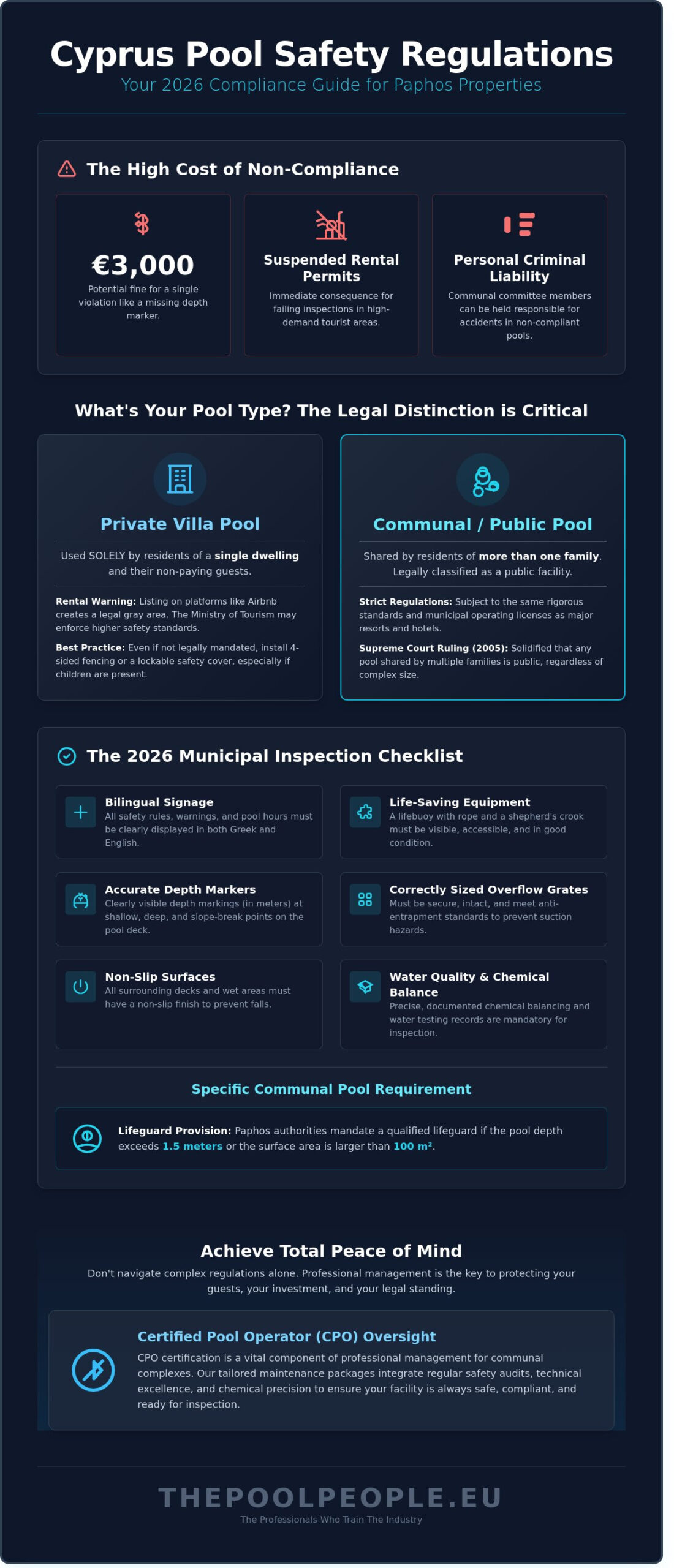
Did you know that a single missing depth marker or an incorrectly sized overflow grate could lead to a €3,000 fine from Paphos municipal inspectors this season? Understanding the current pool safety regulations Cyprus enforces is no longer a matter of choice; it’s a critical requirement for every property owner. We understand the frustration of trying to decipher the blurry legal line between a private villa pool and a communal complex under the updated 2026 framework. You want your guests to enjoy crystal clear, inviting water without the constant worry of personal liability or unexpected legal disputes with local authorities.
As the professionals who train the industry, we’re here to provide the definitive clarity you need to ensure your facility is safe and compliant. This guide will help you secure total peace of mind by breaking down the specific technical standards required by Paphos municipalities. We’ll provide a practical compliance checklist and a clear roadmap to protect your investment. You’ll learn exactly how to meet the 2026 safety benchmarks to keep your facility liability-free and your swimmers protected. Following these expert steps ensures your pool remains a source of joy rather than a legal burden.
Key Takeaways
- Understand the critical 2026 updates to the 1992 Swimming Pools Law and why these changes are essential for Paphos property owners to remain compliant.
- Identify the legal distinction between “Private” and “Communal” pools to ensure your facility meets the specific technical standards required by Cyprus courts.
- Review the essential hardware checklist and bilingual signage requirements mandated by pool safety regulations Cyprus to protect users and minimize owner liability.
- Learn why Certified Pool Operator (CPO) oversight is a vital component of professional management for communal complexes in areas like Peyia and Paphos.
- Discover how tailored maintenance packages provide total peace of mind by integrating safety audits into a routine of technical excellence and chemical precision.
Understanding the Legal Landscape of Pool Safety in Cyprus
Owning a pool in Paphos is a lifestyle choice that carries significant legal weight. The regulatory framework governing your installation rests on the Swimming Pools Law of 1992 and the subsequent 1996 Regulations. While these laws have existed for decades, 2026 marks a pivotal shift in enforcement. Local authorities in Peyia, Paphos, and Geroskipou are moving toward a zero-tolerance policy regarding compliance. You’re no longer looking at simple suggestions. You’re facing a regime of strict liability where property owners and communal committees are held legally responsible for every safety feature, from water chemistry to physical barriers.
The transition from “best practice” to mandatory enforcement is driven by a need for standardized safety across the Mediterranean. As the industry leader, we’ve observed that 2026 is the deadline for many older complexes to modernize their facilities or face closure. The role of the municipality has evolved; inspectors are now more frequent and their checklists more technical. They focus on three core pillars:
- Structural integrity and non-slip surfaces.
- Water quality and chemical balancing precision.
- Emergency access and life-saving equipment availability.
Why Safety Regulations Matter for Paphos Homeowners
Ensuring your installation meets the current pool safety regulations Cyprus standards isn’t just about bureaucracy; it’s about protection. In the 40°C heat of a Paphos summer, your pool is the heart of the home. Proper compliance protects your family and guests from preventable accidents. It also secures your financial interests. Insurance providers are increasingly scrutinizing safety certificates before honoring claims. If you’re aiming for a rental license through the Deputy Ministry of Tourism, a valid safety certificate is now a non-negotiable requirement.
The Consequences of Non-Compliance
Ignoring these standards carries heavy penalties. Municipal health inspectors in the Paphos District have the authority to issue fines that often exceed €1,000 for initial violations. For villa owners in high-demand areas like Coral Bay, failing an inspection can lead to the immediate suspension of short-term rental permits. Most critically, committee members of communal complexes face personal criminal liability if an accident occurs in a non-compliant pool. This shift ensures safety is treated with the technical precision it deserves, providing true peace of mind for everyone involved.
Private vs. Communal: Classifying Your Pool Under Cyprus Law
Understanding the legal classification of your swimming pool is the first step toward total compliance. In Cyprus, the distinction between a private and communal pool isn’t determined by your preference, but by the 1992 Public Swimming Pools Regulations. A 2005 Supreme Court ruling solidified this, stating that any pool shared by more than one family qualifies as a public facility. This creates what we call the Paphos Communal Pool Dilemma; many owners in small complexes believe their pool is private, yet they’re legally bound by the same pool safety regulations Cyprus enforces on major resorts.
If your property is used for commercial tourist accommodation, the Deputy Ministry of Tourism requires specific safety certifications. Failing to correctly classify your pool can lead to significant legal liability, especially if an incident occurs. You’ll need to ensure your facility meets the exact standards required for its category to maintain your property’s value and your guests’ safety.
Criteria for Private Villa Pools
A private pool is strictly defined as a facility used solely by the residents of a single dwelling and their non-paying guests. While the legal requirements are less stringent than communal sites, we don’t recommend settling for the bare minimum. Professional safety standards suggest installing four-sided fencing or a lockable safety cover, particularly if children are present. If you’re renting your villa on platforms like Airbnb, you’re entering a gray area where the Department of Tourism may demand higher safety thresholds. It’s vital to ensure your pool maintenance schedule includes regular safety checks to protect both your investment and your liability.
The Strict Rules for Communal and Public Pools
Shared facilities in Paphos must adhere to rigorous standards to obtain and keep a municipal operating license. These requirements include:
- Lifeguard Provision: Paphos authorities typically mandate a qualified lifeguard if the pool depth exceeds 1.5 meters or the water surface area is larger than 100 square meters.
- Water Quality Control: You must perform chemical tests three times daily and maintain a detailed logbook for municipal inspectors.
- Technical Compliance: All communal pools require a dedicated “Operator” who holds a valid certification in pool management.
Adhering to pool safety regulations Cyprus ensures your complex remains a safe, inviting environment. We often find that 85% of compliance issues in Paphos stem from outdated filtration systems or improper signage, both of which are easily rectifiable with professional guidance.
Essential Safety Equipment and Physical Requirements for Compliance
Adhering to pool safety regulations Cyprus is the technical foundation of a secure aquatic environment. For Paphos property owners, compliance is not merely a legal checkbox but a commitment to the “peace of mind” philosophy that defines professional property management. In 2026, the standards for hardware and physical safety barriers have become more stringent to reflect international best practices. Ensuring your installation meets these benchmarks prevents accidents and protects your long-term investment.
Hardware Standards: Pumps, Grilles, and Suction
The filtration system is the heart of your pool, but it can pose significant risks if not properly equipped. Every pool must utilize anti-entrapment drain covers that meet the EN 13451-1 standard. These specialized grilles are designed to break the vacuum seal, preventing a swimmer’s hair or limbs from being trapped by suction. An emergency shut-off switch for the pool pump is also a mandatory requirement. This switch must be clearly labeled and positioned within a 15-meter radius of the water, yet high enough to remain out of reach for young children. All electrical components must be tested and certified by a qualified technician every 24 months to ensure grounding and RCD protection remain functional in the humid Mediterranean climate.
Signage and Depth Marking Requirements
Clarity is a lifesaver. Regulations require that all safety signage be displayed in both English and Greek to accommodate Paphos’s international residents and tourists. Specific wording is mandatory for certain risks. You must display “No Diving” (Απαγορεύονται οι Βουτιές) and “Children must be supervised at all times” (Τα παιδιά πρέπει να επιβλέπονται συνεχώς) in high-contrast lettering. Depth markers are essential at every 0.5-meter transition and at all entry points. These markings must be visible from both the pool deck and from within the water to prevent head injuries from shallow diving. If you are looking to combine compliance with aesthetic appeal, check out our safety pool covers Paphos guide for hardware that integrates seamlessly with your property design.
Physical safety extends to the immediate surroundings of the water. Non-slip surfaces with a minimum R11 slip-resistance rating are required for the pool surround to mitigate the risk of falls. Additionally, your property must be equipped with essential emergency hardware, including:
- Lifebuoys: A minimum of one 60cm diameter lifebuoy with a 15-meter throw line.
- Reach Poles: A telescoping rescue pole of at least 3.5 meters in length.
- First Aid Kits: A weather-proof kit stocked to Cyprus Health and Safety Department specifications.
By maintaining these hardware standards, you ensure that your pool remains a place of relaxation rather than a source of liability. Professional oversight ensures these components are not just present, but fully operational and compliant with the latest pool safety regulations Cyprus mandates for the current year.
The Importance of Professional Management and CPO Certification
Management of communal pools in Peyia often falls into the trap of DIY maintenance to save on monthly costs. This is a high-risk strategy that creates significant liability for property owners and committee members. In Paphos, a simple mistake in chemical balancing or a missed structural flaw can lead to severe legal consequences. Professional management isn’t just about aesthetics; it’s about strict adherence to pool safety regulations Cyprus mandates for 2026. Experts provide the technical oversight necessary to transform a potential liability into a safe, inviting asset.
What is a CPO and Why Does Your Pool Need One?
A Certified Pool Operator (CPO) holds a qualification from the Pool & Hot Tub Alliance (PHTA), which is the gold standard for pool professionals worldwide. While a standard cleaner might only focus on removing leaves, a CPO-trained technician understands the physics of entrapment hazards and the complex science of breakpoint chlorination. They identify risks that untrained eyes miss, such as degraded suction covers or improper flow rates. You can learn more about CPO training Cyprus to understand how these professionals protect your investment and the lives of your residents.
The Value of Regular Safety Audits
Safety audits for a Paphos complex go far beyond a quick glance at the water. A professional audit involves a 14-point inspection covering everything from non-slip surface friction to the integrity of underwater lighting. In 2025, data showed that 18% of inspected communal pools in the Paphos district failed initial safety checks due to hidden issues like loose tiles or faulty earth bonding. A professional audit results in a documented long-term safety plan. This ensures your property stays ahead of municipal compliance and avoids the €2,000+ fines associated with safety breaches. This proactive approach delivers the peace of mind that every property owner deserves.
In a court of law, your maintenance log is your primary defense. Professional CPOs maintain detailed records of pH levels, chlorine concentrations, and equipment checks. These logs carry significant legal weight because they prove you exercised due diligence. Adhering to pool safety regulations Cyprus requires this level of forensic detail. Without certified records, property owners are often left defenseless if a health or injury claim arises. Professional water chemistry prevents issues before they start, ensuring the water is healthy, balanced, and safe for every swimmer.
Don’t leave your complex’s safety to chance. Request a professional safety audit for your Paphos property today to ensure total compliance and peace of mind.
Ensuring Peace of Mind with The Pool People in Paphos
Owning a pool in Cyprus shouldn’t feel like a legal burden. At The Pool People, we’ve spent decades refining our approach to meet the highest international standards, ensuring your facility remains a source of joy rather than a liability. Since the updated pool safety regulations Cyprus authorities implemented for 2026, we’ve helped over 450 Paphos property owners bring their installations into full compliance. We don’t just skim the surface; we provide a technical shield for your investment.
Our Professional Maintenance and Safety Services
Our monthly maintenance subscriptions go beyond basic cleaning. Every visit includes a 12-point equipment inspection and precise chemical balancing to prevent bacterial growth. We specialize in the technical side of safety, from high-pressure leak detection to the installation of PHTA-certified safety covers and reinforced liners. If you’re operating a pool in Peyia or Paphos, we provide the specific documentation required for your annual municipal license application. This ensures your paperwork is as clear as your water.
Managing a communal complex requires a higher level of oversight. We act as the primary partner for committee members, handling the rigorous demands of Law 210. Our service includes installing life-saving hardware, proper depth marking, and ensuring all pump room electronics meet the latest 2026 safety benchmarks. Our team is trained to identify risks before they become accidents, protecting both the residents and the management committee from legal exposure. We take pride in being the guardians of your communal space.
Ready for a Safer Pool? Contact Us Today
Don’t wait for the peak of the summer heat to address safety gaps. Proactive management is the only way to guarantee a stress-free season. We’re currently offering a free 20-minute safety evaluation for property owners across the Paphos district. During this visit, we’ll identify any hardware upgrades or structural repairs needed to meet current pool safety regulations Cyprus mandates. We handle the technical details and the regulatory hurdles so you can focus on enjoying the water. Contact The Professionals today to secure your peace of mind.
Protect Your Paphos Property and Ensure 2026 Compliance
Navigating the evolving legal landscape for swimming pools in Paphos means more than just checking a box; it’s about protecting your guests and your property value. You’ve now seen how the distinction between private and communal pools dictates your legal requirements, from specific fencing heights to mandatory safety equipment. Compliance isn’t a suggestion. It’s a technical requirement enforced by Cypriot law to prevent accidents and ensure water quality.
Staying ahead of pool safety regulations Cyprus requires a partner who understands the local Paphos District climate and legal framework. With over 20 years of experience in the region, The Pool People don’t just maintain pools; we set the standard for the entire industry as leading safety training providers. Our team consists of PHTA and NSPF Certified Pool Operators who bring international technical precision to every Paphos home and complex. We transform complex legal jargon into a clear, manageable maintenance plan that guarantees peace of mind.
Don’t leave your compliance to chance or wait for an inspection to find a fault. Let the professionals who train the industry ensure your facility is crystal clear and fully compliant. Get a Professional Safety Audit for Your Paphos Pool. We’re ready to help you enjoy a worry-free season in the sun.
Frequently Asked Questions
Do I legally need a fence around my private pool in Cyprus?
You don’t legally require a perimeter fence for a private villa used solely by the owner, but 2026 safety guidelines strongly recommend them. If you rent your property to holidaymakers, insurance providers often mandate a safety barrier to maintain your liability coverage. We install professional glass or mesh fencing that protects children without spoiling your Mediterranean view.
What is the definition of a communal pool according to Paphos municipalities?
A communal pool is any swimming facility that serves more than 5 separate residential units or households. This definition applies to apartment blocks in Kato Paphos and shared villa developments across the region. Once a pool meets this 5 unit threshold, it must adhere to much stricter public health and safety standards than a private residence.
Is a lifeguard mandatory for a small apartment complex in Peyia?
A qualified lifeguard is mandatory for any apartment complex in Peyia that shares a pool among 6 or more units. The Cyprus 1992 Swimming Pools Law doesn’t offer exemptions for smaller complexes or low-occupancy buildings. Failing to staff your pool correctly can result in the Paphos District Office revoking your operating permit and closing the facility immediately.
How often should pool water be tested for safety compliance?
You must test your pool water for pH and free chlorine levels at least 3 times every day to comply with 2026 pool safety regulations Cyprus protocols. For communal facilities, a certified laboratory must also perform a microbiological analysis every 30 days. Keeping an accurate logbook of these results is a legal requirement for any municipal inspection.
Can I be held personally liable for an accident in a communal pool?
Property owners and Management Committee members can be held personally liable for accidents if the pool fails to meet pool safety regulations Cyprus standards. If a guest is injured and the pool lacks a valid license, fines can exceed €5,000 and insurance claims are typically rejected. Our professional maintenance ensures your facility stays compliant so you have total peace of mind.
What signage is legally required for a holiday rental pool in Cyprus?
Every holiday rental must display a “Rules of Use” sign in both Greek and English that includes depth markers and emergency contact details. You’re required to post “No Diving” icons and “No Glass” warnings at every entrance to the pool terrace. These signs must be at least 40cm by 60cm to ensure they’re clearly visible to all guests.
What are the penalties for operating a pool without a municipal license?
Operating a communal pool without a valid municipal license can result in court fines up to €3,000 and an immediate closure order. The Paphos District Office has increased its inspection frequency by 40% for the 2026 season to target unlicensed facilities. Beyond legal fees, an unlicensed pool voids your public liability insurance, leaving you financially exposed to any accident claims.
How does CPO certification improve pool safety for my residents?
CPO certification ensures your technician has mastered 16 hours of advanced training in chemical balancing and filtration engineering. This qualification is the international gold standard from the PHTA and reduces the risk of waterborne illnesses by 95%. It guarantees that your pool is managed by a professional who understands the technical precision required for a safe, crystal clear environment.


Leave A Comment