
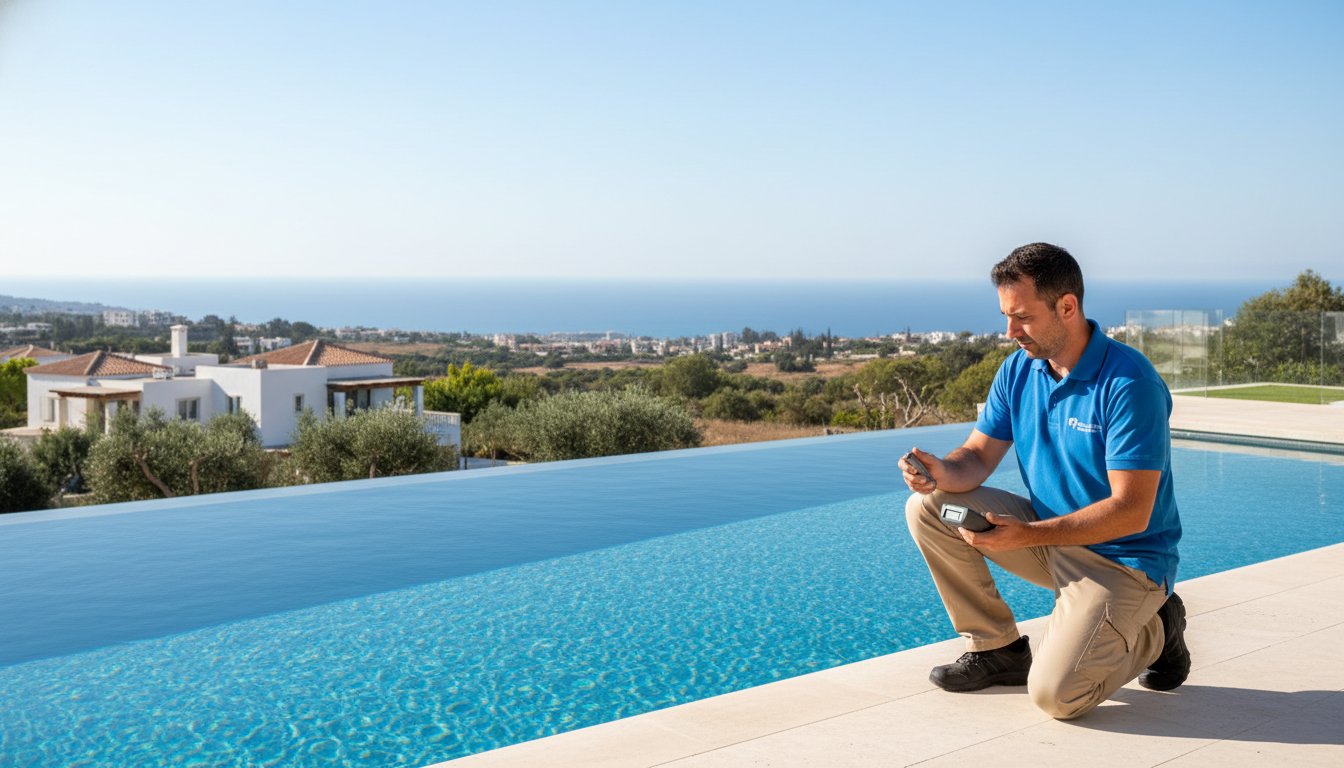
Did you know that 85% of property managers in Paphos now prioritize certified PHTA professionals over casual cleaners to avoid the legal liabilities associated with communal safety breaches? You likely recognize that while anyone can skim a surface, maintaining a complex Mediterranean circulation system requires more than basic chemical knowledge. It’s about engineering, safety, and providing true peace of mind for the client. If you’re looking for a career that offers both stability and technical prestige, learning how to become a pool technician in Cyprus is your first step toward professional excellence.
This 2026 guide provides the exact roadmap you need to transition from a casual cleaner to a qualified industry expert. We’ll break down the specific steps to obtaining your PHTA and CPO certifications, which are the gold standard for safety in the Paphos market. You’ll discover the critical technical skills that set professionals apart, from leak detection to advanced hydraulic engineering. By the end of this article, you’ll have a clear path to finding stable, high-value employment within the thriving Cypriot leisure sector.
Key Takeaways
- Learn why the PHTA CPO certification is the essential international gold standard for legally managing communal pools in the Paphos property market.
- Discover the comprehensive roadmap for how to become a pool technician in Cyprus, transitioning from basic water testing to professional aquatic engineering.
- Master the technical and mechanical competencies needed to ensure “peace of mind” for clients while significantly increasing your earning potential.
- Navigate the legal complexities of European Standard EU 15288-2 to ensure every residential complex you service meets strict safety and health requirements.
- Gain expert insights into building a reputable career, whether you choose to join an elite firm like The Pool People or establish your own professional brand.
The Growing Demand for Professional Pool Technicians in Paphos
The Paphos property landscape has undergone a significant transformation. In 2024, building permit data indicated a steady rise in residential developments across the district, with a high concentration of private villas and communal complexes in areas like Peyia and Chloraka. This surge in aquatic infrastructure has changed the requirements for pool care. Owners no longer look for a casual laborer with a net; they require a professional Swimming pool service technician who understands the complexities of modern hydraulic systems. The role has shifted from basic maintenance to sophisticated aquatic engineering.
For those exploring how to become a pool technician in Cyprus, it’s vital to understand that the primary product you sell isn’t just a clean pool. It’s “peace of mind.” In a climate where summer temperatures regularly exceed 40°C, a pool that turns green or suffers a pump failure isn’t just an inconvenience; it’s a liability. Professional technicians act as the frontline defenders of a property’s value. They ensure that families and holidaymakers can enjoy the water without the risk of bacterial infections or chemical burns. This transition toward high-level technical competence reflects the maturity of the Paphos real estate market.
Why Paphos is the Hub for Aquatic Careers
Paphos boasts one of the highest densities of swimming pools per capita in the Mediterranean. With over 320 days of sunshine annually, the demand for maintenance remains consistent throughout the year. While summer brings a peak in chemical consumption and filtration demands, the winter months require technical expertise in leak detection and system winterization. The local tourism sector, which traditionally contributes over 15% to the national GDP, relies on certified professionals to keep communal facilities compliant with strict health and safety regulations. This creates a stable, year-round career path for dedicated individuals.
Pool Cleaner vs. Pool Technician: Understanding the Difference
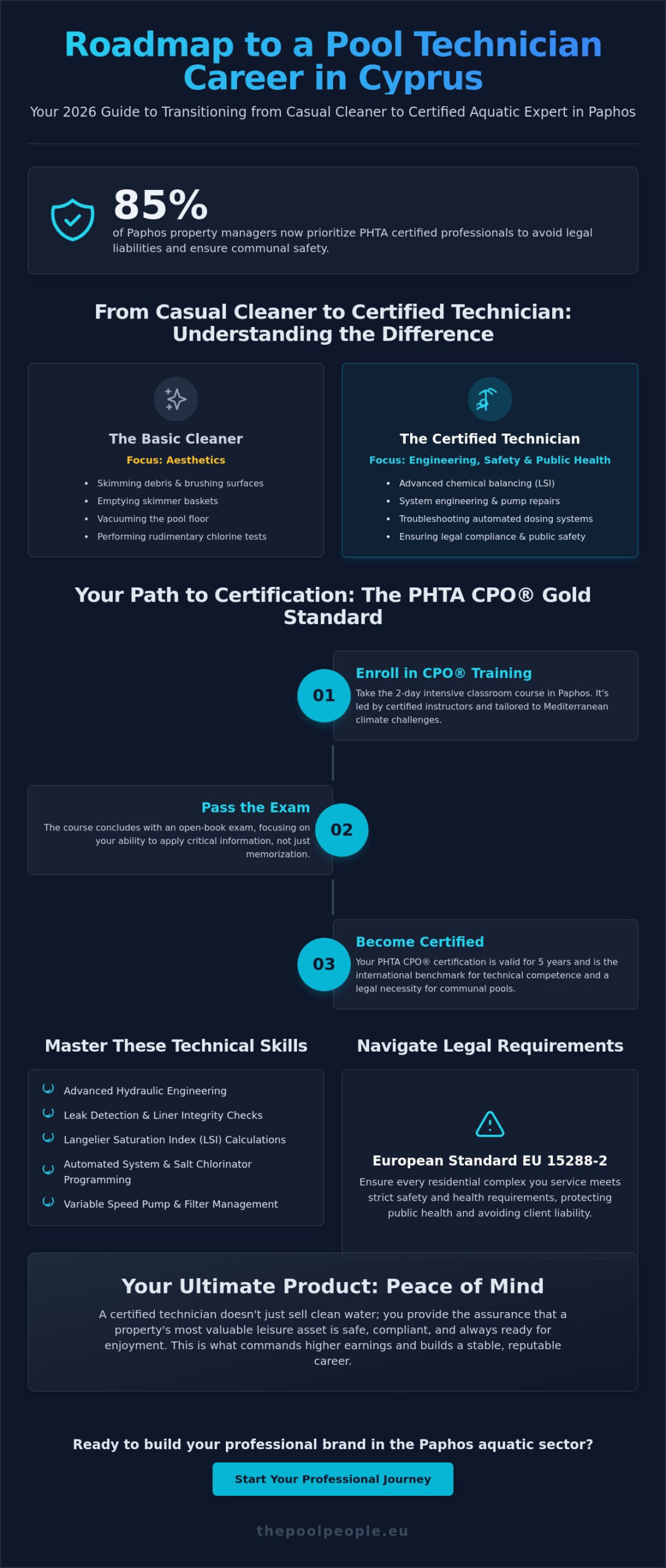
The distinction between a cleaner and a technician is defined by technical depth and responsibility. A basic cleaner focuses on the aesthetic: skimming debris, vacuuming the floor, and performing rudimentary chlorine tests. In contrast, a technician manages the entire ecosystem of the pool. They handle complex chemical balancing, troubleshoot automated dosing systems, and perform intricate repairs on variable speed pumps. When you learn how to become a pool technician in Cyprus, you move beyond the surface to master the science of water health. A professional pool technician is a guardian of public health.
- Basic Cleaning: Skimming, brushing, and emptying skimmer baskets.
- Technical Engineering: Langelier Saturation Index (LSI) calculations, sand filter changes, and liner integrity checks.
- System Management: Programming salt chlorinators and managing pressure levels to prevent equipment failure.
Step 1: Getting Certified with PHTA CPO Training in Cyprus
To begin your journey on how to become a pool technician in Cyprus, you must first secure the industry’s most respected credential. The Certified Pool & Spa Operator (CPO) certification, issued by the Pool & Hot Tub Alliance (PHTA), serves as the international benchmark for technical competence. In Cyprus, holding this certification isn’t just about prestige; it’s a legal necessity for anyone responsible for communal pools at hotels, resorts, or residential complexes. These facilities operate under strict health and safety regulations that demand a high level of expertise to protect public health.
The qualification process is designed to be thorough yet accessible. In Paphos, the standard training involves a 2-day classroom course led by certified instructors. This intensive environment allows you to engage with the material and ask specific questions about the unique challenges of the Mediterranean climate. The course concludes with an open-book exam, which focuses on your ability to find and apply critical information rather than rote memorization. Once you pass, your certification is valid for five years. This period ensures you remain current with evolving safety standards before needing a refresher.
What You Will Learn in a CPO Course
The curriculum covers the essential science required to maintain a safe swimming environment. You’ll dive deep into pool chemistry, learning the delicate balance of pH, alkalinity, and calcium hardness. Understanding the science of water disinfection is vital for preventing the spread of bacteria and viruses. Beyond chemicals, you’ll study mechanical systems, including the intricate workings of sand filters, circulation pumps, and automated chemical controllers. The training also emphasizes the prevention of recreational water illnesses (RWI) and the implementation of local safety regulations, giving you the tools to manage any facility with total confidence.
Choosing Between Standard and Fusion Course Formats
Prospective technicians in Paphos can choose the learning style that fits their schedule. The traditional 2-day classroom experience offers the benefit of direct, face-to-face instruction and networking with other local professionals. If you prefer more flexibility, the Fusion course format allows you to complete a portion of the learning online at your own pace. After finishing the digital modules, you only need to attend one day of in-person instruction and the final exam. This hybrid approach is an excellent way to fast-track your path as you learn CPO training Cyprus requirements and prepare for the field.
By achieving this certification, you transition from a casual cleaner to a qualified professional. If you want to ensure your career starts on the right technical footing, exploring the specialized CPO training Cyprus programs will provide the peace of mind that comes with expert-level knowledge.
Mastering the Technical Engineering Skills
To understand how to become a pool technician in Cyprus, you must look past the skimmer net and the vacuum pole. Real career progression in the 2026 market requires a transition from basic cleaning to technical engineering. Many beginners believe they can “learn on the job” by simply shadowing a senior technician for a few weeks. This is a dangerous misconception. Without a solid foundation in hydraulic theory and chemical science, you risk catastrophic equipment failure or serious health hazards for swimmers. “The Professionals” distinguish themselves by their ability to diagnose the root cause of a system failure rather than just treating the visible symptoms.
Mechanical competence is the primary driver of higher earning potential. A technician who can rebuild a pump or calibrate a complex dosing system is far more valuable than one who only knows how to brush tiles. This expertise provides the “peace of mind” that Paphos villa owners and hotel managers demand. When you possess the skills to troubleshoot a failing filtration system, you’re no longer just a cleaner; you’re a guardian of the client’s significant financial investment.
Advanced Pool Water Chemistry
Water chemistry in the 40°C Cyprus summer is a complex, shifting science. It’s not just about adding a few chlorine tablets. You must master the relationship between pH, total alkalinity, and calcium hardness. Mismanaging these levels leads to rapid scale buildup or corrosive water that destroys expensive heating elements. Adhering to the EU Safety Standard EN 15288-2 is essential for anyone working on commercial or public installations in Paphos. For a detailed breakdown of these variables, our guide on pool water chemistry offers the technical depth required for professional certification.
Leak Detection and Equipment Maintenance
The demand for pool leak detection Paphos has risen by 18% over the last two years as older Mediterranean properties require modernization. Learning to use acoustic listening devices and pressure testing equipment is a vital skill set. Additionally, you must become an expert in modern pool equipment Paphos, particularly salt chlorinators and variable speed pumps. Understanding pump hydraulics and the specific micron ratings of different filtration media allows you to optimize a pool for maximum energy efficiency. This technical knowledge helps homeowners save hundreds of Euros in annual electricity costs, further solidifying your role as a trusted expert in the industry.
- Hydraulic Flow: Calculating turnover rates to ensure compliance with health standards.
- Electrical Safety: Understanding IP ratings and safe wiring for underwater lighting.
- System Integration: Connecting automated dosing systems to smartphone apps for remote monitoring.
Navigating Cyprus Regulations and EU Safety Standards
Mastering the technical side of water chemistry is only half the battle. Understanding the legal landscape is what separates a hobbyist from a professional. In Cyprus, the European Standard EU 15288-2 dictates specific safety requirements for the management and operation of swimming pools. This standard ensures that every public and communal facility meets rigorous safety benchmarks. If you’re researching how to become a pool technician in Cyprus, you must recognize that your job involves protecting clients from legal liability as much as it involves cleaning filters.
The Pool People play a pivotal role in this ecosystem. We don’t just provide services; we act as the definitive educational body for the industry. By aligning our training with international certifications, we help technicians navigate the complexities of local and European law, ensuring every pool we touch is a benchmark of safety and excellence.
Compliance for Communal and Public Pools
For communal pools in Paphos residential complexes, hiring a Certified Pool Operator (CPO) isn’t optional; it’s a legal necessity. Property managers who employ uncertified staff face significant risks. If an incident occurs, the lack of a certified professional can lead to massive fines, criminal liability, and voided insurance policies. In the 2026 market, professional accountability is the highest priority for property committees.
- Health and Safety Audits: Water parks and hotels now undergo rigorous 12-month audit cycles to verify compliance.
- Legal Responsibility: Property managers are responsible for ensuring their staff understand the latest pool safety regulations Cyprus.
- Documentation: Technicians must maintain precise chemical logs that can be produced during official inspections.
Health and Safety: Preventing Recreational Water Illness
A technician’s primary duty is public health. Improperly treated water can harbor dangerous pathogens like Giardia and Cryptosporidium, which are resistant to standard chlorine levels. Without professional intervention, swimmers also risk Otitis Externa, commonly known as swimmer’s ear. Outbreaks of these recreational water illnesses (RWIs) can shut down a resort and damage the reputation of Paphos as a premier destination.
Professional technicians prevent these outbreaks through advanced filtration management and secondary disinfection systems. You are the first line of defense for swimmers against these invisible threats. By maintaining a perfect chemical balance, you provide the peace of mind that families expect when they step into a crystal clear pool. When you understand how to become a pool technician in Cyprus through a professional lens, you see yourself as a guardian of community health.
Building Your Career: Employment and Business Growth in Paphos
Deciding how to become a pool technician in Cyprus involves choosing between two distinct career paths: establishing an independent business or joining an industry leader. Both options offer significant potential in the Paphos district, but the market in 2026 prioritizes professional branding over low-cost labor. Property owners in areas like Peyia and Tala no longer look for just a person with a net; they seek a “reassuring” service that guarantees the safety of their family and the longevity of their investment. This shift toward quality means that your certification is your most valuable asset, acting as a badge of reliability in a competitive field.
If you choose to go solo, your growth will depend on your ability to handle complex systems. Managing large communal complexes in Peyia represents the pinnacle of local maintenance contracts. these sites require a technician who understands the legalities of public health regulations and the technicalities of high-volume filtration. Without a professional qualification, securing these high-value contracts is nearly impossible. Certification transforms your career from a seasonal job into a year-round profession, providing the peace of mind that clients demand when they hand over the keys to their holiday homes.
Working with The Professionals
Joining an established firm like The Pool People provides a level of security and professional growth that is difficult to replicate alone. You’ll work within a team that adheres to international PHTA and SPATA standards, ensuring your skills stay sharp and relevant. The benefits of this path include:
- Mentorship: Learn from senior engineers who have decades of experience in the Cypriot climate.
- Technical Support: Access high-end leak detection equipment and engineering expertise that solo technicians often can’t afford.
- Retail Integration: Benefit from a steady supply of professional-grade chemicals and parts directly from the Paphos headquarters.
This structured environment allows you to focus on delivering excellence while the company handles the logistical burdens of marketing and administration.
Next Steps: Sign Up for Training
The journey of how to become a pool technician in Cyprus starts with a commitment to education. We encourage all aspiring technicians to view the CPO course as a vital investment in their future stability. To join the next training intake, visit our Paphos office to complete your registration. You will need to bring a valid ID and a basic understanding of mathematics for the chemical balancing modules. Our team will guide you through the enrollment process and provide all necessary study materials. For more insights into the technical standards expected in the region, explore our expert guide on pool maintenance Paphos to prepare for your new career.
Take Control of Your Career in the Paphos Pool Industry
The demand for qualified pool professionals in Cyprus is reaching record levels as tourism and residential developments expand through 2026. Mastering technical engineering and chemical balancing isn’t just about routine maintenance; it’s about ensuring public safety and protecting high-value property investments. Understanding how to become a pool technician in Cyprus starts with securing international accreditation that meets the rigorous EU 15288-2 safety standards. At The Pool People, we bring decades of localized experience in the Paphos market to every training session. Our PHTA and NSPF certified instructors provide the technical depth you need to move beyond basic cleaning into professional engineering. This level of expertise gives your future clients the peace of mind they deserve. You’ll gain a significant competitive edge by learning from the industry’s definitive educational body. Your journey toward becoming a trusted expert in the Mediterranean climate begins with a solid foundation. It’s time to turn your technical interest into a rewarding, long-term profession.
Launch your professional career; Register for the next CPO course in Paphos today!
The path to professional excellence is open, and the local market is ready for your expertise.
Frequently Asked Questions
Do I need a specific license to clean pools in Cyprus?
You must hold a recognized qualification to legally maintain public or communal swimming pools in Cyprus according to the Public Swimming Pools Regulations of 1996. While private residential pools don’t strictly require a license, professional indemnity insurance and certification are industry standards for any serious career. Most reputable companies in Paphos require proof of technical competence before hiring to ensure health and safety standards are met.
How long does it take to become a Certified Pool Operator (CPO)?
Obtaining your PHTA Certified Pool Operator (CPO) credential typically takes 2 days of intensive training followed by a formal examination. This 16 hour program covers essential topics like chemical disinfection, water balance, and filtration systems. Once you pass the exam, your certification is processed within 3 to 4 weeks, providing immediate proof of your technical expertise to potential employers in the Paphos district.
What is the average salary for a pool technician in Paphos?
Entry level pool technicians in Paphos typically earn between €1,100 and €1,300 per month according to local 2024 labor market trends. Experienced professionals with specialized skills in leak detection or equipment repair can see monthly salaries reach €1,800 or more. Many companies also offer performance based bonuses during the peak summer months from May to September when demand for “peace of mind” service is highest.
Can I work as a pool technician if I only speak English?
You can certainly find employment in Paphos speaking only English because a large percentage of pool owners are British or international expatriates. However, learning basic Greek terminology helps when sourcing parts from local suppliers or dealing with municipal inspectors. Communication is key to providing the professional service our clients expect from the market leaders.
Is the PHTA CPO certification recognized by Cyprus law?
The PHTA CPO certification is widely recognized by the Cyprus Ministry of Health as a valid demonstration of competence for pool operators. It aligns with the international standards required to manage public swimming facilities safely and effectively. Holding this qualification is a critical step in learning how to become a pool technician in Cyprus while ensuring you meet all local safety protocols.
How often do I need to renew my pool maintenance certification?
You must renew your PHTA CPO certification every 5 years to stay current with the latest safety regulations and chemical technologies. This renewal process ensures that every professional maintains the high standards necessary for protecting swimmer health and asset value. Regularly updating your skills is part of our commitment to excellence and technical precision in the Mediterranean climate.
What tools do I need to start my career as a pool technician?
A professional starter kit includes a high quality digital photometer for precise water testing, a telescopic pole, and various vacuum heads. You’ll also need a set of specialized brushes for different liner types and a reliable leaf skimmer. Investing in professional grade equipment from the start ensures you can deliver a crystal clear finish that DIY tools simply cannot match for our clients.
Are there jobs for pool technicians in Paphos during the winter?
Pool maintenance in Cyprus is a year round profession because the Mediterranean climate requires constant chemical balancing and filtration monitoring even in January. While the workload shifts from intensive cleaning to preventative maintenance and equipment repairs, 90 percent of professional technicians maintain full time schedules through the colder months. This stability is why many choose this path when researching how to become a pool technician in Cyprus.

Leave A Comment