

Did you know that a single compliance oversight under the EN 15288-2 standard can now result in immediate fines of up to €5,000 for Cyprus property committees? You likely already feel the pressure of managing a communal facility, especially when the intense Paphos heat challenges your water chemistry throughout the peak summer months. It’s often difficult to distinguish where private leisure ends and strict commercial regulations begin, leaving many operators feeling exposed to unnecessary legal risks.
By following this professional guide, you’ll master the technical and legal requirements necessary to secure your commercial pool operator license Cyprus. Our goal is to replace your compliance anxiety with the peace of mind that comes from professional certification and industry leading expertise. We’ll walk you through the essential steps to protect your investment, lower your insurance premiums, and ensure your residents enjoy crystal clear, safe water every day of the year. From understanding local legislation to mastering chemical balance, we provide the roadmap to total facility excellence.
Key Takeaways
- Understand the strict legal definition of communal pools under Cyprus Law to ensure your facility remains compliant and avoids heavy administrative fines.
- Discover how to secure a commercial pool operator license Cyprus authorities recognize by following a structured, professional path to international certification.
- Learn why the PHTA CPO certification is the gold standard for local compliance, covering essential technical competencies in chemistry, filtration, and risk management.
- Master the comprehensive 18-chapter curriculum through expert-led training in Paphos to gain the technical depth required for modern aquatic system management.
- Leverage over 20 years of local engineering expertise to transform complex regulations into a “peace of mind” strategy for your property’s safety and long-term value.
Understanding the Commercial Pool Operator License in Cyprus
Securing a commercial pool operator license Cyprus is no longer a matter of choice for property managers; it’s a foundational legal requirement. Within the Cyprus legal framework, this license serves as a formal validation that the individual managing a swimming facility possesses the technical expertise to maintain public health standards. The Cyprus Ministry of Health sets these stringent guidelines, while local Paphos municipalities act as the enforcement bodies. It’s vital for owners to distinguish between a municipal operating permit, which is granted to the physical building or complex, and the individual operator certification, which is held by the person physically managing the water chemistry and safety protocols.
The governing authority for all communal pools across the island is the European standard EN 15288-2. This regulation dictates the operational requirements for swimming pools, focusing specifically on safety and management. These standards align with international guidelines for the safety of swimming pools to ensure that every bather is protected from waterborne pathogens and chemical imbalances. As The Professionals in the industry, we emphasize that this certification is the only way to guarantee the crystal clear, safe environment that residents expect.
The Legal Reality for Paphos Property Managers
Property managers in regions like Peyia and Chloraka often operate under the misconception that their pools are private. However, if a pool serves more than one unit or family, it’s legally classified as a commercial or communal pool. This classification triggers a mandatory requirement for a “designated responsible person” to be present or on-call for the site. This individual must demonstrate a deep understanding of filtration systems and chemical handling. Current pool safety regulations Cyprus dictate that without a licensed operator, the facility is technically unfit for public use. Since 2024, municipal inspectors have increased site visits in the Paphos district to verify these certifications, leaving no room for administrative shortcuts.
Fines and Liability for Non-Compliance
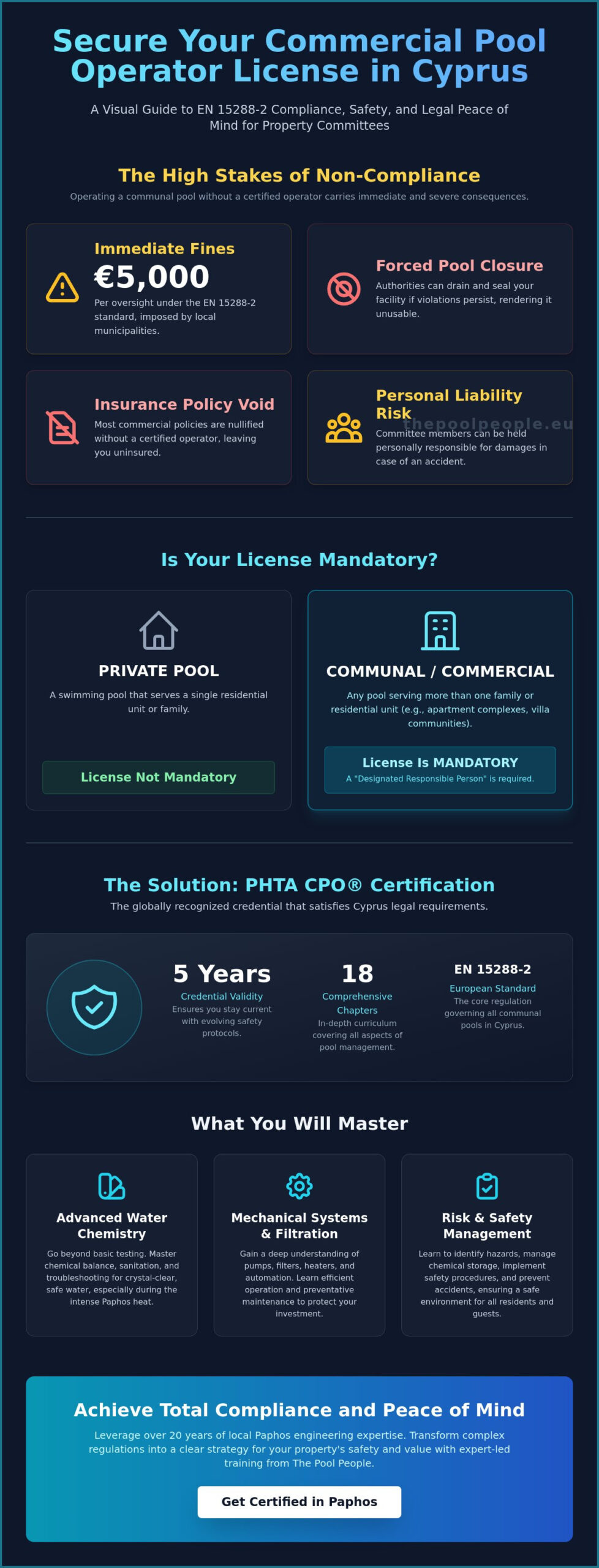
The consequences of operating without a valid commercial pool operator license Cyprus are severe and immediate. Local authorities have the power to impose a €5,000 fine on any complex found to be in breach of these health and safety laws. If the violation continues, the pool can be drained and sealed by the municipality. Beyond the initial fine, the financial risk extends to insurance coverage. Most commercial insurance providers in Cyprus explicitly state that their policies are void if the pool is not managed by a certified professional.
This creates a massive personal liability risk for communal committee members. If an accident or health issue occurs in an unlicensed pool, the committee members can be held personally liable for damages, as they’ve failed in their duty of care. Our mission is to provide the training and support that eliminates this risk. We believe that professional certification isn’t just about avoiding fines; it’s about providing the peace of mind that comes from knowing your facility meets the highest international standards of excellence.
The PHTA CPO Certification: The Gold Standard for Cyprus
The PHTA Certified Pool Operator (CPO) credential is the most widely recognized qualification for those who wish to operate a public swimming in the Republic of Cyprus. This certification provides the technical foundation required to manage high-traffic facilities safely and efficiently. While local regulations mandate specific safety standards, the CPO course bridges the gap between basic maintenance and professional risk management. It effectively shifts the industry away from the outdated “pool guy” image and toward a model of technical excellence.
Once earned, the credential remains valid for five years. This duration ensures that operators stay current with evolving safety protocols and chemical technologies. The curriculum focuses on three critical pillars: advanced water chemistry, mechanical filtration systems, and comprehensive risk assessment. For those seeking a commercial pool operator license Cyprus, this training is the essential first step toward full compliance and operational peace of mind. Professional training transforms an operator into a technician who understands the “why” behind every chemical addition, rather than just following a routine.
Mastering Water Chemistry for the Paphos Climate
The Mediterranean sun creates unique challenges for water balance that simple test strips cannot solve. In regions like Paphos, where summer temperatures frequently exceed 35°C, managing the Langelier Saturation Index (LSI) is vital for protecting your investment. Failure to balance the LSI leads to rapid calcium scaling or aggressive water that damages grout and liners. Mastering pool water chemistry in Paphos is a core requirement for passing legal audits and maintaining water clarity. In hard-water areas like Peyia, operators must monitor calcium hardness levels daily to prevent expensive equipment failure and ensure the water remains inviting for guests.
Disease Prevention and Public Health
Public health is the primary responsibility of any facility manager. Professional training teaches operators how to combat Recreational Water Illnesses (RWIs) such as Cryptosporidium, which can survive in standard chlorine levels for several days. Maintaining a commercial pool operator license Cyprus requires strict adherence to legal record-keeping. You must log chemical levels, bather loads, and filter pressure readings multiple times a day to meet health inspector requirements. Safety protocols for handling hazardous chemicals like liquid chlorine or hydrochloric acid are also mandatory to protect staff and the public. If you feel overwhelmed by these technical requirements, you can partner with our expert team
Communal vs. Private: When is a License Mandatory?
Cyprus Law is clear: any swimming pool shared by more than one family is a communal facility. This includes residential complexes, apartment blocks, and hotels. If you’re a property owner in a shared development, you aren’t just maintaining a pool; you’re managing a public health asset. Any shared water body requires a certified operator to ensure chemical levels and safety protocols meet strict national standards.
Starting in January 2026, Paphos authorities are rolling out stricter enforcement for short-term holiday rentals. If your complex hosts tourists, the lack of a commercial pool operator license Cyprus could lead to heavy fines or the suspension of your rental permit. Beyond legal compliance, a license acts as a badge of excellence. It tells guests and residents that their health is in expert hands, which significantly enhances the market value of the property.
Identifying Your Pool Classification
The Paphos Health Inspector classifies facilities based on European standards, specifically looking at Type 1 and Type 2 facilities. Type 1 covers large-scale public pools, while Type 2 encompasses semi-public facilities like those found in small apartment complexes in Geroskipou. Even if your pool is tucked away in a quiet residential corner, it still requires professional oversight if it serves multiple households.
Classification depends on factors like bather load and water volume. The Pool & Hot Tub Alliance sets the international tone for these standards, ensuring that water chemistry and filtration systems are robust enough for communal use. The inspector’s role is to verify that your facility meets these technical benchmarks before issuing an operating permit.
The “Peace of Mind” for Communal Committees
Managing a communal pool shouldn’t be a source of constant anxiety for committee members. The legal landscape in Cyprus is shifting toward higher accountability. You can effectively manage this risk by choosing professional pool maintenance in Paphos. This isn’t just about cleaning the water; it’s about delegating legal responsibility to a certified expert.
A professional service provider creates a transparent safety audit trail. This documentation includes daily chemical logs and equipment inspections, providing a solid defense in the event of an insurance claim. It shifts the management burden from the residents to the professionals. This “set it and forget it” approach ensures the pool remains a stress-free asset rather than a legal liability. Having a commercial pool operator license Cyprus
How to Obtain Your Commercial Pool Operator License in Paphos
Securing your commercial pool operator license Cyprus in the Paphos district requires a disciplined approach to both technical education and local administrative compliance. This process ensures that every professional responsible for a communal or hotel facility possesses the expertise to protect bather health and maintain expensive aquatic infrastructure. The path to certification is structured into five definitive steps designed to build total operational confidence.
- Step 1: Enroll in a PHTA-certified CPO course in Paphos. You must select a training provider authorized by the Pool & Hot Tub Alliance. The Pool People host these sessions locally, providing the necessary materials and expert instruction required for the Cyprus market.
- Step 2: Complete the 18-chapter curriculum. This comprehensive syllabus covers everything from advanced hydraulics and filtration to chemical disinfection and facility safety protocols. It’s the technical foundation for modern pool management.
- Step 3: Pass the open-book international examination. You’ll sit for a rigorous exam under the supervision of a qualified proctor. This ensures the integrity of the certification and proves you can navigate technical resources under pressure.
- Step 4: Register your certification with your local Paphos municipality. Once you receive your credentials, you must present them to the municipal health and safety department. This step is vital for the legal operation of any commercial pool within the district.
- Step 5: Implement a formal Pool Safety Management Plan (PSMP). Certification is only the beginning. You’re required to establish a documented system for daily testing, maintenance logs, and emergency response procedures to maintain your standing.
Choosing Your Course Format: Classroom vs. Fusion
The traditional 2-day intensive classroom session in Paphos remains the most popular choice for dedicated operators. This format allows for direct interaction with instructors who understand the unique challenges of the Paphos climate, such as managing high calcium hardness in local water and the rapid chlorine degradation caused by intense Mediterranean UV exposure. Face-to-face learning facilitates networking with other industry professionals and provides immediate clarity on complex hydraulic theories.
For busy property managers or those overseeing multiple sites, the Online Fusion course offers necessary flexibility. You complete the first portion of the training via a self-paced online portal and then attend a single day of in-person review and testing. This hybrid model ensures you don’t sacrifice technical depth for convenience. Both paths lead to the same globally recognized certification, providing the peace of mind that your facility meets the highest safety benchmarks.
Preparing for the CPO Examination
Success in the CPO exam depends heavily on your ability to apply mathematical formulas to real-world scenarios. You’ll need to master volume calculations for various pool shapes, flow rate requirements to ensure proper turnover, and precise chemical dosing to avoid waste or unsafe water conditions. These calculations aren’t just for the test; they’re the daily tools of a professional operator.
During the exam and throughout your career, the PHTA Handbook serves as an essential reference tool. It’s a technical manual that provides immediate answers to complex problems involving bather load, saturation index, and equipment troubleshooting. The exam requires a 75% score for certification. By treating the handbook as a lifelong resource rather than just a textbook, you ensure your facility remains a safe, crystal-clear environment for all guests.
Ready to elevate your professional standing and secure your facility’s compliance? Book your CPO training with The Pool People today and join the ranks of Paphos’s elite aquatic professionals.
Why Train with The Pool People in Paphos?
Choosing the right partner for professional certification determines the safety and longevity of your aquatic facilities. The Pool People stand as the definitive educational authority for CPO training in Cyprus, bringing over 20 years of hands-on engineering and maintenance expertise to the classroom. We don’t just teach theory. We share two decades of local knowledge gained from managing the most complex commercial pool systems across the island. Understanding the technical requirements for a commercial pool operator license Cyprus is easier when you’re learning from the market leader.
Our commitment to your success extends far beyond the final exam. We provide comprehensive post-certification support to help you implement rigorous safety standards that protect both your guests and your business reputation. By choosing us, you aren’t just getting a certificate; you’re gaining a professional mentor dedicated to the “Peace of Mind” philosophy that defines our brand. We ensure every Cyprus pool owner and operator feels confident that their investment is in expert hands, backed by international PHTA standards.
Expert Instruction from Certified Professionals
The Pool People believe that the best teachers are those who work in the field every day. Your instructors are active pool engineers who possess a deep understanding of Paphos infrastructure and the specific challenges posed by the Mediterranean climate. We use real-world troubleshooting examples from active sites in Peyia and Chloraka to illustrate complex hydraulic and chemical balance issues. This practical approach ensures you’re prepared for the unique technical demands of the local market. Students also gain direct access to information regarding high-quality chemicals and hardware, ensuring your facility maintains excellence through every season.
Join the Next 2026 CPO Intake
Securing your commercial pool operator license Cyprus is a critical step for 2026 compliance and operational safety. Our upcoming course dates in Paphos are strategically scheduled throughout the year to accommodate busy tourism professionals. We offer specialized group training options for hotel staff and property management companies, ensuring your entire team operates with synchronized precision and technical competence. These sessions are kept small to maintain our high standards of instruction and individual attention. Don’t leave your professional standing to chance. Secure your place on the next CPO course with The Pool People today and lead the industry with confidence.
Secure Your Professional Future in Cyprus Pool Management
Maintaining a safe and compliant swimming environment is about more than just clear water; it’s about protecting your investment and your guests. As EU Law 15288-2 standards become increasingly stringent, obtaining your commercial pool operator license Cyprus is the most effective way to ensure full legal compliance and operational excellence. By mastering advanced chemical balancing and risk assessment through the PHTA curriculum, you move beyond basic maintenance into true technical proficiency.
The Pool People bring over 20 years of Paphos expertise to every training session. Our PHTA/NSPF Certified Instructors specialize in the specific challenges of the Mediterranean climate, helping you achieve the peace of mind that comes with elite-level safety standards. Don’t leave your professional reputation to chance when you can learn from the industry’s recognized educational leaders. We’ve spent two decades refining these processes to ensure every operator we train feels confident behind the pump room door.
Register for the next Paphos CPO Course and secure your license today. We’re ready to help you set a new standard for excellence in the Cyprus pool industry.
Frequently Asked Questions
Is a CPO certificate the same as a commercial pool license in Cyprus?
No, a CPO certificate is a professional qualification while the commercial pool operator license Cyprus requires is the legal permit issued by your local municipality. You must first earn the CPO designation through an accredited body like the PHTA to satisfy the technical requirements for the municipal license. This distinction ensures that the person managing the water chemistry possesses the technical depth to maintain a safe environment for all swimmers.
Does a small apartment block in Paphos really need a certified operator?
Yes, any pool shared by more than one residential unit requires a certified operator under Cyprus Law Cap 261. This regulation applies regardless of whether you have 4 or 40 apartments in the block. If your Paphos complex has a communal pool, the law views it as a public facility. This means you must have a designated professional to ensure the safety of all residents and guests through precise chemical balancing.
How long does it take to get a commercial pool operator license?
Obtaining your professional certification usually takes 2 days of intensive training followed by a formal examination. Once you pass, the municipal application for the commercial pool operator license Cyprus authorities issue can take between 30 and 60 days to process. We recommend starting this transition at least 90 days before the summer season begins to ensure your facility remains compliant during peak usage periods.
What happens if a Paphos health inspector finds my pool is uncertified?
Operating without the correct certification can lead to immediate closure of the facility and legal prosecution. Health inspectors in Paphos have the authority to issue fines that often reach €850 per violation depending on the severity of the case. Beyond the financial penalty, the lack of a license exposes the building committee to massive civil liability if an accident or infection occurs. Protecting your investment requires strict adherence to these safety standards.
Can I use a foreign pool operator license in Cyprus?
Foreign licenses are not automatically valid and must be vetted by the Cyprus Ministry of Health or local district offices. Most authorities require a certification that aligns with PHTA or SPATA standards to ensure the operator understands local climate challenges. If your license is from outside the EU, you’ll likely need to complete a local certification to meet the 2026 standards. This ensures you’re familiar with specific Cypriot health and safety legislation.
How much does the CPO training course cost in Paphos?
Training fees for a professional CPO course in Cyprus generally range from €450 to €550 per candidate. This investment typically covers the comprehensive study materials, examination fees, and the five year certification. While prices fluctuate between different accredited training providers, this cost is a small fraction of the potential fines for non compliance. Investing in proper education provides the ultimate peace of mind for property managers and owners.
Does my CPO certification expire?
Your CPO certification is valid for exactly 5 years from the date of your successful examination. After this period, you must attend a refresher course to renew your status and learn about updated safety protocols. Staying current is vital because water treatment technology and health regulations evolve over time. We track these dates for our students to ensure no one in the industry falls behind on their legal obligations or technical knowledge.
Can a communal committee be held criminally liable for pool accidents?
Yes, communal committee members can face criminal charges for negligence if a pool accident occurs at an uncertified facility. Under the 1996 Swimming Pool Regulations, the committee is legally defined as the “owner” of the pool. If you don’t employ a licensed operator, you’re failing in your statutory duty of care. This makes the committee personally and collectively liable for any health incidents or drownings that happen on the premises.




Leave A Comment