
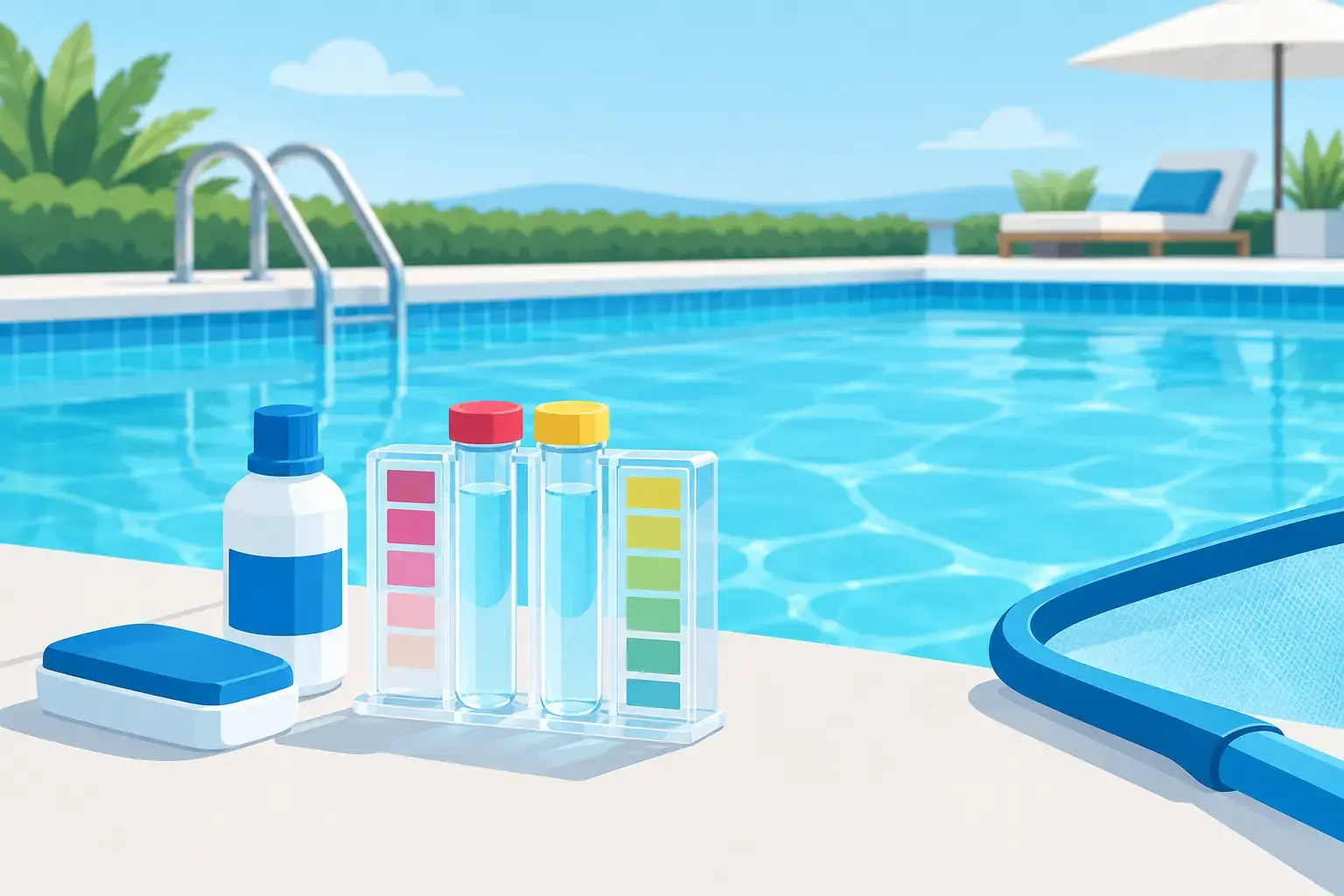
A pool can look beautifully clear on a hot Cyprus afternoon and still be unsuitable for swimming. Clear water is not proof that enough disinfectant is present, that pH is under control, or that the filtration system is removing contamination effectively. Pool water testing is the routine that turns assumptions into safe operating decisions.
For a private villa pool, poor testing can mean irritated eyes, algae, damaged finishes and an avoidable call-out. For a communal pool, holiday rental or hospitality site, it can also expose residents and guests to unacceptable hygiene risks. Water quality is not a cosmetic detail. It is part of the operator’s responsibility to provide clean, healthy and safe water.
What pool water testing is actually measuring
A good test does more than produce a row of numbers. It shows whether the chemicals in the water can do their job, whether the water is becoming aggressive or scale-forming, and whether changing conditions require action. Heat, high bather loads, sunscreen, dust and stormwater all place greater pressure on pools in Paphos and across the wider region.
The first readings most owners recognise are free chlorine and pH. Free chlorine is the active disinfectant available to control bacteria, algae and other contamination. A low reading leaves swimmers and the pool exposed. An excessively high reading can be uncomfortable, damage materials and usually points to dosing or control problems that should be investigated rather than ignored.
For many conventional outdoor pools, a free chlorine level of around 1 to 3 mg/l is commonly used as an operating guide, subject to the pool’s stabiliser level, bather use, treatment system and product instructions. A heavily used communal pool may need tighter monitoring and a different operating plan. Salt-water pools still need this check: a salt chlorinator produces chlorine, but it does not remove the need to verify that sufficient disinfectant is actually present.
pH affects almost everything else. Water that is too acidic may corrode metal components, grout, heaters and fittings. Water that is too alkaline can encourage scale, cloudiness and reduced chlorine performance. Most pools operate best with pH broadly between 7.2 and 7.6, but the correct response should account for total alkalinity, calcium hardness and the equipment installed.
The readings that explain the bigger picture
Total alkalinity helps resist sudden pH movement. If it is too low, pH can swing sharply after chemical additions or rainfall. If it is too high, pH becomes difficult to reduce and scale risk may rise. Calcium hardness matters particularly where there are tiled surfaces, plaster finishes or heaters. Water with insufficient calcium can become aggressive; excessive calcium, particularly alongside high pH, can leave scale on surfaces and inside pipework.
Cyanuric acid, often called stabiliser, is another essential outdoor-pool test. It protects chlorine from rapid loss in sunlight, which is useful in Cyprus summer conditions. However, too much stabiliser slows chlorine’s sanitising action. Adding stabilised chlorine products repeatedly without checking cyanuric acid is a common reason a pool seems to need more and more chlorine while water quality becomes harder to control. High stabiliser normally requires partial dilution with fresh water, not another dose of chlorine.
In salt pools, test salt concentration against the chlorinator manufacturer’s specified range. In larger, commercial or problem pools, total dissolved solids, phosphates, metals and oxidation-reduction potential may also help diagnose persistent issues. These are not numbers to chase in isolation. They must be interpreted alongside circulation, filtration, temperature and how the pool is being used.
How often should pool water testing be carried out?
The right frequency depends on risk and use. A lightly used residential pool may need free chlorine and pH checked at least two to three times a week during the swimming season, with full balance testing carried out routinely. During periods of intense heat, family visits, dusty winds or after a storm, test more often. Conditions can change markedly in a single day.
Holiday-rental pools and communal facilities need a more disciplined approach. Disinfectant and pH should be checked daily, and often before opening or before guests use the water. High-use facilities may require checks during operating hours as well. Readings, corrective actions and equipment issues should be recorded. A record is not bureaucracy for its own sake: it helps show patterns, supports accountable management and allows a technician to identify why a recurring fault is occurring.
Do not wait until water turns green or cloudy. By that point, the cause may include low chlorine, inadequate circulation, a dirty filter, high stabiliser, poor pH control or contamination after heavy use. Correcting visible water problems often costs more chemical, more energy and more downtime than maintaining stable readings from the outset.
Test at the right time, in the right place
Poor sampling can produce misleading results. Take the sample away from return inlets and skimmers, ideally from elbow depth, then test it promptly. Do not use a sample collected immediately after chemicals have been added or while the pump has been off for long periods. Water needs time to circulate before a result represents the pool as a whole.
For routine domestic monitoring, a quality DPD tablet comparator or properly maintained photometer is generally more reliable than guessing from faded test strips. Strips can be useful as a quick indication, but humidity, age, hand contamination and subjective colour matching can make them unreliable for important decisions. For communal or commercial installations, professional-grade testing equipment and formal records are the sensible minimum.
Reagents also have a shelf life. Store them out of direct sunlight and excessive heat, keep lids closed, and replace them when expired. A precise-looking result from degraded tablets is still a wrong result.
What to do when the readings are wrong
The safest response is measured correction, not chemical panic. Test first, identify which parameter is out of range, then use the relevant product at the calculated dose for the pool volume. Allow adequate circulation, retest, and record what was added. Throwing several products into the pool at once makes it harder to understand the result and can create a more difficult imbalance.
If free chlorine is low but pH, stabiliser and circulation are correct, controlled dosing may be enough. If chlorine will not hold, investigate the chlorine demand. Heavy contamination, algae beginning to form, a failed dosing unit, poor filtration or excessive cyanuric acid may be consuming or limiting the disinfectant. A shock treatment can be appropriate in certain circumstances, but it should be based on the condition of the water and product guidance, with the pool kept out of use until safe levels are restored.
Cloudy water should not be treated as a chlorine-only issue. Check the filter pressure, pump run time, circulation at the return inlets and whether the filter media is functioning properly. Backwashing or cleaning should be carried out when pressure and system condition indicate it is required, not simply on an arbitrary calendar date. Over-backwashing wastes water; failing to clean a loaded filter undermines filtration.
A strong ‘chlorine smell’ is another frequent misunderstanding. It does not necessarily mean there is too much usable chlorine. It can indicate combined chlorine compounds formed when disinfectant reacts with bather waste. This is a warning that testing, oxidation and filtration need attention. Swimmers should not be asked to accept eye irritation or unpleasant odour as normal.
Testing supports the equipment, too
Water balance has a direct financial impact. Corrosive water can shorten the life of pumps, heaters, light fittings, pipework and heat-exchanger components. Scale can restrict flow, reduce heating efficiency and make surfaces harder to clean. Preventive testing therefore protects both swimmer wellbeing and the value of the installation.
For managed sites, water testing should sit within a wider operating routine aligned with the principles of EN 15288-1 and EN 15288-2. These standards place emphasis on safe design, operation and management rather than treating chemistry as an isolated task. A correctly balanced sample cannot compensate for a failing pump, inadequate turnover, blocked skimmer, defective dosing system or poorly maintained filter.
If readings repeatedly drift, water remains dull, or guests report irritation, the answer may be an engineering inspection rather than more chemicals. The Pool People can assess the relationship between water chemistry, filtration and plant performance, then set out a practical maintenance plan for the pool concerned.
The most useful habit is simple: test before the water looks wrong, act on the cause rather than the symptom, and keep a record that proves the pool has been cared for properly. That is how a pool remains ready for swimmers, not merely presentable from the terrace.


Leave A Comment