
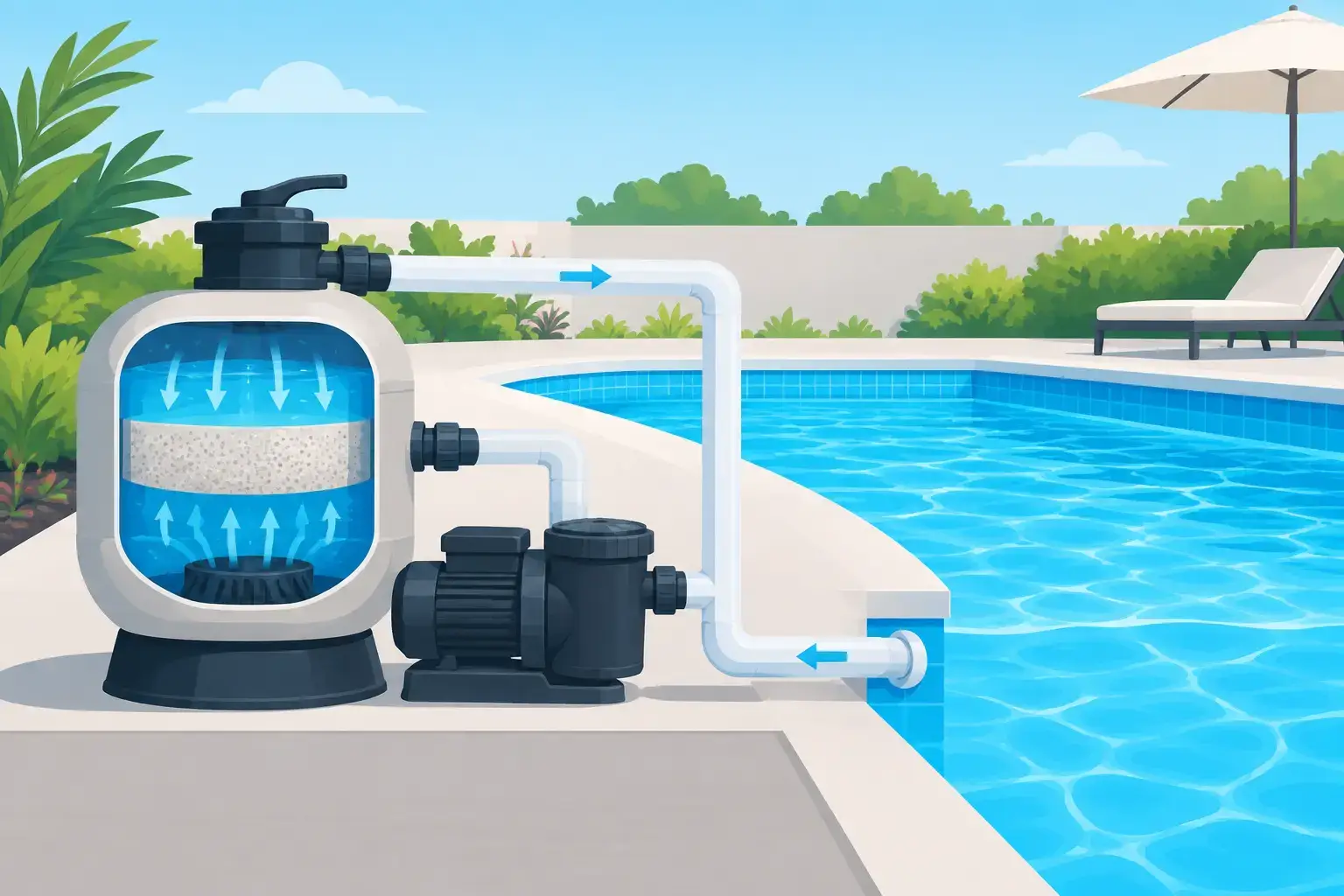
A pool can look clear at first glance and still present a hygiene risk. Effective pool filtration is what continuously removes the dust, organic debris and fine particles that cloud water, feed algae and reduce the performance of disinfectant. It is not a cosmetic extra. For private owners, holiday-rental operators and communal-pool managers, it is a core part of providing clean, healthy and safe water.
In Cyprus, filtration systems work particularly hard. Long hot periods, high bather loads, wind-blown dust and occasional heavy rain can change water conditions quickly. A filter that is undersized, dirty, bypassed or poorly matched to the pump can turn a manageable maintenance routine into green water, equipment wear and avoidable closures.
What pool filtration actually does
The circulation system draws water from the pool through skimmers and the main drain, moves it through the pump and filter, then returns treated water through the inlet fittings. As water passes through the filter media, suspended material is trapped. This includes visible debris such as leaves and insects, but also much smaller particles that make water dull or provide shelter for microorganisms.
Filtration and chemical treatment do different jobs. Chlorine or another approved sanitiser controls microorganisms in the water, while the filter removes contamination from it. Neither can reliably compensate for failure in the other. Adding more chemicals to a pool with poor circulation may temporarily alter a test result, but it does not remove the underlying debris or restore even treatment throughout the pool.
This matters most where several people use the same water. Communal and commercial facilities have a duty to operate systems in a way that protects users, not merely keeps the water looking presentable. European standards such as EN15288-1 and EN15288-2 place proper operation, maintenance and risk management at the centre of safe pool provision.
The filter is only as good as the circulation system
A filter cannot clean water that does not reach it. The pump must be correctly sized for the pool, pipework and chosen filter, while valves, skimmer baskets, suction lines and return fittings must remain unobstructed. Poor circulation often reveals itself in familiar ways: debris collecting in one corner, algae returning on shaded walls, uneven water chemistry or weak flow from return inlets.
The aim is to circulate the entire pool volume through the treatment system within an appropriate turnover period. There is no single setting that suits every pool. Pool volume, pump capacity, bather load, water temperature, pipework design and the type of facility all affect the required run time. A heavily used communal pool in peak summer needs a more closely managed approach than a lightly used domestic pool.
Reducing pump hours can cut electricity use, but reducing them too far can create far greater costs in chemicals, corrective work and damaged equipment. Modern variable-speed pumps can be a sensible solution because they allow longer, lower-energy circulation while retaining the flow needed for filtration. The correct programme should be based on the actual installation, not a guess or a neighbour’s timer setting.
Signs that filtration is struggling
Cloudiness is the obvious warning sign, but it is not the first one. A rising pressure reading on a sand or glass-media filter often shows that collected debris is restricting flow. Low pressure may indicate a blockage before the pump, a suction leak, a worn pump component or another circulation fault. Air bubbles at the return inlets, noisy operation and a pump basket that repeatedly fills with debris also deserve investigation.
A pool that needs frequent shock treatment, develops algae soon after cleaning or has persistent fine sediment on the floor may have a filtration issue rather than a simple chemical-balance problem. Treating only the visible symptom can waste time and product.
Choosing the right pool filter
Most residential and communal pools use one of three filter types: sand or glass media, cartridge, or diatomaceous earth. Each has a place, and the best choice depends on the pool’s usage, plant-room space, water source, maintenance arrangements and existing hydraulic design.
Sand filters are widely used because they are durable, straightforward to operate and well suited to many Cyprus pools. Glass media is often selected as an upgrade because of its particle-capturing properties and resistance to compaction. Both require periodic backwashing to remove trapped debris. Backwashing too often wastes water and reduces filtration efficiency; leaving it too long restricts flow. Pressure readings and water condition should guide the decision.
Cartridge filters can provide very fine filtration and do not require backwashing, which can be useful where water conservation is a priority. Their cartridges need careful removal, cleaning and eventual replacement. A neglected cartridge may look intact but become blocked with oils, scale and fine debris, reducing circulation considerably.
Diatomaceous earth filters offer exceptionally fine filtration, but they need skilled handling and disciplined maintenance. They are not automatically the right answer for every pool. The installation must be compatible, and the operator must understand how to inspect, clean and recharge the system safely.
Why clear water is not proof of safe water
A well-filtered pool can still be unsafe if disinfectant levels, pH, alkalinity or other water-quality factors are out of range. Equally, chemically balanced water can remain unhygienic if the filter is failing to remove contamination. Professional pool care treats these as connected parts of one operating system.
Fine particles, body oils, sunscreen, dust and organic matter place demand on the sanitiser. As contamination builds, chlorine works harder and may become less effective at maintaining a stable residual. This is one reason filters should be inspected and cleaned before water problems become visible. It also explains why busy periods, children’s parties and holiday changeovers require more than a quick visual check.
For landlords and property managers, written service records are valuable. They provide evidence of routine checks, chemical readings, equipment observations and corrective actions. They also help identify repeated faults, such as a pump losing prime after storms or a filter pressure rising unusually fast.
Practical maintenance that prevents expensive failures
Daily attention does not mean dismantling the filter every day. It means checking the system is running as intended: the pump is operating normally, water is moving through the returns, skimmer and pump baskets are clear, and pressure readings are within the normal range for that installation.
At scheduled service visits, the filter should be assessed alongside the wider system. This includes inspecting seals, valves, gauges, pipework, pump components and electrical connections, as well as testing and adjusting water quality. Media filters eventually require media assessment or replacement; cartridge filters require cleaning and planned replacement; all systems benefit from proper winter and storm preparation.
After high winds or rain, do not assume the pool will correct itself. Dust and runoff can add a heavy particle load, while rainwater may affect balance. Run the circulation system, remove debris promptly and test the water before normal use. If cloudiness develops or the pressure changes sharply, a qualified engineer can determine whether the cause is contamination, a blocked filter, a pump issue or a fault in the circulation line.
When professional support is the sensible option
Basic owner checks are useful, but recurring water problems, unexplained pressure changes, leaks, electrical concerns and ageing plant equipment need trained assessment. This is especially true for communal pools, spas and holiday properties, where interruption affects residents or guests and where hygiene responsibilities are higher.
The Pool People applies trained operational and engineering knowledge to the full system rather than treating filtration as an isolated task. That approach helps protect water quality, extend equipment life and identify faults before they become costly repairs.
A clean pool begins with water that is moving, filtered and tested properly. Give the plant room the same attention as the pool surface, and it will quietly do the work that keeps every swim safer.



Leave A Comment