
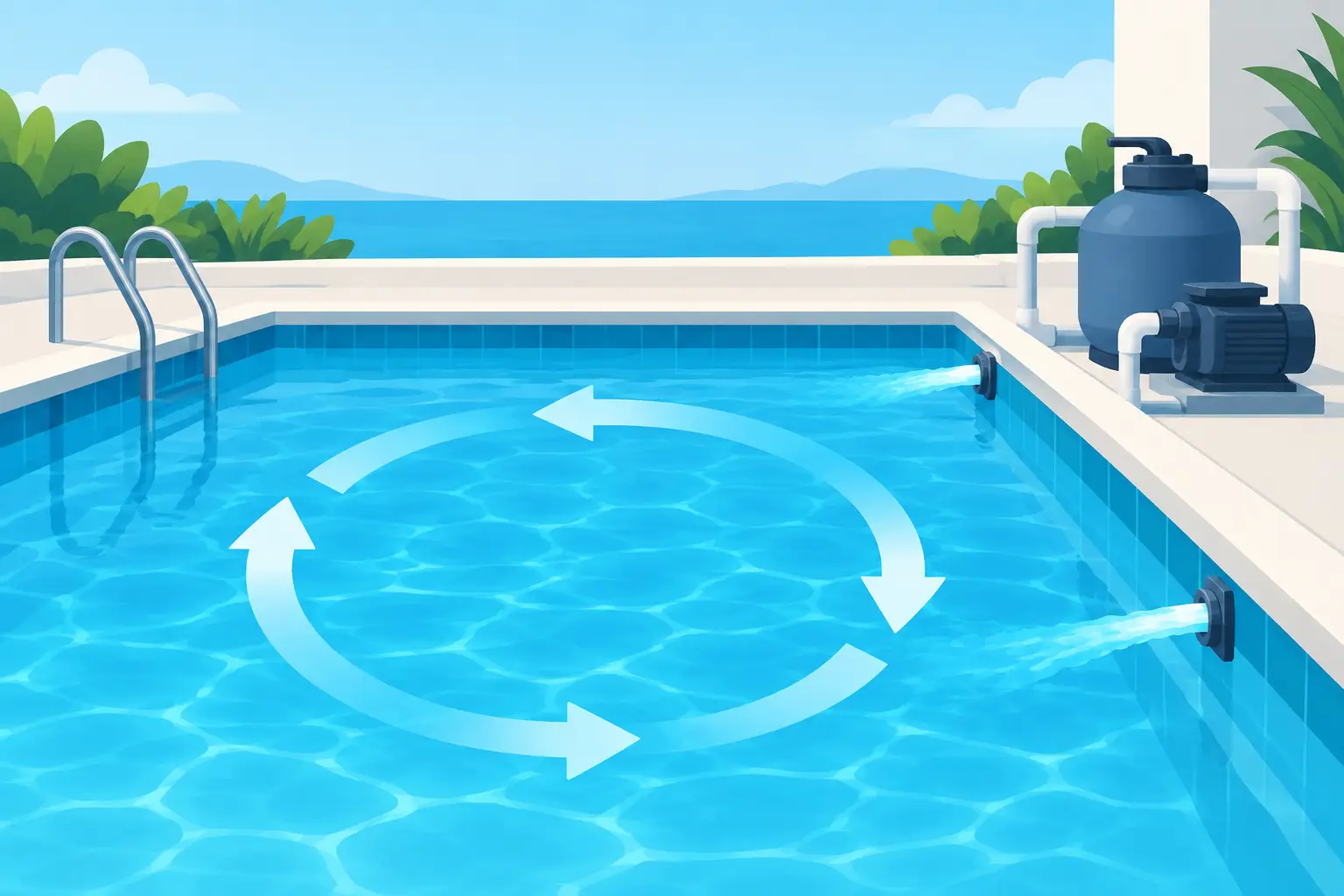
A pool can look clear while its circulation is failing. That is the problem with treating appearance as proof of hygiene. The pool turnover rate is a far more useful operational measure: it indicates how long the circulation system needs to move a volume of water equal to the pool’s total capacity through the filtration system.
For private pools, holiday rentals and communal facilities, turnover affects much more than clarity. It influences how reliably disinfectant reaches the whole pool, how effectively debris and fine particles are removed, and how hard the pump and filter must work. In Cyprus, where high summer temperatures, wind-blown dust and intensive use can rapidly change water conditions, correct circulation is a basic requirement for clean, healthy and safe water.
What is a pool turnover rate?
Turnover rate is usually expressed as a number of hours. If a 60 m³ pool has an actual circulation flow of 10 m³ per hour, its theoretical turnover time is six hours.
Pool volume ÷ actual flow rate = turnover time
It is a useful calculation, but it is not a guarantee that every litre has been filtered once within that exact period. Pool water mixes continuously, and some areas receive poorer circulation than others. Steps, shallow ledges, corners, overflow channels and areas behind fittings can become low-flow zones if the system has not been designed, adjusted or maintained correctly.
That distinction matters. A pump can be running, the water can be sparkling, and yet insufficient circulation at the far end of the pool can allow contaminants, algae spores and poorly mixed treatment chemicals to remain where they should not.
Why pool turnover rate matters for water safety
Filtration and disinfection work together. The filter removes suspended debris and particles. The disinfectant controls microorganisms, provided it is present at the correct level and can circulate effectively. Neither process can compensate indefinitely for the other.
When turnover is too slow, organic contamination stays in the water for longer. Fine dust, sunscreen residue, leaves and early algae growth place additional demand on the disinfectant. This can lead to dull water, poor chlorine performance, increased chemical consumption and a greater risk of uncomfortable swimming conditions.
For communal pools, the consequences are more serious. High bather loads introduce sweat, cosmetics, body oils and microbiological contamination at a faster rate. Water must be adequately treated, filtered and circulated throughout opening hours, with testing and operational records that demonstrate responsible management. European standards, including EN 15288-1 and EN 15288-2, place strong emphasis on risk management, safe operation and the responsibilities of pool operators.
A correct turnover calculation is therefore part of the picture, not a box to tick. It must be considered alongside chemical testing, filtration condition, circulation patterns, cleaning standards and the number of people using the pool.
How to calculate your pool turnover rate
Start with an accurate pool volume. For a rectangular pool, multiply length by width by average depth. A pool that slopes from shallow to deep must use the average depth, not the maximum depth. Irregular shapes, freeform pools and pools with attached spas may need a more careful calculation.
Next, establish the actual flow rate. This is where many calculations become unreliable. Pump specifications often quote a maximum flow under ideal conditions, not the flow achieved on your installation. Pipe diameter, pipe length, bends, valves, filter condition, heater resistance, chlorinator cells and elevation all create resistance. A partially blocked skimmer line or dirty filter can reduce flow further.
The best figure comes from a correctly installed flow meter or a professional assessment of the hydraulic system. Using the number printed on the pump label can make a slow system appear adequate on paper.
For example, a pool holding 75 m³ with a measured flow of 15 m³ per hour has a theoretical turnover time of five hours. If the same pool is assumed to have 15 m³ per hour but actually delivers only 10 m³ per hour because the filter is clogged or the pipework is restrictive, turnover increases to seven and a half hours. That difference has practical consequences during hot weather and busy holiday periods.
There is no single run time for every pool
Property owners often ask whether a pump should run for six, eight or twelve hours a day. The honest answer is that it depends. Turnover time must reflect pool volume, hydraulic design, filter type, bather load, water temperature, treatment method and the condition of the equipment.
A lightly used domestic pool may have different needs from a busy rental villa, while a communal pool needs a more formal operating approach. A spa or hot tub is another category entirely: its small water volume, high temperature and heavy organic load demand particularly close attention to circulation, filtration and disinfection.
Longer pump run times can improve distribution and filtration, but they also increase electricity use. The objective is not to run equipment unnecessarily. It is to achieve sufficient circulation at the lowest sensible energy cost without compromising hygiene. Variable-speed pumps can be valuable here, provided they are commissioned correctly. Running a pump too slowly simply to save power can leave the filter, heater and treatment equipment operating outside their effective range.
Warning signs that circulation is underperforming
Poor turnover does not always announce itself with green water. Watch for a pattern of operational symptoms, especially when they return soon after cleaning or chemical adjustment:
- recurring cloudy water or fine debris that does not clear;
- weak movement at return inlets or poor skimming at the surface;
- frequent chemical corrections despite regular testing;
- algae repeatedly forming on steps, walls or in corners;
- a pressure gauge reading that indicates a dirty filter, or unusually low pressure that may suggest restricted suction or pump issues;
- uneven water temperature or inconsistent sanitiser readings around the pool.
These symptoms can have several causes. A poor turnover rate is one possibility, but blocked baskets, air leaks, worn pump components, incorrect valve positions, damaged filter media and badly aimed return inlets can create similar results. Repeatedly adding more chemicals without finding the hydraulic fault usually raises costs without restoring control.
Improving circulation without guessing
Begin with the essentials: keep skimmer and pump baskets clear, maintain the water level at the correct height, clean or backwash the filter according to its condition and operating instructions, and inspect pressure readings routinely. Do not backwash simply by calendar habit. Excessive backwashing wastes water and can reduce filtration efficiency, while waiting too long restricts flow.
Return inlets should be directed to create a consistent circulation pattern rather than merely agitating one section of the pool. The aim is to move surface contamination towards the skimmers while preventing stagnant areas below the surface. In pools with persistent dead spots, inlet adjustment, additional returns or hydraulic alterations may be necessary.
It is also worth checking whether the pump and filter are correctly matched to the pool. An oversized pump is not automatically better. Excessive flow can push water through a filter too quickly, increase noise and strain pipework or fittings. An undersized pump, on the other hand, may struggle to provide adequate flow once the system becomes dirty or seasonal demand increases. Good engineering is about balanced flow, not the largest available motor.
For ageing pools in Paphos and the surrounding region, a circulation assessment can identify whether energy-saving equipment, pipework improvements or filtration refurbishment will address both water-quality problems and running costs. The Pool People assess the whole system, including real flow, filtration performance and treatment equipment, rather than treating a recurring water issue as a cleaning problem alone.
Make turnover part of routine pool management
For a private owner, this means recording test results, observing circulation and responding early when water behaviour changes. For landlords and communal-pool managers, it means a documented maintenance programme with accountable checks, trained operators and prompt action when equipment performance falls away.
The most useful question is not, “Is the pump running?” It is, “Is the pool receiving the circulation and filtration it needs for the way it is being used?” Answer that properly, and many avoidable water-quality and equipment problems can be stopped before they affect swimmers.



Leave A Comment