
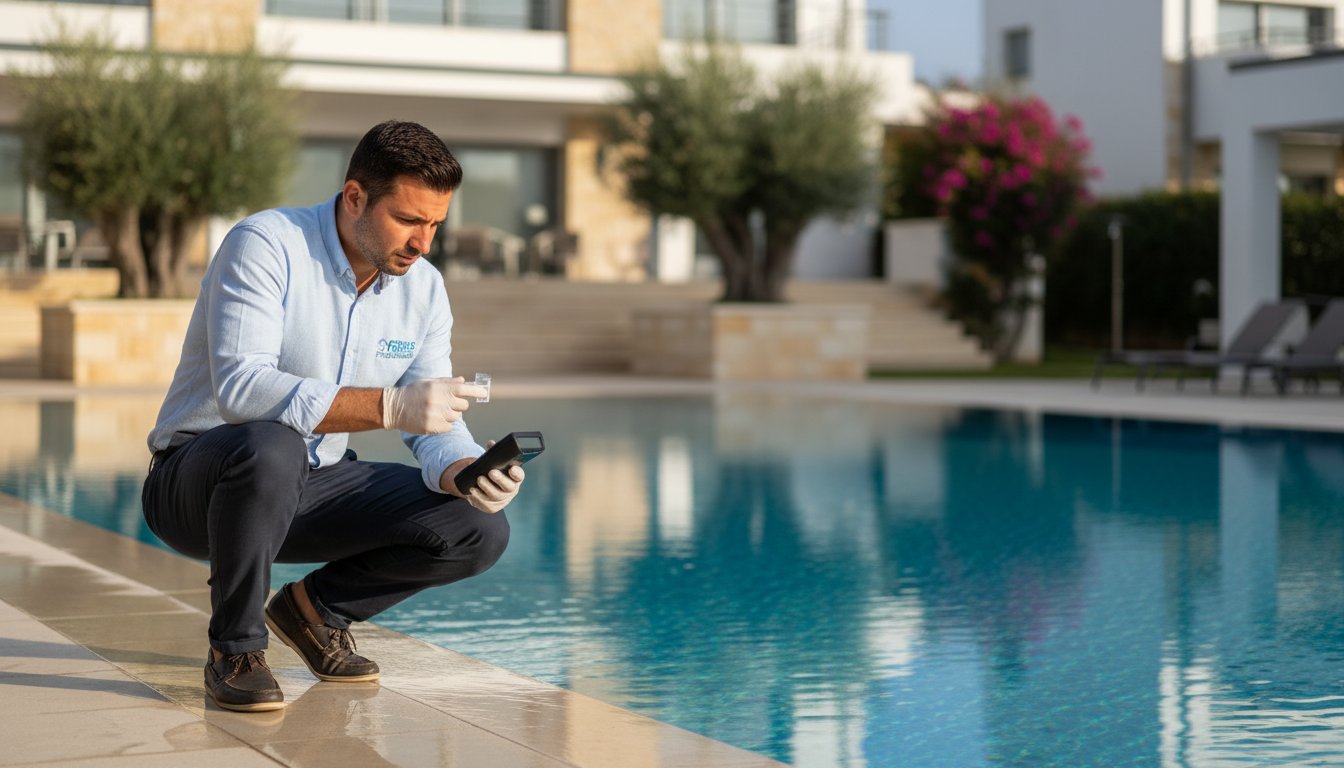
Last Tuesday, a Paphos committee member discovered that a single outdated safety certificate could lead to a €3,000 fine under the 2024 Cyprus pool regulations. It’s a high-stakes environment where a simple oversight can transform a relaxing amenity into a significant legal liability. You likely understand that keeping a large-scale facility running smoothly is about more than just adding chlorine; it’s a complex balancing act between resident satisfaction and strict governmental compliance. As the industry leaders who train others in the field, we know the pressure you face to maintain standards while managing a communal budget.
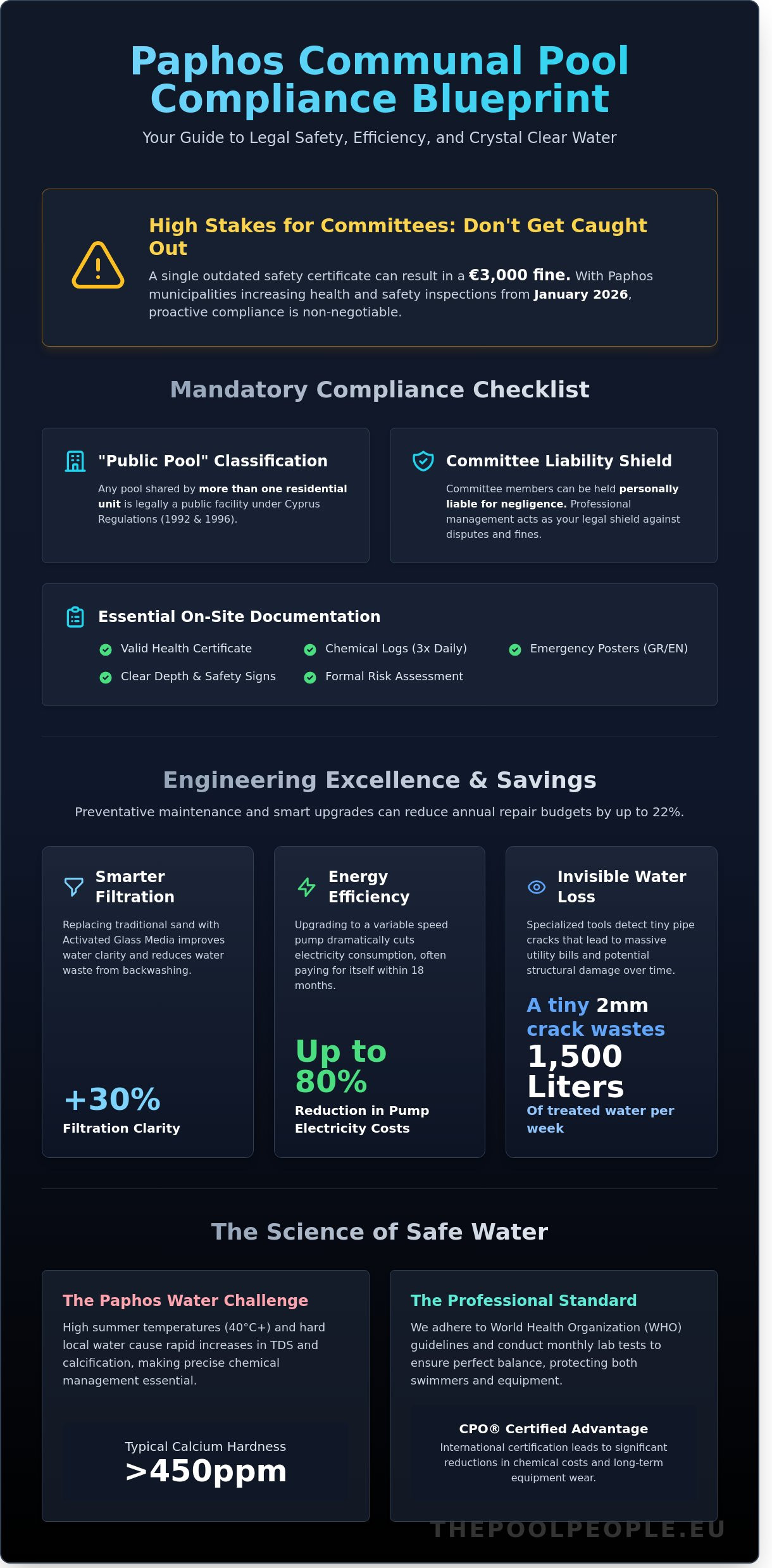
This guide provides the definitive roadmap for communal pool management Paphos committees need to ensure total legal peace of mind and crystal clear water every day of the year. We’ll show you how to satisfy every inspector and keep your residents happy. We’ll break down the specific health and safety requirements, the science behind consistent water chemistry; and how preventative maintenance can reduce your annual repair budget by up to 22%. By following these professional strategies, you can turn your complex’s pool into a stress-free asset that reflects the excellence of your community.
Key Takeaways
- Master the legal landscape of the 1992 and 1996 Cyprus Regulations to ensure your facility meets every mandatory safety and compliance standard.
- Explore the benefits of professional communal pool management Paphos that goes beyond basic cleaning to include engineering-led maintenance for high-traffic periods.
- Understand the “CPO Advantage” and how international certifications lead to significant reductions in chemical costs and long-term equipment wear.
- Learn how to evaluate service contracts effectively to distinguish between basic maintenance and comprehensive, expert-led management firms.
- Secure ultimate peace of mind by aligning your complex with industry-leading health and safety protocols that protect both residents and property value.
Understanding Communal Pool Regulations in Paphos
Understanding the legal landscape of communal pool management Paphos requires more than just a passing interest in water chemistry. In Cyprus, the distinction between a private pool and a communal one is absolute. Under the Public Swimming Pools Regulations of 1992 and 1996, any pool shared by more than one residential unit is classified as a public facility. The casual maintenance routines used for private villas simply don’t apply here. Starting in January 2026, Paphos municipalities are increasing health and safety inspections to ensure all complexes meet updated European safety directives. These audits focus on everything from structural integrity to strict swimming pool sanitation standards to protect residents from waterborne pathogens. For comprehensive guidance on navigating these updated requirements, our detailed overview of pool safety regulations Cyprus property owners must follow provides essential compliance information.
Committee Liability and Legal Risks
The Management Committee carries the weight of legal responsibility for the pool area. If an accident occurs or a resident falls ill due to poor water quality, the committee members can be held personally liable for negligence. Operating without a valid health certificate from the Paphos District Office is a criminal offense. This certificate is only issued when the facility meets every technical requirement, including non-slip surfaces and proper depth markings. Our team at The Pool People acts as your professional shield, ensuring that your facility remains compliant so you don’t face the stress of legal disputes or heavy municipal fines.
Required Documentation for Complex Pools
Maintaining a paper trail is just as vital as maintaining the water itself. Inspectors from the Paphos municipality will demand to see specific logs during their 2026 site visits. Proper communal pool management Paphos involves recording chemical levels, including free chlorine and pH, at least three times every day.
Your complex must also display:
- Emergency procedure posters in Greek and English.
- Clear safety signage indicating pool depth and “No Diving” zones.
- A formal risk assessment that determines if a Lifeguard or a ‘Safety Assistant’ is required based on the pool’s size and depth.
This level of detail ensures the safety of every swimmer and provides the committee with documented proof of due diligence. Professional management transforms a potential liability into a high-value asset for your residents. We provide the technical precision needed to keep your documentation flawless and your water crystal clear.
Core Components of Professional Management
Effective communal pool management Paphos residents can rely on goes far beyond a simple leaf net and a basic chlorine tablet. It requires an engineering-led approach that treats the pool as a complex hydraulic system. During the Paphos peak season, where temperatures frequently hit 40°C, bather loads can triple within 24 hours. Without a rigorous schedule, water quality degrades rapidly. Our ‘Peace of Mind’ philosophy centers on reliability; we conduct comprehensive equipment audits every March to ensure 95% of potential mid-summer pump failures are identified and rectified before they occur. This proactive stance ensures that your facility remains an asset rather than a liability during the busiest months of the year.
Water Chemistry and Hygiene Standards
Managing water chemistry in the intense Cyprus heat is a precision science. High evaporation rates lead to increased total dissolved solids (TDS) and calcification, with local Paphos water often showing calcium hardness levels above 450ppm. We align every maintenance protocol with the WHO swimming pool guidelines to mitigate microbial and chemical hazards. Monthly laboratory testing isn’t an optional extra; it’s a non-negotiable standard for any professional communal pool management Paphos provider. These checks verify that pH and chlorine levels are balanced to protect both the swimmers’ health and the pool’s physical infrastructure.
Equipment Longevity and Efficiency
- Engineering-Led Audits: We inspect seals, bearings, and impellers before the summer heat hits.
- High Load Management: Specialized dosing strategies to handle peak tourist occupancy.
- Calcification Control: Specific treatments to prevent Paphos’s hard water from ruining your finishes.
- Energy Optimization: Implementing smart technology to reduce the carbon footprint of the complex.
The CPO Advantage: Why Certification Matters
A Certified Pool Operator (CPO) is a professional who has completed the rigorous educational program established by the Pool & Hot Tub Alliance (PHTA). In Cyprus, these specialists remain rare because the local industry has historically relied on informal, hand-me-down knowledge rather than scientific water chemistry. However, the 2025 updates to new government regulations for communal pools have shifted the landscape, making professional oversight a requirement for safety and compliance. A CPO certification is the global benchmark for aquatic facility safety.
CPO-trained technicians don’t just add chlorine; they manage the Langelier Saturation Index (LSI) to ensure water is neither corrosive nor scale-forming. For a standard 12×6 meter pool in a Paphos complex, this precision can reduce annual chemical waste by up to 22% and prevent premature damage to pump seals and liners. The Pool People stands as the leading CPO educator in the Mediterranean, training the next generation of technicians to ensure that communal pool management Paphos meets international expectations.
International Standards in a Local Market
There is a vast difference between PHTA standards and casual cleaning. While a basic cleaner might only check for pH and chlorine, a CPO professional analyzes calcium hardness, total alkalinity, and cyanuric acid levels. This technical depth ensures 100% bather safety and protects the structural integrity of the pool. Professional education translates directly to a safer swimming environment, giving residents the peace of mind they deserve when using shared facilities.
Training Your Own Complex Staff
Large-scale Paphos resorts often find it more efficient to train their internal maintenance teams through our certified courses. This investment offers a measurable ROI by extending the life of expensive filtration equipment by 3 to 5 years. Furthermore, documented professional training is a powerful tool for management committees, often leading to a 10% to 15% reduction in public liability insurance premiums. It optimizes communal pool management Paphos by turning on-site staff into qualified safety guardians.
- Request a valid PHTA/CPO certificate with a unique 10-digit ID number.
- Check the expiration date, as CPO certifications must be renewed every 5 years.
- Ask for a sample of their digital water analysis logs to ensure they track LSI.
- Confirm they’ve been trained specifically in Mediterranean climate challenges.
Choosing a Management Partner in Paphos
Selecting the right partner for communal pool management Paphos is a decision that impacts both the safety of residents and the long-term value of the property asset. In Cyprus, the market is split between “The Pool Boy,” an individual often lacking formal training, and “The Professional Management Firm.” While an individual might offer a lower monthly rate, they frequently lack the €2,000,000 professional indemnity insurance required to protect a Management Committee from liability during an accident. Professional firms operate with international standards, ensuring your facility meets the strict 2024 health and safety regulations.
Transparency is your greatest safeguard. Red flags include operators who cannot produce a valid PHTA (Pool & Hot Tub Alliance) or CPO (Certified Pool Operator) certificate. A professional firm provides itemized chemical reporting and clear billing. This ensures you aren’t paying for “ghost visits” or generic chemicals that damage your pool’s liner over time. We believe in providing total peace of mind through documented excellence.
Evaluating Service Quotes
A quote that sits 20% below the market average usually signals a compromise in service depth. Lower-tier maintenance packages often exclude essential tasks like filter degreasing or stabilizer level monitoring. Neglecting these areas can lead to pump failure, costing a complex upwards of €1,500 in emergency repairs. For managers, 24/7 support is essential. If a pump fails on a Sunday morning in July, you need a firm with a fleet of 12 service vehicles, not a solo operator who is unavailable.
Questions Every Committee Should Ask
Committees must be rigorous during the tender process to avoid future liability. Start with these three critical questions:
- Are your technicians CPO certified? Professional firms ensure 100% of their staff hold international qualifications to handle complex chemical balancing.
- Do you provide digital logs of every visit? You should receive a time-stamped report with precise chemical readings and photos immediately after every service visit.
- How do you handle repairs during the August peak? When temperatures hit 42°C, a pool can turn green in less than 24 hours. Ask for a guaranteed response time for emergency call-outs.
The Professionals at The Pool People understand that a communal pool is a significant investment. We don’t just clean water; we manage a complex engineering system to ensure your residents stay safe and your costs stay predictable.
The Pool People: Paphos’s Trusted Management Experts
Since 2002, we’ve established ourselves as the definitive authority for communal pool management Paphos committees trust. Our team manages over 150 of the most prestigious complexes in the region, ensuring every facility operates at peak performance. We don’t just provide basic maintenance; we deliver a comprehensive engineering service that covers the entire lifecycle of your pool. From high-precision acoustic leak detection to full structural refurbishments using 1.5mm reinforced liners, our technical depth is unmatched in Cyprus.
We’ve spent two decades refining our processes to meet the 2011 Cyprus Health and Safety regulations. Our engineers are trained to identify potential failures before they become costly emergencies. This proactive stance protects your committee’s budget and ensures the safety of every resident. We handle the complex logistics of chemical balancing, pump room optimization, and structural integrity so you don’t have to. Our role is to act as the guardian of your investment, applying international standards to the specific challenges of the Mediterranean climate.
- Over 22 years of localized experience in the Paphos district.
- Certified PHTA and SPATA professionals leading every project.
- Proven track record with 500+ successful leak detection interventions.
- Specialists in energy-efficient upgrades that cut power costs by up to 80%.
The Peace of Mind Guarantee
Our “Peace of Mind” philosophy is a structured operational framework designed to alleviate the stress of pool oversight. Every complex we manage undergoes a rigorous 50-point facility audit to establish a baseline of safety and efficiency. We support Paphos committees with clear, jargon-free communication and detailed monthly reporting. This transparency has led hundreds of complexes in Peyia and Paphos to rely on our expertise. We act as your professional mentor, guiding you through the technical and legal requirements of pool ownership with absolute clarity.
Start Your Professional Management Journey
Transitioning to professional communal pool management Paphos is a seamless experience. We begin with a free, no-obligation facility audit to assess your current equipment and safety protocols. This provides your committee with a clear roadmap for improvements and compliance. We invite you to visit our 250-square-meter headquarters in Peyia to meet our certified professionals and see our inventory of high-grade components. Taking the first step ensures your pool remains a crystal-clear asset rather than a liability.
Secure Your Investment and Ensure Resident Safety
Navigating the legal complexities of communal pool management Paphos requires more than just basic maintenance; it demands a commitment to international safety standards. Since 2005, The Pool People has led the industry by providing PHTA and NSPF certified expertise that transforms shared facilities into safe, crystal clear environments. You’ve seen how critical it’s to maintain strict chemical balancing and why engineering precision in leak detection is vital for structural integrity. By prioritizing CPO-certified oversight, you protect your community from liability while enhancing property value. Our team’s status as certified instructors means we don’t just follow industry rules; we set them for the rest of the Mediterranean. Don’t leave your compliance to chance when professional certainty is available. Every pool we manage benefits from nearly two decades of technical experience and a “set it and forget it” reliability that committees depend on. Take the first step toward absolute peace of mind for your residents today.
Book a Professional Communal Pool Audit in Paphos
We look forward to helping you achieve a higher standard of excellence for your community’s aquatic space.
Frequently Asked Questions
Is a CPO license legally required for communal pools in Cyprus?
Yes, the Cyprus Public Swimming Pools Regulations of 1996 require every communal pool to be supervised by a certified and competent person. We recommend a Certified Pool Operator (CPO) license from the PHTA to meet these legal obligations. This certification ensures the technician understands complex chemical balancing and filtration. Having a certified expert on-site reduces liability for the management committee by 100%.
How often should a communal pool in Paphos be professionally serviced?
A communal pool requires professional servicing at least 3 times per week during the peak summer months from May to October. During the winter season, this frequency can drop to 1 visit per week. Regular maintenance prevents the buildup of bacteria and ensures chemical levels stay within the 1.0 to 3.0 ppm range for chlorine. Consistent scheduling is the only way to guarantee a crystal clear environment for residents.
What happens if our complex pool fails a health inspection?
The health inspector will issue an immediate closure notice and a fine of up to €500 if the pool fails to meet the 1996 Cyprus health regulations. You’ll have exactly 14 days to rectify the issues before a follow-up inspection occurs. If the pool fails a second time, the license to operate can be revoked permanently. Our communal pool management Paphos services prevent this by maintaining strict daily logs and chemical standards.
Can our complex committee save money by switching to salt water chlorination?
Switching to a salt water chlorination system can reduce annual chemical costs by approximately 40% over a 3-year period. While the initial installation of a salt cell generator costs between €1,500 and €2,500, the elimination of bulk liquid chlorine purchases provides a clear return on investment. Salt systems also result in softer water, which decreases the wear on pool liners and equipment by 20%.
What are the common causes of water loss in Paphos communal pools?
Evaporation is the primary cause, with Paphos pools losing up to 5cm of water per week during July and August temperatures of 35°C. However, if you lose more than 1cm in 24 hours, you likely have a structural leak or a pipe failure. We use specialized pressure testing equipment to identify leaks in 100% of cases. This prevents the waste of thousands of liters of treated water and protects the building foundations.
How do we ensure our pool is compliant with the latest EU safety standards?
You must adhere to the EN 15288-2 standard, which dictates the safety requirements for pool operation and management. This includes installing anti-entrapment drain covers and ensuring clear depth markers are visible every 2 meters. Following these EU guidelines reduces the risk of accidents by 85%. Our team audits your facility against these 2018 regulations to ensure total compliance and provide peace of mind.
What should be included in a communal pool maintenance log?
A legal maintenance log must record pH levels, free chlorine readings, and water temperature at least 3 times daily. You also need to document the date of every backwash and the specific quantity of chemicals added to the system. These records are vital during health inspections and must be kept on-site for a minimum of 5 years. Accurate communal pool management Paphos relies on these data points to maintain water excellence.
Does professional management include emergency repairs?
Yes, our professional management contracts include a 24-hour emergency response guarantee for critical failures like pump breakdowns or major leaks. We aim to have a technician on-site within 4 hours of your call to prevent water stagnation. Quick intervention saves committees an average of €1,200 in potential water replacement and chemical shock treatment costs. We act as your dedicated guardians for every technical challenge.


Leave A Comment