
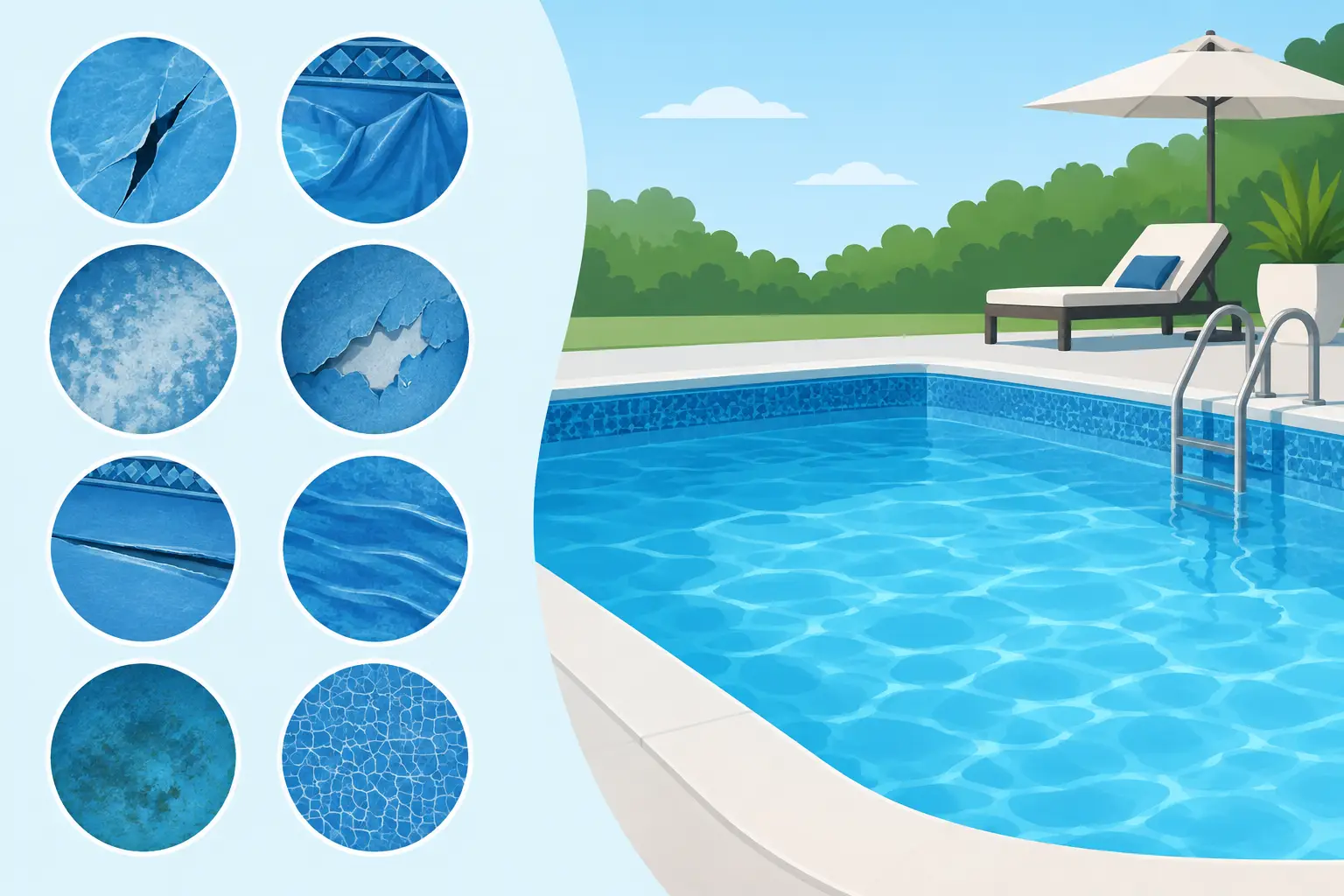
A pool liner can look tired long before it fails completely. The key is recognising the signs pool liner needs replacing before a small split, weakened fitting or persistent leak becomes a water-quality issue, damages the pool structure or disrupts guests at a holiday property.
In Cyprus, liners work hard. Strong UV exposure, high summer water temperatures, frequent chemical demand and heavy seasonal use all accelerate wear. A professional inspection can distinguish a liner that needs careful cleaning or minor repair from one that has reached the end of its safe service life.
1. The liner has faded, become brittle or lost its texture
Fading alone does not always mean immediate replacement. Dark blue and patterned liners commonly fade under intense sunshine, especially in pools with long daily exposure. However, a liner that has changed colour while also feeling dry, rough, thin or brittle is a different concern.
Vinyl needs flexibility to accommodate normal movement in the pool shell and changing water temperatures. As plasticisers gradually leave the material, the liner can shrink and become less able to stretch. This often appears first around steps, corners, skimmer openings and return fittings, where the material is under greatest tension.
If the surface is chalky, cracked or noticeably less smooth than before, cleaning alone will not restore its structural condition. Continuing to use aggressive chemicals or abrasive cleaning methods may make the deterioration worse.
2. Tears, punctures or splits keep appearing
A single small puncture can sometimes be repaired successfully, provided the surrounding vinyl remains sound. Repeated holes, widening splits or tears close to seams are stronger signs that the liner is no longer dependable.
Pay particular attention to damage around fittings, steps and the waterline. These areas experience regular contact from bathers, cleaning equipment and changing water levels. A tear near a fitting can allow water behind the liner, making it more difficult to assess the true extent of leakage.
Do not assume a patch is a permanent answer simply because it holds initially. Where the liner has become brittle, the material around the repair can fail next. For communal pools and holiday rentals, repeated temporary repairs can also create avoidable operational disruption at the busiest time of year.
3. Water level loss is greater than normal evaporation
Water loss is one of the most important signs a pool liner needs replacing, but it must be diagnosed properly. In hot, windy conditions, evaporation is expected. Splash-out from families and guests may also be significant. A leak should not be declared from a falling waterline alone.
A simple bucket comparison test can help establish whether loss is likely to be from evaporation or the pool itself. Place a bucket of pool water on a step, mark the level inside and outside the bucket, then compare both after 24 hours with the circulation system in its normal operating pattern. If the pool level falls more than the level inside the bucket, further investigation is needed.
A falling level that stops at a particular point can offer a useful clue. For example, a loss that slows below the skimmer may point towards a problem at the skimmer, return fitting, light niche or a defect in the liner at that level. Leak detection should include the liner, pipework and equipment, rather than assuming the liner is automatically responsible.
4. Wrinkles will not smooth out
Small wrinkles can develop after installation or following a period of unusual water pressure behind the liner. Some can be carefully repositioned. Persistent, spreading or deep wrinkles are more serious because they may indicate that the liner has stretched, shrunk unevenly or lost its original fit.
Wrinkles trap dirt and make thorough brushing more difficult. In warm water, that creates an area where biofilm can establish and sanitiser may not reach as effectively. They can also become uncomfortable underfoot and, if severe, create a trip hazard on steps or shallow areas.
Do not drag heavy furniture, improvised tools or sharp objects across the liner in an attempt to flatten it. This can puncture the vinyl or pull it away from its retaining track. The cause must be identified before corrective work begins.
5. The liner is pulling away from the coping or fittings
A liner should sit securely in its track and seal correctly around penetrations such as skimmers, lights, inlets and main drains. If it is slipping from the track, visibly pulling away from a corner or drawing tight around fittings, the material may have shrunk beyond a workable limit.
This is not merely an appearance issue. A loose or poorly seated liner can permit water behind it, while excessive tension increases the risk of a sudden split. It may also compromise seals around fittings, allowing hidden leakage that is difficult to identify until damage is more advanced.
Prompt assessment matters. In some limited cases, a local re-seating or fitting repair is possible. If shrinkage is widespread, however, replacement is usually the more reliable and cost-effective decision.
6. Stains return quickly after correct treatment
Surface staining can come from organic debris, metals, scale, sunscreen residues or poor chemical control. Not every stain means the liner has failed. A trained operator should first check water balance, filtration performance and the type of deposit before recommending replacement.
The concern is when a liner has become permanently discoloured, porous or heavily marked and stains reappear despite correct circulation, brushing and balanced treatment. An aged surface is harder to keep hygienic because it can hold contamination and make visual checks less reliable.
For properties with paying guests or shared users, presentation and hygiene are closely linked. A visibly stained liner can undermine confidence even when test results are acceptable. More importantly, it should prompt a review of the water-management routine that contributed to the staining in the first place.
7. There are bubbles, soft areas or movement beneath the liner
Bubbles, raised areas or a noticeable squelching sensation beneath the liner can indicate water trapped between the vinyl and the pool shell. This may result from a leak, groundwater pressure, drainage problems or a failure around a fitting.
Leaving trapped water in place risks further stretching and staining. It can also conceal defects in the underlying structure. In Paphos and surrounding areas, winter storms and changes in local ground conditions can add pressure to pools that have drainage or shell defects.
This requires investigation before a new liner is ordered. Replacing vinyl without resolving a drainage problem, leaking pipe or damaged fitting may mean the new liner encounters the same failure conditions.
8. The liner is approaching its realistic service life
Quality and installation conditions vary, but many residential pool liners provide around 10 to 15 years of service. Heavy-use communal and commercial pools may need attention sooner. Strong sunlight, poor water balance, sustained high chlorine levels and inadequate winter management can all shorten lifespan.
Age is not a replacement date on its own. A well-maintained 12-year-old liner may remain serviceable, while a younger liner exposed to persistent chemical imbalance may fail early. Still, once a liner is in its second decade, property owners should budget for replacement and arrange regular inspections rather than waiting for a major leak.
Why liner condition affects more than appearance
A failing liner affects the pool as a complete system. Water escaping behind vinyl can wash out supporting material, affect the pool shell and place added strain on surrounding finishes. Lower water levels can also lead to air being drawn into the circulation system, interrupting filtration and potentially damaging equipment.
Water quality is equally important. A liner with tears, wrinkles and degraded surfaces is harder to clean effectively. That makes routine brushing, circulation, filtration and disinfection even more critical. For communal facilities, responsible management means acting before deterioration affects safe operation or creates a preventable closure.
European pool operating standards, including the principles reflected in EN 15288-1 and EN 15288-2, place risk assessment, maintenance planning and safe operation at the centre of pool management. Liner replacement should be treated as planned preventative work, not simply a cosmetic refurbishment.
Repair or replace: making the right decision
A repair may be appropriate where damage is isolated, the vinyl remains flexible and the liner is still properly seated. A replacement is normally the wiser option when there is widespread fading and brittleness, recurring tears, clear shrinkage, persistent wrinkles or confirmed leakage through aged material.
Before replacement, the pool should be inspected for underlying faults. This includes fittings, lights, pipework, drainage, steps, the retaining track and the condition of the pool shell. It is also the right time to consider practical improvements such as efficient circulation equipment or upgraded lighting, where these suit the property and existing installation.
The Pool People can assess liner condition as part of a wider engineering and water-quality review, helping owners avoid replacing a visible component while a hidden cause remains unresolved. The objective is not simply a smart-looking finish. It is a clean, healthy and safe pool that performs reliably through the season.
If you notice falling water levels, loose material around fittings or changes in the liner’s feel, arrange an assessment before summer demand is at its highest. Early action usually gives you more choice, less disruption and a better chance of protecting the pool beneath it.


Leave A Comment