

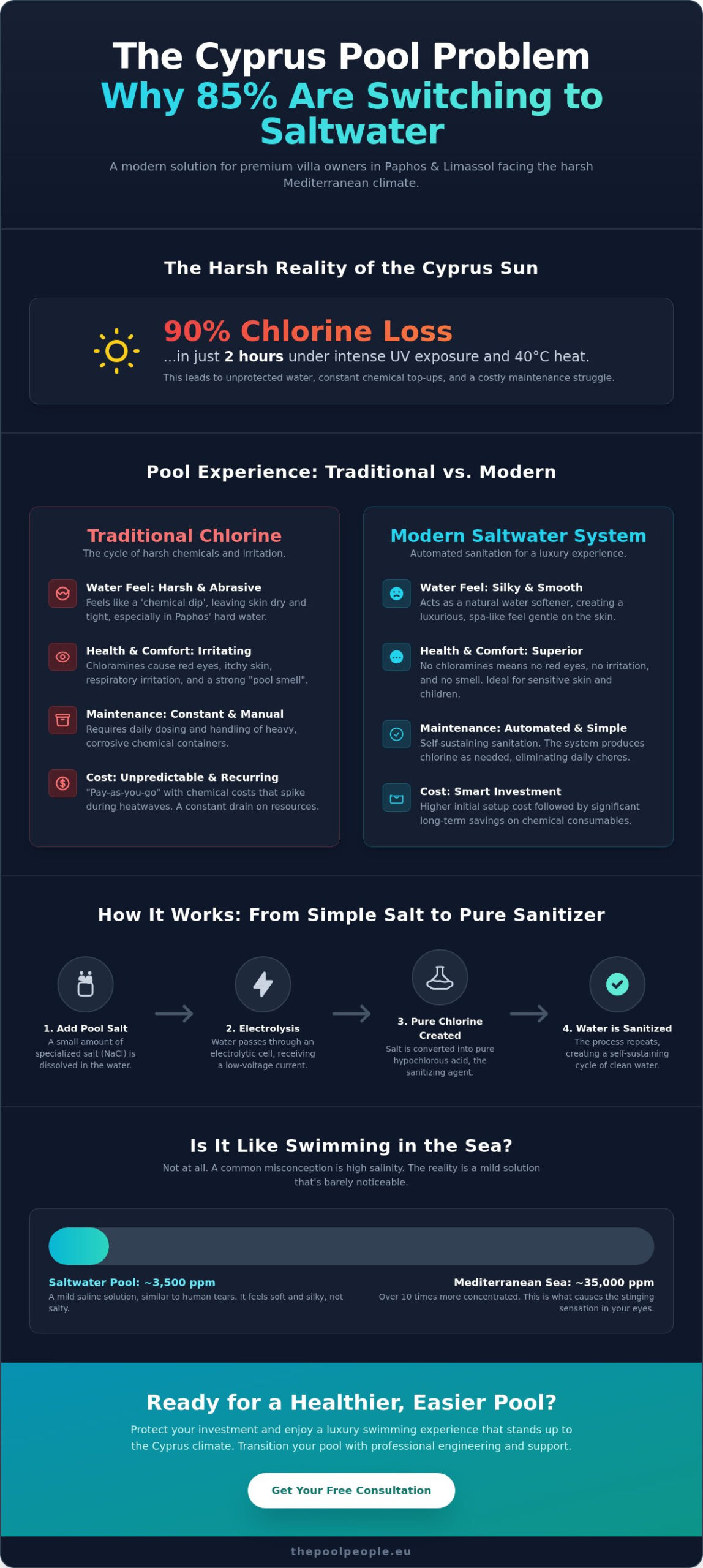
Why are 85% of premium villa owners in Paphos and Limassol choosing alternative disinfection methods over traditional chlorine in 2026? It’s a shift driven by the search for a more natural swimming experience and the harsh reality of the Cyprus sun. You’ve likely experienced the discomfort of red eyes and dry skin, or perhaps you’re tired of watching expensive chlorine tablets vanish within hours during a 40°C heatwave. The intense UV exposure on the island can deplete chlorine levels by as much as 90% in just two hours, making traditional maintenance a constant, costly struggle.
By understanding the salt water pool benefits cyprus residents can enjoy, you’ll discover how to achieve silky water that feels gentle on the body while remaining professionally sanitized. We promise to show you how these systems thrive in high temperatures and how to navigate the specific challenges of our limestone-rich hard water. This guide provides a technical overview of saltwater conversion, the reality of monthly maintenance in the current economy, and what the 2025 Swimming Pools Law means for your property’s designated “Responsible Person.” We will help you maintain a crystal-clear pool that stands up to the Mediterranean climate with total reliability.
Key Takeaways
- Understand the electrolysis process that creates a self-sustaining sanitation cycle, reducing the need for constant manual chemical dosing in the Cyprus heat.
- Explore how the salt water pool benefits cyprus residents by providing a natural water-softening effect that eliminates the irritation caused by chloramines.
- Learn professional techniques to protect your equipment from Paphos’s hard water and prevent calcium scaling on your salt cell plates.
- Analyze the total cost of ownership by weighing the initial investment against the long-term savings on chemical consumables and maintenance.
- Determine if your current pool plumbing is compatible with modern salt systems and what to expect during a professional engineering installation.
Understanding Salt Water Chlorination in the Cyprus Climate
A common misconception among Paphos property owners is that a salt water pool is entirely chlorine-free. In reality, these systems are advanced, self-sustaining chlorine generation plants. Instead of manually adding liquid or tablet chlorine, you add specialized pool salt to the water. The system then uses this salt to produce a pure form of sanitizer on-site. This constant, automated delivery is one of the primary salt water pool benefits cyprus residents appreciate, especially when the summer heat makes manual dosing a full-time job.
It’s vital to distinguish between a salt pool and the Mediterranean Sea. The salinity of a salt water pool is approximately 3,000 to 4,000 parts per million (ppm). For comparison, the sea water surrounding Cyprus is roughly 35,000 ppm. This lower concentration is just enough to facilitate the chemical process without the harsh, stinging sensation of high-salinity ocean water. It feels more like a light saline solution than a dip in the sea.
The Science: From Salt to Sanitizer
The heart of the system is the electrolytic cell. As salt water passes through this cell, a low-voltage current triggers a reaction that breaks down the sodium chloride (NaCl) into sodium and chlorine gas. This gas immediately dissolves into the water to create hypochlorous acid, the active agent that kills bacteria and algae. You can explore the technical details of how salt water chlorination works to understand this molecular transformation. The control unit acts as the brain of the operation, allowing you to increase or decrease production based on the bather load or the intensity of the sun. Because the chlorine is produced in its natural state, it lacks the harsh additives found in commercial tablets, making it much gentler on the skin.
Why Paphos Homeowners are Making the Switch
The Cyprus climate presents a unique challenge for pool chemistry. Intense UV exposure can deplete traditional chlorine levels by as much as 90% in just two hours. This burn-off effect often leaves pools unprotected during the hottest parts of the day. A salt water system counters this by providing a steady, reliable stream of sanitation that doesn’t rely on you remembering to add chemicals. It’s a proactive approach to property maintenance that ensures the water is always safe for a swim.
Owners of holiday rentals and communal complexes also find this transition alleviates the logistical burden of property management. You no longer need to store and handle heavy, corrosive tubs of chlorine tablets. By choosing a salt system, you’re investing in a more stable environment that maintains safety standards even when Paphos temperatures exceed 40°C. This reliability is a cornerstone of the salt water pool benefits cyprus homeowners seek to protect their investment and their guests’ health.
The Health and Lifestyle Benefits for Paphos Residents
Beyond the technical advantages of automated sanitation, the most immediate impact of a salt system is the physical sensation of the water. Traditional chlorine pools often feel “harsh” due to high chemical concentrations. In contrast, salt water systems act as a natural water softener. This is a significant advantage in Paphos, where our local supply is notoriously hard. The low salinity levels create a “silky” texture that feels smooth against the skin, making every swim feel like a high-end spa experience rather than a chemical dip.
The characteristic “pool smell” that many people associate with chlorine is actually caused by chloramines. These are byproducts formed when chlorine reacts with sweat, oils, and other organic matter. Chloramines are the true culprits behind red eyes, itchy skin, and respiratory irritation. Because salt cells continuously break down these compounds through the electrolysis process, the water remains odorless and clear. Understanding these salt water pool benefits cyprus families appreciate is essential, especially for households with children or swimmers who suffer from asthma and sensitive skin conditions.
Protecting your personal property is another lifestyle factor to consider. Concentrated chlorine can be incredibly abrasive, leading to the premature bleaching of expensive swimwear and the drying of hair. Salt water is far more forgiving. It preserves the integrity of swimsuit fabrics and keeps hair from becoming brittle and straw-like after a long summer of daily use. It’s a gentle approach to hygiene that doesn’t compromise on safety.
A Better Swimming Experience
There is a distinct buoyancy in salt water that makes swimming feel more effortless and refreshing, particularly during the intense July heat. Beyond the physical comfort, there is a deep psychological reassurance. You can relax knowing your pool is being managed by a smart system that maintains consistent levels. This eliminates the “yo-yo” effect of manual dosing, where chlorine levels are either dangerously high or too low to be effective. The result is a consistently clean environment without the chemical residue that lingers on the skin long after you’ve dried off.
Safety and Convenience Factors
Handling and storing 25kg tubs of chlorine tablets is a chore and a potential safety hazard, especially in homes with pets or small children. Salt systems require far less maintenance in terms of chemical logistics. You generally only need to add salt to the water once or twice a season. This automation ensures your pool remains professionally sanitized even if you’re away from your Paphos villa for an extended period. These systems also integrate perfectly with other modern technology, such as robotic pool cleaners, which help maintain the floor and walls without disrupting the delicate chemical balance. If you’re considering a transition to a more manageable system, our team can provide expert guidance on salt water chlorination systems tailored to your specific pool volume.
Navigating Technical Challenges: Hard Water and UV Exposure
While the transition to salt offers undeniable lifestyle upgrades, managing the technical nuances of the local environment is crucial for long-term success. Paphos is known for its limestone-rich geology, which results in exceptionally hard water. When this high calcium content meets the heat and chemical reactions inside a salt cell, scaling becomes a significant risk. Without proper management, calcium deposits can bridge the plates in your electrolytic cell, reducing efficiency and eventually causing system failure. This is why understanding the technical salt water pool benefits cyprus homeowners can leverage requires a deeper look at water balance and equipment protection.
Another factor to monitor is pH drift. Saltwater systems naturally produce sodium hydroxide as a byproduct of electrolysis, which steadily pulls the pH of your water upward. In the hard water environment of Cyprus, a high pH is the primary trigger for scale formation on your tiles and internal plumbing. Maintaining a slightly lower alkalinity helps keep your water clear and your equipment running smoothly. By staying proactive with these technical details, you ensure that the health and maintenance benefits of saltwater systems aren’t undermined by mineral buildup.
Combating Calcium and Scaling
In our region, choosing a system with reverse polarity, often called a self-cleaning cell, is non-negotiable. This technology periodically reverses the electrical charge to shed calcium buildup before it hardens. However, technology alone isn’t a silver bullet. You must maintain precise pool water chemistry to prevent the pH from drifting into the danger zone. We often recommend using sequestering agents; these specialized chemicals keep minerals in suspension, preventing them from plating out on your pool liner or the delicate internal components of your salt chlorinator.
UV Protection and Chlorine Stability
The intense sunlight in Cyprus is a constant adversary for pool sanitation. As established, UV rays can destroy the majority of unstabilized chlorine in just a few hours. To protect your sanitizer, maintaining the correct level of Cyanuric Acid (CYA) is vital. Think of CYA as a sunscreen for your chlorine molecules. It shields them from the sun’s rays so they can focus on killing bacteria and algae. During the peak of August or after a busy weekend with guests, don’t hesitate to utilize your system’s “Boost” mode. This feature temporarily ramps up chlorine production to handle the increased bather load, ensuring your pool remains a safe sanctuary despite the relentless 40°C heat.
Total Cost of Ownership: Is Salt a Good Investment in 2026?
Evaluating the financial impact of a salt water system requires a shift in how you view your property budget. While the initial setup involves an upfront purchase of the control unit and the electrolytic cell, the return on investment becomes clear through the reduction of monthly consumable costs. In May 2026, with electricity rates in Cyprus at approximately €0.31 per kWh and a projected 7% increase on the horizon, energy efficiency is a primary concern for every Paphos homeowner. Modern salt chlorinators are designed to operate with minimal power draw, often consuming less energy than a standard household light bulb while providing a continuous sanitization cycle. This efficiency is one of the most compelling salt water pool benefits cyprus residents cite when upgrading their outdoor living spaces.
Beyond the immediate chemical savings, a salt system can actually protect your long-term assets. High-dose liquid chlorine or poorly managed tablets can be incredibly corrosive to pool pumps and heat exchangers. Because a salt system maintains a consistent, low-level chlorine residual, it’s often gentler on your pool pump and filter installation. This stability prevents the “chemical spikes” that degrade seals and O-rings, potentially adding years to the lifespan of your core equipment. It’s a proactive way to safeguard your investment against the wear and tear of the Mediterranean climate.
Initial Investment and Component Lifespan
The system consists of two primary parts: the digital control unit and the electrolytic cell. In the intense Paphos heat, where pools run for longer cycles to combat algae, a high-quality cell typically lasts between three and five years. Professional installation is vital to ensure these components are shielded from local power surges that can damage sensitive control boards. Our engineering team focuses on precise calibration during setup to ensure the cell isn’t overworking, which is the leading cause of premature failure in the region.
Monthly Maintenance Savings
When you compare month-to-month expenses, the savings on chlorine tablets and liquid sanitizer are substantial. A few bags of specialized salt per season replace the need for constant, expensive chemical deliveries. You’ll still need to budget for pH reducers, as established in previous sections, but the overall chemical bill is significantly lower than a traditional setup. By integrating your system with professional pool maintenance, you ensure that the water balance remains optimal, which prevents calcium from clogging the cell and maintains the salt water pool benefits cyprus owners expect. If you’re ready to stabilize your monthly outgoings and move away from the volatility of chemical prices, you can explore our Salt Water Chlorination Systems to find a solution tailored to your pool’s specific volume.
Transitioning Your Paphos Pool: Professional Installation
Converting an existing chlorine pool to a salt system is a technical procedure that requires more than just a simple equipment swap. The process begins with a “Deep Clean” phase. If your pool has been treated with traditional tablets for years, the water likely contains high levels of accumulated cyanuric acid and dissolved solids. To fully realize the salt water pool benefits cyprus homeowners expect, we often recommend a partial or full water change to reset the chemistry. This ensures your new salt cell isn’t fighting legacy chemical imbalances from day one.
A professional installation involves a detailed audit of your current hydraulic layout. Our PHTA/NSPF Certified Pool Operators (CPO) evaluate the integrity of your plumbing to ensure the salt cell is positioned for optimal flow and easy maintenance. Precision is vital during this stage; an incorrectly calibrated system can lead to inefficient chlorine production or localized corrosion. By employing technicians who understand the specific engineering requirements of salt systems, you protect your equipment and ensure the long-term safety of your swimming environment.
Site Survey and Equipment Selection
In many Peyia villas and Paphos townhouses, pump room space is limited. A professional site survey assesses your available footprint and electrical capacity to ensure the control unit is mounted in a ventilated, accessible area. Sizing the chlorinator is equally important. We calculate your pool’s exact volume to select a cell that can maintain sanitation levels without running at 100% capacity, which preserves the component’s lifespan. During this survey, we also identify potential corrosion risks, such as older stainless steel ladders or lighting fixtures that may need upgrading to salt-compatible materials to prevent tea-staining or rust.
Post-Installation Care and Support
The first 48 hours after installation are the most critical. Once the salt is added, it must be manually brushed until fully dissolved before the cell is activated to prevent damage to the plates. Our team provides comprehensive training on how to interpret your control panel’s alerts, such as “low flow” or “cell service” indicators. This educational approach empowers you to manage your system with confidence. We also recommend scheduling regular pool leak detection as part of your annual maintenance. Even a small leak can lead to salt loss and water dilution, forcing your system to work harder than necessary. By combining professional installation with proactive monitoring, you ensure your transition to a salt water pool is a seamless, stress-free upgrade for your Paphos home.
Secure a Smarter Swimming Experience for Your Home
Transitioning to a salt system is more than a luxury upgrade; it’s a strategic move to master the unique environmental challenges of our region. By choosing this modern approach, you secure the full range of salt water pool benefits cyprus homeowners value, from the silky texture of the water to the reliable, automated sanitation that stands up to the intense Mediterranean sun. You’ve seen how these systems manage Paphos’s hard water and significantly reduce the logistical burden of chemical handling while providing a safer environment for your family.
Our expert engineering team has been based in Peyia since 2005, providing specialized knowledge in high-efficiency salt chlorination systems. As PHTA/NSPF Certified Pool Operators, we ensure every conversion is calibrated for maximum performance and equipment longevity. We’re ready to help you protect your investment and enjoy a more natural, effortless swimming experience throughout the long summer season.
Get a Professional Salt Water Conversion Quote for Your Paphos Pool and take the first step toward a healthier, more cost-effective property today.
Frequently Asked Questions
Is a salt water pool actually saltier than the ocean?
No, a salt water pool is significantly less salty than the sea. The Mediterranean surrounding Paphos has a salinity of approximately 35,000 ppm, whereas a salt pool operates at roughly 3,000 to 4,000 ppm. This concentration is barely noticeable to the taste and is approximately the same salinity as a human tear, providing a much gentler experience for your eyes and skin.
Will the salt water corrode my pool pump or stone patio in Paphos?
Corrosion isn’t a major risk if you choose high-quality components and maintain proper water balance. While salt is naturally corrosive, the levels in your pool are low enough that they won’t damage modern pumps or filters. For limestone or natural stone patios common in Paphos, we recommend applying a professional sealant to prevent any potential salt crystallization from affecting the surface over time.
How often do I need to add salt to my Cyprus pool?
You typically only need to add salt once or twice per season. Unlike water, salt doesn’t evaporate in the intense summer heat. It only leaves the pool through splash-out, filter backwashing, or leaks. Monitoring your salt levels twice a year is usually sufficient to keep the system producing chlorine effectively without constant manual intervention.
Can I convert my existing chlorine pool to salt water easily?
Converting a traditional pool is a straightforward process for an experienced engineering team. It involves installing a salt chlorine generator and a control unit into your existing plumbing system. We usually recommend a “Deep Clean” phase to reset the water chemistry before the conversion to ensure the new system operates at peak efficiency from the very first day.
Do salt water pools require less maintenance than traditional ones?
Salt water pools definitely reduce the daily workload of pool ownership. The system automates the sanitation process, so you don’t have to handle, store, or manually dose chlorine tablets. You’ll still need to monitor pH levels and clean the electrolytic cell occasionally, but the overall time spent on chemical management and logistics is significantly lower.
What happens to the salt system during the Cyprus winter?
During the cooler Cyprus winter, the salt cell’s production will naturally decrease. Most systems have a safety shut-off when water temperatures drop below 15°C to protect the cell plates from damage. Since bather load is lower and UV exposure is reduced during these months, the pool requires very little sanitizer to remain clear and healthy.
Is a salt water pool cheaper to run in the long term?
Yes, the long-term operational costs are lower than traditional systems. While the upfront investment for the equipment is higher, the recurring monthly savings on chlorine tablets and liquid sanitizer make it a financially sound choice. One of the major salt water pool benefits cyprus residents experience is the stabilization of their maintenance budget against fluctuating chemical prices.
Does salt water affect the pH balance of the pool more than chlorine?
Salt systems do tend to pull the pH level upward over time. The electrolysis process creates sodium hydroxide as a byproduct, which steadily increases the alkalinity of the water. You’ll need to add a pH reducer more frequently than you would in a traditional pool to keep the water balanced and prevent calcium scaling on your pool tiles and internal equipment.




Leave A Comment