
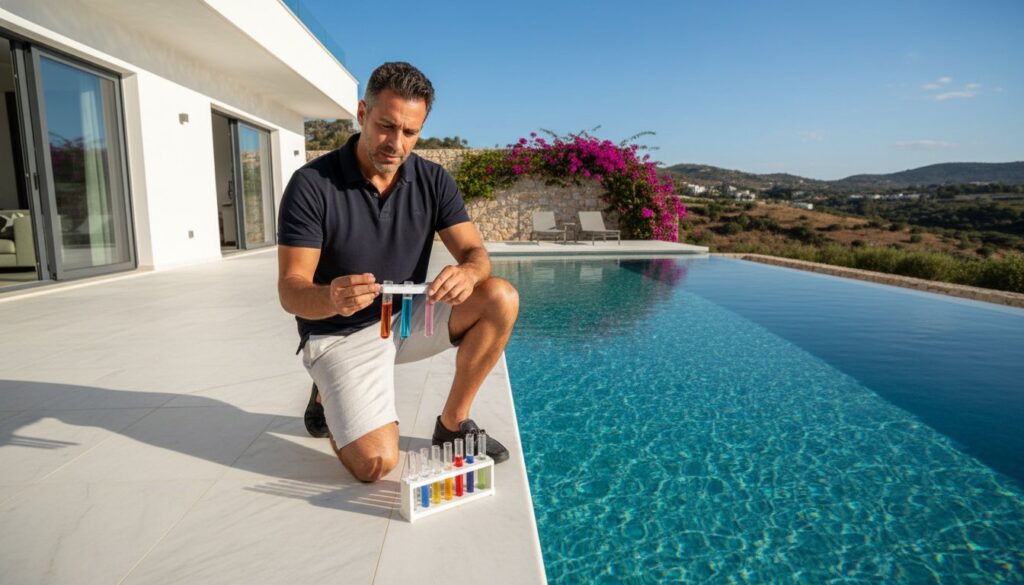
Imagine waking up on a scorching July morning in Coral Bay only to find your once-inviting oasis has turned a murky shade of forest green in under 12 hours. It’s a frustratingly common reality for many homeowners who find that standard maintenance routines simply cannot keep up with the intense UV index in Cyprus. We understand that managing pool chemicals Paphos can feel like a constant battle against evaporation and rising costs, especially when you’re spending upwards of €600 a year on supplies without seeing the results you deserve.
You deserve the peace of mind that comes with a perfectly balanced, healthy swimming environment. This guide teaches you how to master your water chemistry like a professional, allowing you to combat the Mediterranean sun and maintain crystal clear water throughout every season. We’ll explain the critical relationship between pH and chlorine, show you how to reduce chemical consumption by 15% using precise dosing techniques, and provide the technical confidence needed to handle your own maintenance with ease. By following our industry-standard protocols, you’ll transform your pool from a source of stress into a safe, sparkling sanctuary for your family.
Key Takeaways
- Understand how 300+ days of intense Cyprus sunshine affect your water chemistry and why standard maintenance routines require specific local adjustments.
- Identify the essential pool chemicals Paphos villas require to keep sanitizers effective and ensure bather comfort even in peak summer temperatures.
- Learn why professional-grade DPD 1-3 testing and Total Alkalinity stabilization are the critical first steps for achieving crystal clear water.
- Master proven techniques for handling “Green Pool” emergencies and clearing cloudy water caused by frequent African dust storms.
- Discover how the professional mentors in Peyia can help you safeguard your investment with expert advice and high-quality chemical solutions.
Understanding Pool Water Chemistry in the Paphos Climate
Pool water chemistry is the precise balance between effective sanitation and bather comfort. For a Paphos homeowner, this means managing pool water sanitation to ensure the water remains safe without irritating the skin or eyes. Maintaining this balance is a daily task because Paphos enjoys over 300 days of intense annual sunshine. This environment creates a high-demand scenario for your pool chemicals Paphos strategy. We operate on a “Peace of Mind” philosophy where prevention is the priority. It’s always more cost-effective to invest in regular maintenance than to pay for a €200 green pool recovery treatment after a bloom takes hold.
The Role of the Mediterranean Sun
The Cyprus sun is a powerful force that dictates your chemical consumption. Unstabilized chlorine molecules are highly sensitive to ultraviolet light. Without the correct levels of cyanuric acid, the sun’s UV rays can destroy up to 90% of your pool’s free chlorine in just two hours. This rapid degradation leaves your water vulnerable to pathogens. When August temperatures push water levels above 30°C, bacteria and algae growth rates accelerate. To maintain accuracy, you should test your water at the same time every day, ideally in the early morning before the sun reaches its peak intensity and begins stripping your sanitizer levels.
Why “Supermarket Chemicals” Often Fail
Choosing the right supplies is vital for long-term pool health. It’s tempting to grab buckets during a weekly shop, but retail-grade brands often lack the potency required for the Cypriot climate. These products frequently contain high levels of “filler” ingredients that add no value to your water. At The Pool People, we adhere to PHTA standards, selecting professional-grade pool chemicals Paphos residents can trust for high active ingredient concentrations. Low-quality supplies often lead to common issues:
- Reduced Potency: Retail tablets often have only 50% to 60% active chlorine, whereas professional versions offer 90%.
- System Clogs: Cheap “filler” ingredients don’t always dissolve, leading to residue that can damage expensive filtration systems.
- False Economy: You’ll often use double the amount of cheap product to achieve the same result as a single professional dose.
Investing in professional-grade chemicals ensures that your water remains crystal clear and inviting, protecting both your family’s health and your property investment.
The Essential Pool Chemicals for Every Paphos Villa
Maintaining a private pool in the Paphos district requires a disciplined approach to water chemistry. The intense Cyprus sun and high bather loads mean that the pool chemicals Paphos homeowners select must be high quality and precisely balanced to ensure safety. Your primary defense is the sanitizer, typically chlorine or bromine, which eliminates 99.9% of harmful bacteria and prevents the rapid algae blooms common when temperatures exceed 30°C.
Effective sanitization depends entirely on your pH levels. You must keep your pH between 7.2 and 7.6. If the pH climbs above this range, your chlorine loses its pathogen-killing power; if it drops below, the acidic water can etch Cyprus stone surrounds or cause expensive damage to pool liners. Total Alkalinity (TA) acts as the “anchor” for your pH. By keeping TA between 80 and 120 ppm, you prevent “pH bounce,” where levels fluctuate wildly after a heavy rain or a pool party. The chemistry of pool maintenance involves a delicate equilibrium between these factors to keep the water non-corrosive and comfortable for swimmers.
Secondary tools like algaecides and flocculants provide the finishing touches. While chlorine kills algae, a weekly dose of algaecide serves as a preventative insurance policy. If your water looks cloudy, a flocculant will bind tiny particles together so they sink to the floor, where they’re easily vacuumed away, leaving the water crystal clear.
Stabilizers: The Secret to Saving Money
Cyanuric Acid (CYA) acts as a sunscreen for your chlorine. In the Paphos sun, UV rays can destroy 90% of unstabilized chlorine in just two hours. You should maintain CYA levels between 30 and 50 ppm. However, be wary of “Chlorine Lock.” If CYA levels exceed 100 ppm, the stabilizer binds the chlorine so tightly it becomes ineffective. It’s best to measure your stabilizer levels in March, at the start of the season, to avoid wasting money on chlorine that can’t do its job.
Calcium Hardness in Paphos Water
The Paphos district is known for “hard” water, often containing high concentrations of calcium carbonate. When calcium levels exceed 400 ppm, you’ll notice white, crusty scale buildup on waterline tiles and inside salt chlorinator cells. This scale can reduce the efficiency of your pool pump by up to 20% due to restricted flow. To protect your equipment, use a sequestering agent to keep minerals in suspension. If you’re struggling with persistent scaling, our experts provide specialized water balancing services to safeguard your investment.
Step-by-Step: How to Balance Your Pool Chemicals
Achieving crystal clear water in the Mediterranean heat requires more than a casual glance at a test strip. To maintain the long-term health of your investment, you must follow a disciplined sequence. Precision is the difference between a safe swimming environment and one that causes skin irritation or equipment corrosion. When managing pool chemicals Paphos homeowners often struggle with rapid evaporation and high UV exposure, making this five-step process essential for consistency.
- Step 1: Test with DPD professional kits. Discard basic test strips that only provide “ballpark” figures. Use a DPD 1-3 tablet kit to distinguish between Free Chlorine and Total Chlorine. This level of detail is necessary to identify if your water is actually sanitized or merely “smelling” of chlorine due to chloramines.
- Step 2: Balance Total Alkalinity (TA) first. Think of TA as a buffer for your pH. If your TA isn’t between 80 and 120 ppm, your pH levels will bounce erratically, making it impossible to stabilize the water.
- Step 3: Adjust the pH levels. Aim for a range of 7.2 to 7.6. This is the “sweet spot” where your chlorine is most active. If your pH climbs to 8.0, your chlorine becomes roughly 80% less effective, wasting your money and leaving the pool unprotected.
- Step 4: Dose sanitizer based on bather load. Calculate your dosage based on your pool’s actual volume and recent usage. A pool used by six children on a Saturday requires a different response than a pool that’s sat idle all week.
- Step 5: Re-test after circulation. Allow your pump to run for at least 4 to 6 hours before re-testing. This ensures the pool chemicals Paphos sun has interacted with the entire water body, providing an accurate reading of the new baseline.
Testing Like a CPO Professional
Professional Certified Pool Operators (CPOs) focus on the difference between Free Chlorine (the active sanitizer) and Combined Chlorine (the spent “waste” product). To get an accurate reading, always take your water sample from at least 18 inches below the surface. This avoids the “surface film” where sun exposure and debris can skew results. In Cyprus, the best strategy is to test at dusk. Testing after the sun has set allows you to measure the chemical levels without the interference of intense UV rays, which can deplete chlorine by up to 5 ppm in a single afternoon.
Calculating Your Pool Volume
Accurate dosing depends entirely on knowing your pool’s capacity in litres. For a rectangular pool, use the formula: Length x Width x Average Depth x 1000. For an oval pool, use: Length x Width x Average Depth x 785. Over-dosing is a common mistake that leads to “chemical staining” and can significantly shorten the lifespan of a 1.5mm reinforced liner. Parts per million (ppm) is the standard unit for chemical measurement, representing one milligram of chemical per litre of water. Maintaining these precise ratios ensures the “peace of mind” that comes with a perfectly balanced, professional-grade pool environment.
Solving Common Paphos Pool Problems with Chemicals
Paphos weather presents unique challenges for pool maintenance. High temperatures and Saharan winds require a proactive approach to water chemistry. When temperatures exceed 35°C, algae can bloom in under 24 hours. If your pool smells strongly of chlorine, it’s actually lacking active sanitizer. This “pool smell” comes from chloramines, which are spent chlorine particles. To fix this, you must reach breakpoint chlorination by adding a concentrated dose of pool chemicals Paphos professionals recommend. Similarly, if swimmers complain of stinging eyes, don’t blame the chlorine. A pH level outside the 7.2 to 7.6 range is almost always the cause of ocular discomfort.
Recovering from a Dust Storm
Cyprus experiences an average of 4 to 6 major African dust events annually, typically during the spring months. This dust isn’t just dirt; it’s a delivery system for phosphates. When phosphate levels exceed 500 parts per billion (ppb), they act as a buffet for algae. You’ll need a phosphate remover to starve the organisms and a high-quality flocculant to bind fine particles so they sink to the floor. Once the dust settles, backwash your sand filter for at least 3 minutes. This prevents pressure buildup and ensures your circulation system maintains its 100% efficiency rating.
Shock Treatment Protocols
Choosing the right product is vital for safety and efficiency. Use Calcium Hypochlorite, with a 65% concentration or higher, for a deep reset after heavy use or a 40°C heatwave. For a quick refresh where you want to swim sooner, a non-chlorine shock works well because it doesn’t raise stabilizer levels. Never mix different types of shock in the same bucket; this causes dangerous chemical reactions. Always wait until your chlorine levels drop below 4.0 ppm, usually 12 to 24 hours after treatment, before entering the water. Our team at The Pool People follows PHTA standards to ensure every intervention is scientifically sound and provides total peace of mind.
Managing these variables requires precision and the right supplies. Ensure your water remains pristine by sourcing high-quality pool chemicals Paphos homeowners trust for year-round clarity.
Professional Support and Chemical Supply in Peyia
Managing a swimming pool in the intense Paphos heat requires more than just a basic test kit. At The Pool People, we’ve spent over 20 years refining the science of Mediterranean pool care. Our physical shop in Peyia serves as a dedicated hub for high-quality pool chemicals Paphos homeowners rely on for safe, crystal clear water. We provide a professional water analysis service that identifies microscopic imbalances before they cause skin irritation or damage your pool’s infrastructure. Our store is stocked with premium products that are far more effective than the diluted versions often found in local supermarkets.
Expert Guidance from CPO Certified Staff
Safety starts with genuine expertise. We’re proud to be the only PHTA and NSPF CPO training providers in Cyprus. This means we don’t just follow industry standards; we set them and teach them to other professionals across the island. This technical depth ensures your family’s safety by preventing common chemical handling errors that lead to respiratory issues or equipment corrosion. Understanding pool safety regulations Cyprus enforces is essential for every property owner to avoid costly fines and ensure compliance. You’re invited to visit us at Shop 1 in Peyia for a free consultation. Our team will review your current setup and provide a tailored plan based on your pool’s specific volume and usage patterns, ensuring you never over-apply chemicals again.
The “Set it and Forget it” Solution
Many homeowners find that DIY maintenance leads to “chemical seesawing,” where levels fluctuate between dangerously high and ineffective. Transitioning to our monthly pool maintenance eliminates this volatility and the stress that comes with it. Professional chemical management is a financial strategy as much as a hygiene one. Maintaining a perfect saturation index can extend the life of a pool liner by 5 to 7 years. It also prevents the premature calcification of a €700 circulation pump, saving you from expensive emergency repairs.
Our professional maintenance subscription includes several key advantages:
- Precise digital water testing that surpasses the accuracy of basic manual strip tests.
- Application of professional-grade chemicals that leave zero residue or cloudiness.
- Routine inspection of filtration systems to catch minor leaks before they become disasters.
- Full compliance with stringent EU health and safety regulations.
This approach moves you from a position of constant checking to one of total relaxation. We handle the hazardous materials and the technical balancing so you don’t have to. Contact The Pool People today for a maintenance quote and let the experts handle the science while you enjoy the water.
Secure Your Crystal Clear Mediterranean Retreat
Maintaining a pristine villa pool in the Cyprus heat requires more than just basic care; it demands a technical understanding of how intense UV levels affect your water balance. By mastering the application of pool chemicals Paphos homeowners can prevent common issues like rapid chlorine depletion and calcium scaling. Since 2005, The Pool People have provided the local community with the expertise needed to keep water safe and inviting. Our PHTA and NSPF Certified Pool Operators provide a foundation for long-term pool health through professional-grade solutions rather than guesswork.
We are the exclusive distributors of high-grade European pool chemicals, ensuring you receive the highest quality formulations available on the market. Using the right products at correct intervals protects your pool’s liner and internal components from premature wear. This proactive approach saves you money on repairs while delivering the peace of mind you deserve. If you’re ready to take the guesswork out of your maintenance routine, we’re ready to help. Visit our Peyia shop for professional pool chemicals and expert advice and start enjoying a healthier, clearer swim today. Your perfect pool is just a visit away.
Frequently Asked Questions
Is it cheaper to buy pool chemicals in bulk in Paphos?
Buying your pool chemicals Paphos supplies in bulk typically reduces your annual costs by 15% to 20% compared to purchasing smaller containers. For example, a 25kg drum of chlorine tablets generally offers a much lower price per kilogram than a 5kg bucket. You must store these larger quantities in a cool, dry, and ventilated area to prevent degradation from the 40°C Cyprus heat.
How often should I test my pool water during a Cyprus summer?
You should test your pool water at least 3 times per week during the peak Cyprus summer, though daily checks are recommended when temperatures exceed 35°C. High UV levels and increased bather loads rapidly deplete sanitizers. Frequent monitoring ensures you catch chemical imbalances before algae blooms take hold, maintaining that crystal clear water quality we all strive for.
Can I use bleach instead of pool chlorine in my Paphos pool?
We don’t recommend using household bleach because it lacks the concentration and stabilizers found in professional pool products. Most household bleaches contain only 3% to 6% sodium hypochlorite, whereas liquid pool chlorine is typically 10% to 12%. Using the wrong product can lead to pH fluctuations and ineffective sanitation, potentially compromising the safety of your family and guests.
What is the ideal chlorine level for a pool in Paphos?
The ideal free chlorine level for a residential pool in Paphos is between 1.0 and 3.0 parts per million (ppm). If your pool uses a salt chlorinator or experiences high bather loads, maintaining a steady 2.0 ppm provides the best protection against bacteria. Keeping levels within this specific range ensures your water remains inviting and safe for every swimmer throughout the season.
Why does my pool water turn cloudy after a heavy rain or dust storm?
Rainwater and Saharan dust storms introduce fine particulates and organic matter that overwhelm your filtration system. These events often bring phosphates, which act as food for algae and cause visible cloudiness within 4 to 6 hours. You’ll need to shock the pool and use a high quality flocculant to bind these tiny particles so your filter can remove them effectively.
Do salt water pools in Cyprus still need extra chemicals?
Salt water pools still require additional chemicals like pH minus and cyanuric acid to function correctly in the Paphos climate. While the salt cell generates chlorine, it naturally raises the pH level, often requiring 500ml to 1 liter of acid weekly to maintain balance. You must also ensure your stabilizer levels stay between 30 and 50 ppm to prevent the sun from destroying your chlorine.
How long should I wait to swim after adding chemicals?
You should wait at least 30 minutes after adding balancing chemicals like pH adjusters before entering the water. If you’ve performed a shock treatment with high dose chlorine, wait until the levels drop below 5.0 ppm, which typically takes 12 to 24 hours. Always run your pump during this time to ensure the pool chemicals Paphos residents use are fully circulated and safe.
Where can I get my pool water professionally tested in Peyia?
You can get your water professionally analyzed at The Pool People shop located on the main road in Peyia. Our team uses advanced photometer technology to provide a detailed 9 point analysis of your water chemistry. This service gives you a precise roadmap for treatment, ensuring your pool remains a healthy, stress free environment for your home and provides total peace of mind.