
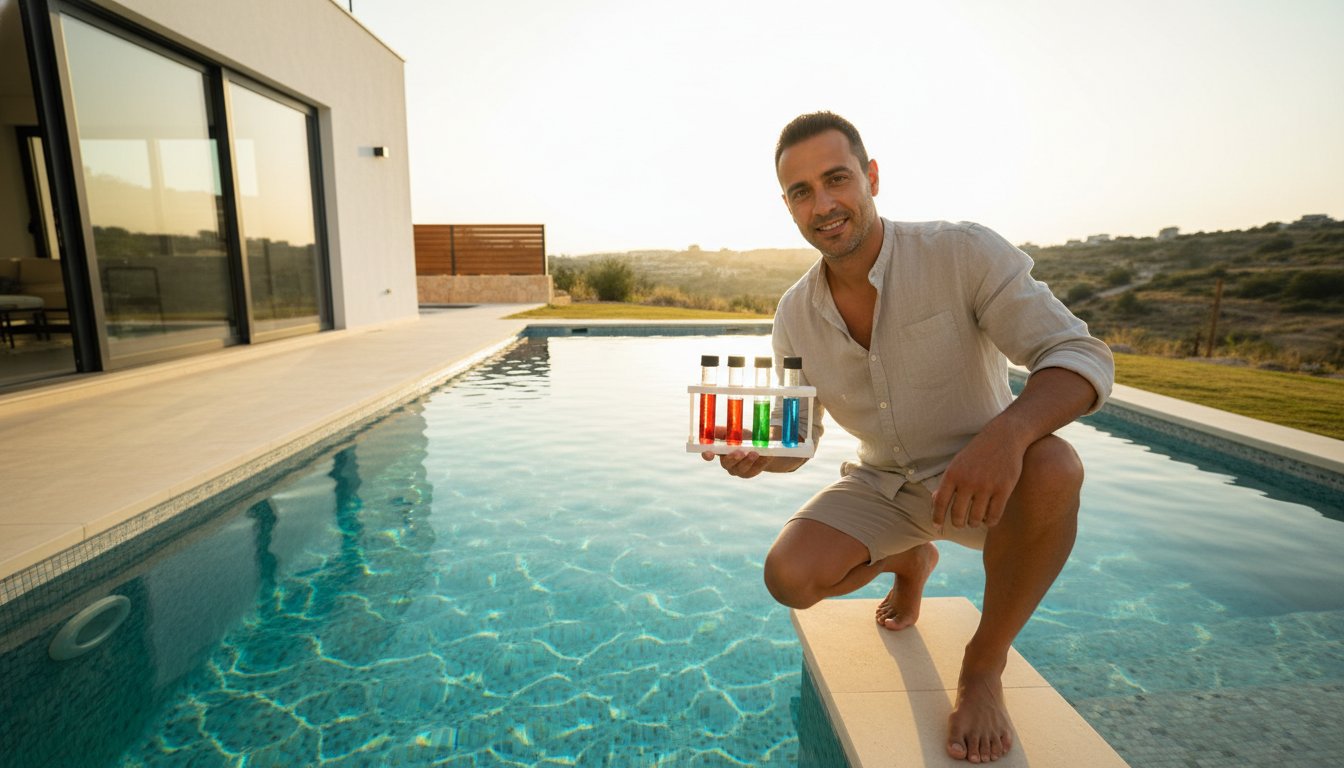
What if the €200 you invested in sanitizers this season is being rendered 80% ineffective by a single hidden factor? In the peak of a Paphos summer, many residents find themselves battling cloudy water and stinging eyes even when their chlorine levels appear correct. It’s a common frustration that stems from the complex chemistry of our local hard water supply. Mastering pool pH balancing Cyprus homeowners need is the only way to stop aggressive white scale from etching your tiles and prematurely aging your expensive filtration equipment.
We understand that you want your swimming area to be a sanctuary, not a source of constant maintenance stress. By following the professional protocols we’ve developed as industry educators, you’ll learn how to maintain perfect equilibrium in your water despite the 35°C heat. This guide details the precise steps to stabilize your chemistry, reduce your annual chemical spend by up to 25%, and ensure your water remains inviting for your family. We will examine the specific testing methods and professional corrective actions that provide total peace of mind for every homeowner.
Key Takeaways
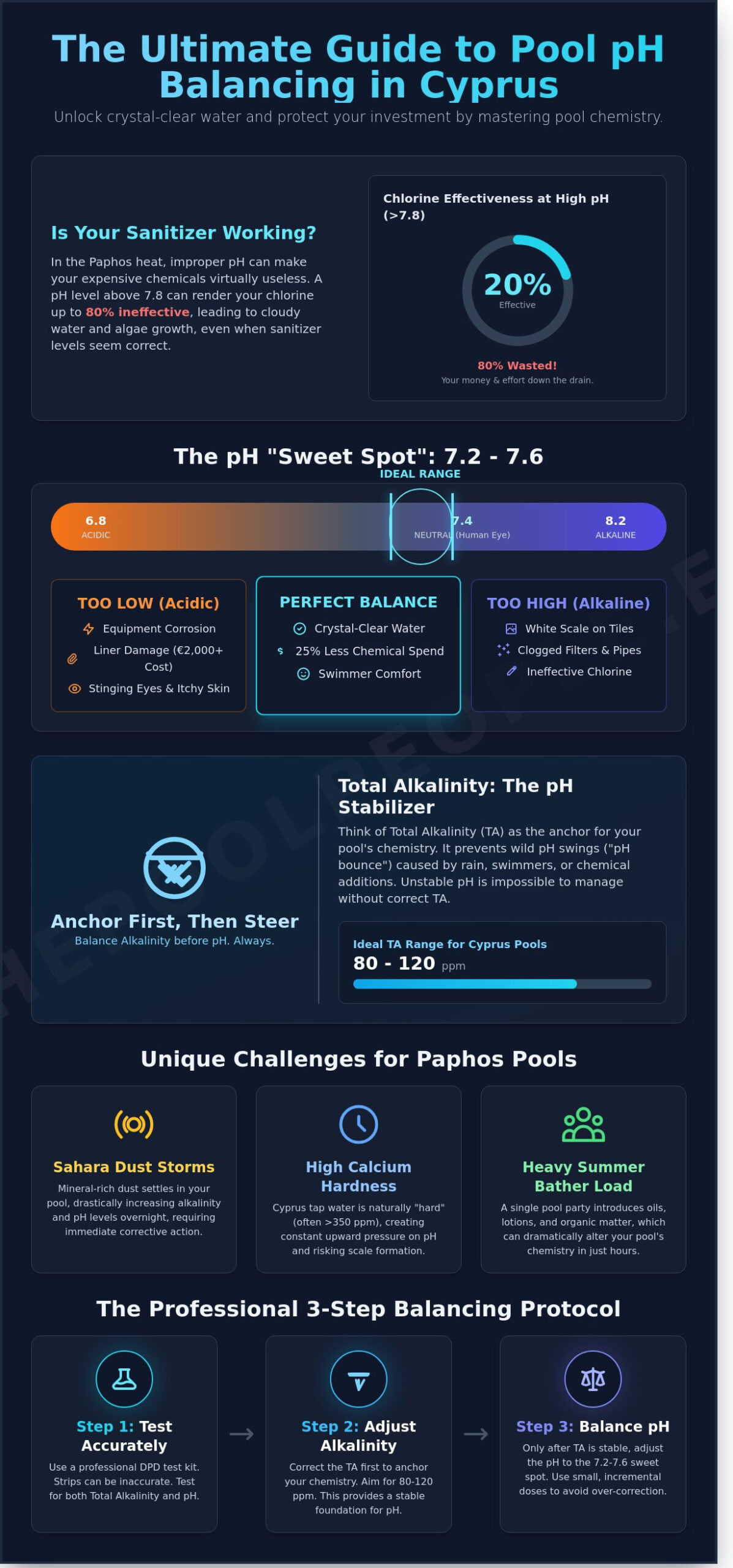
- Understand why maintaining a pH level between 7.2 and 7.6 is the critical “sweet spot” for ensuring crystal-clear water in the unique Paphos climate.
- Learn how to balance Total Alkalinity first to act as a stable anchor, preventing the erratic pH swings that can damage your pool’s infrastructure.
- Master the precise steps for effective pool pH balancing Cyprus experts recommend, including the use of professional DPD test kits and accurate villa pool volume calculations.
- Identify and avoid common maintenance pitfalls, such as the chemical “over-correction” trap and the specific impact of salt chlorinators on rising pH levels.
- Discover how professional water analysis and monthly maintenance contracts can provide total peace of mind and long-term protection for your pool investment.
What is Pool pH Balancing and Why is it Critical in Cyprus?
At its core, pH stands for “potential hydrogen,” and it measures the concentration of hydrogen ions in your Paphos pool water. The scale runs from 0 to 14, where 7.0 is perfectly neutral. For a healthy swimming environment, the “sweet spot” sits strictly between 7.2 and 7.6. Maintaining this narrow window is the cornerstone of the fundamentals of pool sanitation. When air temperatures in Paphos exceed 35°C during the peak of July, water evaporates at an accelerated rate. This process concentrates dissolved solids and triggers significant pH drift, making pool pH balancing Cyprus a vital daily consideration for any property owner. Our “Peace of Mind” philosophy is built on the belief that you should enjoy the lifestyle of a pool owner while we manage the complex technicalities of water chemistry.
The Science of Comfortable Water
The human eye has a natural pH of approximately 7.4. If your pool water deviates significantly from this number, swimmers will experience stinging eyes and itchy skin, regardless of the chlorine levels. It’s a common misconception that “too much chlorine” causes irritation; usually, it’s a pH imbalance. When pH levels climb above 7.8, your chlorine becomes “locked” and loses roughly 60% of its sanitizing effectiveness. In Peyia homes, we frequently encounter the physical consequences of poor balancing. Water with low pH becomes acidic, which aggressively corrodes copper heat exchangers and thins vinyl liners. Replacing a damaged liner can cost upwards of €2,000, a heavy price for a problem that’s entirely preventable through professional monitoring.
Local Factors Affecting Paphos Pools
The Mediterranean climate introduces specific variables that demand expert attention. We don’t just look at the water; we look at the environment surrounding it. Several factors unique to pool pH balancing Cyprus include:
- Sahara Dust Storms: These seasonal events deposit mineral-rich dust that acts as a buffer, often causing alkalinity to spike and dragging pH levels up with it.
- High Calcium Hardness: Cyprus tap water is notoriously “hard,” with calcium levels often testing above 350 ppm. This creates a constant upward pressure on your pH levels.
- Summer Bather Loads: A single afternoon pool party with 8 to 10 guests introduces enough organic matter to shift the chemistry of a 50-cubic-meter pool in under four hours.
Managing these local challenges requires a disciplined, methodical approach. We provide the technical precision needed to ensure your water remains crystal clear and safe, regardless of the heat or the guest list. Our team treats every pool as a long-term investment that requires constant, expert guardianship.
The Relationship Between pH and Total Alkalinity
Think of Total Alkalinity (TA) as the anchor for your pool’s chemistry. While pH measures how acidic or basic the water is, TA acts as a buffer that prevents the pH from swinging wildly. For effective pool pH balancing Cyprus owners must understand that TA provides the stability needed for a safe swimming environment. If your TA is incorrect, your pH won’t remain stable, regardless of how many chemicals you add. Total Alkalinity is the water’s ability to neutralize acids.
The industry standard for TA in Cyprus pools is between 80 and 120 parts per million (ppm). When TA falls below 80 ppm, you will likely experience “pH bounce.” This occurs when even minor additions of chemicals or a heavy rainstorm cause the pH to shift dramatically from one extreme to the other. To maintain a healthy pool, you must always balance the TA before you attempt to adjust the pH levels. This sequence is one of the fundamental water chemistry principles that ensures your sanitizers work efficiently and your equipment remains protected.
Managing the ‘Anchor’ in Hard Water
In regions like Paphos, the local water supply is notoriously hard. This geological reality often results in high TA levels, which makes the pH “stubborn” and difficult to lower. To bring these levels down safely, we recommend using Muriatic acid or dry acid (sodium bisulfate). Handling these chemicals requires precision. Adding too much at once can crash your pH and damage your pool’s surface. At The Pool People, we find that a controlled, incremental approach provides the most reliable long-term results for our clients.
Identifying Alkalinity Issues
Recognizing the physical signs of an imbalance can save you from costly repairs. High alkalinity often presents as cloudy water or white, crusty scale deposits forming along the tile line. Conversely, low alkalinity is more insidious. It leads to rapid pH fluctuations and can cause metal components, such as ladder rails or heat exchanger parts, to corrode. While retail test strips provide a quick snapshot, they often lack the accuracy required for the Mediterranean climate. Professional liquid reagents or digital photometers offer the technical precision needed to protect your investment and ensure your family’s safety.
Step-by-Step: How to Balance Your Pool pH in Paphos
Achieving perfect water chemistry requires a methodical approach that mirrors the precision we use in our professional training programs. In the high heat of a Paphos summer, evaporation rates can reach 1cm per day. This process concentrates minerals and quickly destabilizes your water. Follow these five professional steps to master pool pH balancing Cyprus requirements and ensure your swim zone remains safe.
- Step 1: Measure with Precision. Use a professional-grade DPD test kit. While test strips are convenient, they often lack the accuracy required for the hard water common in the Paphos region. DPD tablets provide a clear, color-coded result that identifies your exact starting point.
- Step 2: Calculate Your Volume. You must know your pool’s capacity in cubic meters (m³). A typical 8m x 4m villa pool in Paphos usually holds between 48m³ and 55m³. Dosing chemicals based on guesswork is the leading cause of “chemical yo-yoing,” where levels swing wildly from one extreme to the other.
- Step 3: Stabilize Total Alkalinity First. Think of Alkalinity as the anchor for your pH. If your Alkalinity isn’t between 80 and 120 ppm, your pH will fluctuate. Use sodium bicarbonate to raise it or dry acid to lower it before you touch the pH levels.
- Step 4: Adjust pH in Stages. Add pH Increaser (Soda Ash) or pH Decreaser (Dry Acid) based on your test results. It’s vital to add chemicals in small doses. Never add more than 500g of product per 50m³ of water in a single application to avoid clouding the water.
- Step 5: Circulate and Re-test. Run your filtration pump for at least 4 to 6 hours. This timeframe is essential for the chemicals to move through the entire body of water. Only after this period should you take a second reading to confirm the adjustment was successful.
Testing Like a Pro
Reliable results depend on how you collect your sample. Always take your water sample from elbow-depth, which is approximately 30cm below the surface. Ensure you collect the water far away from return jets or chemical dispensers to avoid skewed data. During the process, pay close attention to the difference between Free Chlorine and Total Chlorine. If the gap between these two numbers is greater than 0.5 ppm, your pool is struggling with combined chloramines and requires professional attention. For a definitive analysis of your water health, you can book our pool cleaning services for a technician-led audit.
Safe Chemical Handling in the Cyprus Heat
Safety and “peace of mind” are at the core of everything we do. Always remember the “Acid to Water” rule: fill a plastic bucket with pool water first, then add your chemical to the water. Never do the reverse, as adding water to concentrated acid can cause a violent, heat-generating reaction. Given that Paphos temperatures frequently exceed 35°C, store all containers in a cool, dry, and shaded area. Direct sunlight causes chemicals like liquid chlorine to lose potency by 50 percent in just a few weeks. When you’re ready to dose, broadcast the pre-dissolved mixture evenly around the perimeter of the deep end to ensure the best possible distribution.
Common pH Balancing Mistakes to Avoid in Peyia
Maintaining a swimming pool in Peyia requires more than just a passing interest in chemistry. Many homeowners fall into the over-correction trap. They test the water, see a high reading, and dump in a massive dose of dry acid. This creates a “yo-yo” effect that makes pool pH balancing Cyprus residents struggle with unnecessarily difficult. You should wait at least 4 to 6 hours between chemical additions to allow for full circulation and accurate re-testing.
Using uncertified chemicals from local supermarkets is another frequent error. These products often contain fillers or lower concentrations of active ingredients. While a 5kg bucket might look like a bargain at €15, you’ll end up using twice as much to achieve the same result as a professional-grade product certified by PHTA standards. Don’t forget the weather; during Paphos storms between November and March, rainwater with a pH as low as 5.0 can rapidly pull your pool’s levels down. If you don’t adjust your chemistry within a 24-hour window after a heavy downpour, you risk aggressive water conditions that damage your liner.
The Salt Water pH Myth
Many Peyia residents believe salt pools are “set and forget” systems. This is a dangerous misconception. The process of electrolysis creates sodium hydroxide, which has a very high pH of approximately 13.0. This causes your pool water to drift upward constantly. You must monitor your acid levels weekly to counteract this natural rise and keep the water comfortable for swimmers.
Protecting Your Pool Hardware
Poor chemistry is the silent killer of pool equipment. When pH exceeds the 7.8 threshold, calcium carbonate precipitates out of the water. It forms hard scales inside your filter and heat exchanger. This reduces your system’s efficiency by up to 25% within just one summer season. Low pH is even more destructive, acting as an acid bath for your pool hardware.
- Heater Failure: A copper heat exchanger can fail in under 24 months if pH levels stay below 7.0.
- Seal Damage: Acidic water eats away at rubber seals in your pump, leading to expensive leaks.
- Financial Impact: Investing in preventative chemistry costs roughly €120 per year, whereas a new heater replacement starts at €1,500.
Ensure your water stays crystal clear and your equipment remains protected by booking a professional water analysis with our expert team today.
Professional Support for Your Paphos Pool
Achieving the perfect chemical equilibrium isn’t always straightforward. While basic testing handles routine days, complex issues like sudden cloudiness or stubborn scale buildup often require advanced diagnostics. You should contact The Pool People for a professional water analysis if your levels remain unstable despite regular dosing. Our technicians utilize high-precision digital photometers to measure 10 distinct chemical parameters, providing a level of accuracy that manual test strips cannot achieve.
We hold the distinction of being the only PHTA Certified Pool Operators (CPO) in the region who actively train the rest of the industry. This elite status means we understand the molecular science behind pool pH balancing Cyprus, ensuring your water remains safe for your family while protecting your expensive hardware. We don’t just guess; we calculate the exact Langelier Saturation Index (LSI) to prevent corrosive water from damaging your pool’s liner or heating system. This technical precision is why we’re recognized as the definitive experts in the Paphos district.
The Peace of Mind Maintenance Program
Our weekly maintenance service is designed for property owners who prioritize safety but want to eliminate the labor. These visits involve a comprehensive 25-point inspection checklist. We manage over 450 communal pools across Paphos, ensuring every facility meets the strict health and safety regulations required by Cyprus law. This professional oversight protects residents and committee members from liability while guaranteeing a pristine environment. For those looking to turn pool care into a career, you can Explore our CPO Training courses to learn the international standards we implement daily.
Visit Our Peyia Shop
For homeowners who prefer a hands-on approach, our flagship store on Akamantos Avenue in Peyia serves as a local hub for expert advice. We stock professional-grade chemicals with higher active concentrations than standard supermarket brands, which means you need smaller doses to achieve the same pool pH balancing Cyprus results. Our inventory also includes the latest Maytronics robotic cleaners, which can reduce the workload on your filtration system by 30 percent. Stop by for a consultation with our staff to ensure your maintenance routine is both efficient and effective. Contact The Professionals today for a crystal-clear pool.
Secure Your Peace of Mind with Professional Water Chemistry
Mastering pool pH balancing Cyprus requires more than just basic testing kits; it demands a precise understanding of how total alkalinity stabilizes your water’s acidity against the intense Mediterranean sun. Since 2005, we’ve helped homeowners in Peyia and across Paphos avoid the common pitfalls of chemical mismanagement that lead to equipment corrosion and skin irritation. Maintaining this delicate equilibrium ensures your swimming environment remains healthy, safe, and crystal clear year-round.
As the official CPO training provider in Cyprus, our PHTA and NSPF certified pool operators bring elite technical standards to your backyard. We don’t just manage chemicals; we provide a comprehensive solution that protects your long-term investment. You can trust our team to deliver the professional excellence required for a truly stress-free lifestyle. Our 19 years of local experience means we understand the specific challenges of the Paphos climate better than anyone else in the industry.
Get a Free Quote for Professional Pool Maintenance in Paphos
Take the guesswork out of your maintenance and enjoy the pristine, inviting water your family deserves.
Frequently Asked Questions
How often should I test my pool pH in Cyprus?
You should test your pool pH at least 2 to 3 times per week during the peak summer months from June to September. The intense Mediterranean sun and increased bather loads during these 4 months cause rapid chemical fluctuations. Regular testing provides the peace of mind that your water remains safe and your equipment is protected from corrosion.
Why does my pool pH keep rising every week?
High evaporation rates and the naturally high alkalinity of Cyprus tap water are the primary reasons your pH levels climb. As water evaporates in the 35°C heat, minerals become more concentrated, while aeration from salt chlorinators or water features also drives levels up. Consistent pool pH balancing Cyprus is essential to counteract these local environmental factors and maintain crystal clear water.
Can I swim immediately after adding pH decreaser?
You must wait at least 30 to 60 minutes after adding pH decreaser before anyone enters the water. This window allows the filtration system to circulate the chemicals thoroughly, preventing localized areas of high acidity that can irritate skin or eyes. Our professional team recommends re-testing the water after one full turnover cycle to ensure the pH has settled between 7.2 and 7.6.
What happens if I leave my pool pH too high?
A pH level exceeding 7.8 makes your chlorine 50% less effective, which significantly increases the risk of algae growth. High pH also leads to calcium scaling on tiles and can cause permanent damage to your pool’s internal components and heating systems. Keeping your levels balanced is a fundamental part of protecting your long term investment and ensuring a healthy swimming environment.
Does the Cyprus heat affect my pool’s alkalinity?
Yes, the Cyprus heat causes water to evaporate at a rate of up to 10cm per week in July, which leaves behind concentrated alkaline minerals. This concentration increases the total alkalinity, creating a “buffer” that makes it much harder to adjust your pH levels correctly. Monitoring alkalinity is a technical necessity for any pool owner who wants to achieve professional-grade water chemistry.
Is it better to use liquid acid or dry acid in Paphos?
Liquid hydrochloric acid is the preferred choice for many pool owners in Paphos because it acts instantly and is more cost-effective for large volumes. While dry acid is easier to store, liquid acid provides the technical precision required for effective pool pH balancing Cyprus during the hottest months. Our PHTA-certified experts often favor liquid solutions for their reliability in high-demand environments.
What is the best time of day to add chemicals to my pool?
The best time to add chemicals to your pool is at dusk or during the early evening after the sun has set. Adding treatments at 8:00 PM prevents the harsh Cyprus UV rays from degrading the active ingredients before they’ve had a chance to work. This simple timing shift can improve chemical efficiency by up to 20%, saving you money on seasonal maintenance costs.
How do I calculate the volume of my pool for chemical dosing?
Multiply the length by the width by the average depth, then multiply by 1,000 to find the total volume in liters. For example, a standard 8m x 4m pool with an average depth of 1.5m contains 48,000 liters of water. Knowing this exact figure is vital for accurate dosing, as it prevents the common mistake of over-treating the water, which can lead to chemical waste and skin irritation.


Leave A Comment