
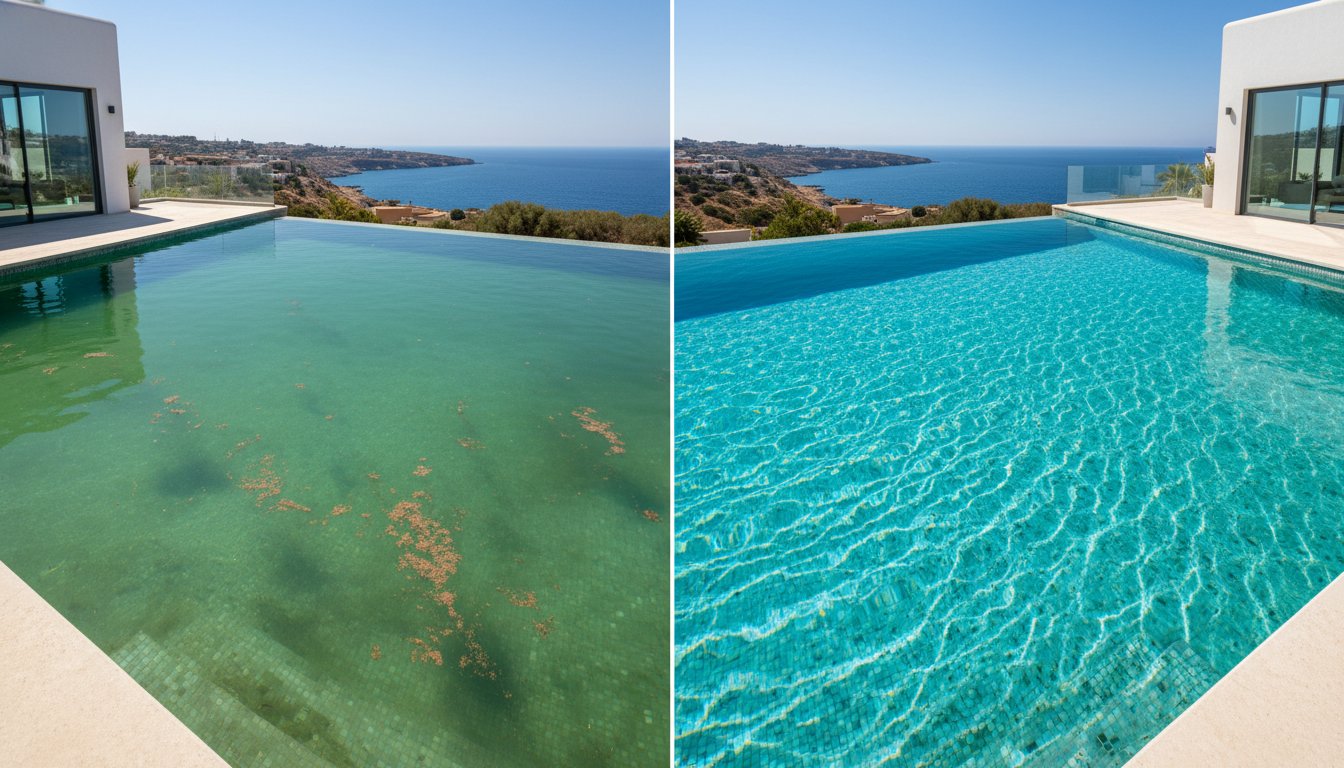
Adding more chlorine to a murky pool is often the fastest way to ensure it stays green. If you’ve been dumping chemicals into your water only to see that stubborn emerald hue remain, you aren’t alone. Many villa owners in Cyprus struggle with chlorine lock, a common issue where high levels of stabilizer actually prevent your sanitizer from working. Learning how to fix a green pool fast in Paphos requires more than just guesswork; it demands a strategy tailored to our unique Mediterranean climate, especially after the heavy Saharan dust storms of early 2026. It’s incredibly frustrating to look at a dirty pool when you’ve invested so much in your property, and the fear of wasting money on ineffective treatments is a stress you simply don’t need.
We’re here to replace that confusion with professional clarity and technical precision. This guide provides the industry certified protocol used by CPO experts to transform your water into a crystal clear oasis in under 24 hours. You’ll learn why the 2026 shift toward precise water chemistry, focusing on the critical ratio between Cyanuric Acid and chlorine, is the secret to rapid recovery. We’ll walk you through the essential steps of chemical balancing and filtration optimization that bypass the need for a costly drain and refill, ensuring your pool remains a safe, beautiful environment for your family.
Key Takeaways
- Learn why the Paphos climate and seasonal Saharan dust make pools uniquely vulnerable to rapid algae blooms during the peak summer months.
- Discover the industry-certified protocol on how to fix a green pool fast in Paphos by following a strict order of operations for chemical and physical recovery.
- Identify how to break “chlorine lock” by balancing Cyanuric Acid levels, ensuring your sanitizer isn’t rendered useless by the intense Cyprus sun.
- Understand the role of high-speed filtration and why modern glass media outperforms traditional sand in clearing dead algae from your water.
- Transition from reactive emergency treatments to a proactive professional maintenance schedule that ensures long-term water safety and clarity.
Understanding the Paphos ‘Green Swamp’ Phenomenon
Seeing your pool transform into a “green swamp” is a stressful experience for any property owner. Essentially, green water represents a rapid algae infestation. It occurs when your sanitizer levels drop low enough for spores to colonize the water, triggered by a perfect storm of heat and chemical imbalance. While it looks like an environmental disaster, it is actually a technical failure of swimming pool sanitation methods. We want to reassure you that this is a logical problem with a professional, step-by-step solution. You haven’t failed as a pool owner; you’re simply battling a very aggressive local climate.
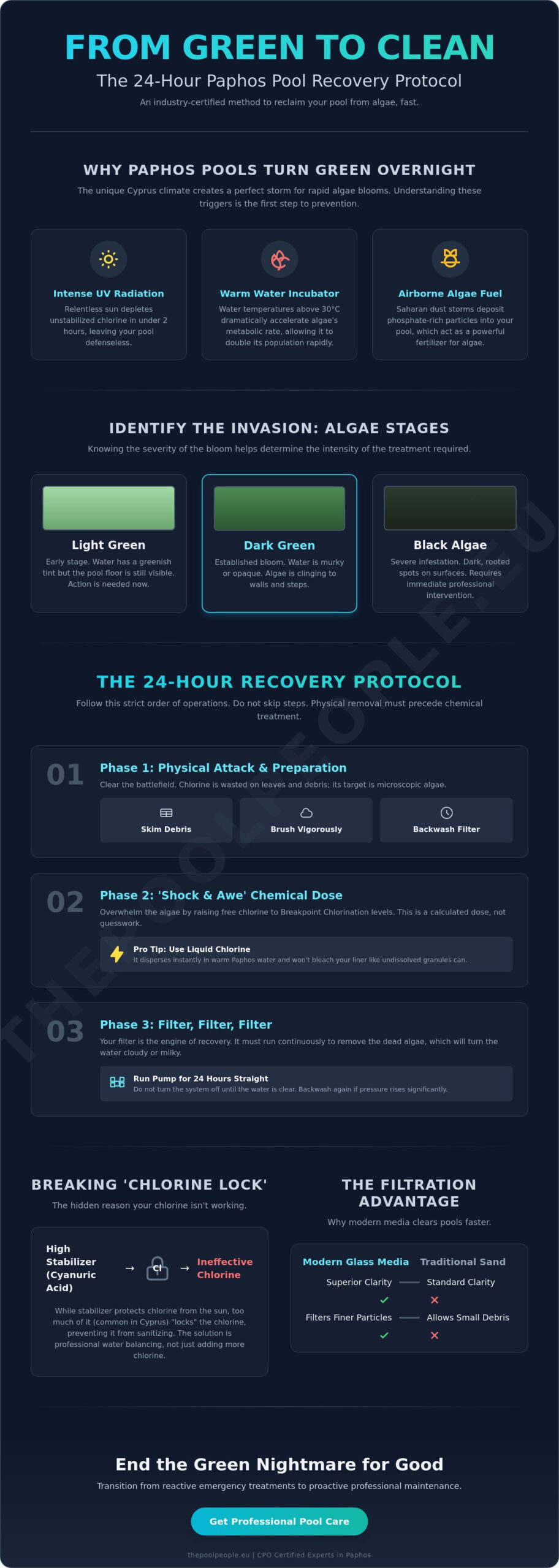
In Paphos, the vulnerability window is widest between June and September. During these months, the environment acts as a biological catalyst. Algae growth typically follows three distinct stages, and identifying yours is key to knowing how to fix a green pool fast in Paphos:
- Light Green: The early stage where visibility is slightly impaired. The floor is still visible, but the water has a distinct tint.
- Dark Green: The established stage. Algae has taken over the water column and is beginning to cling heavily to the walls and steps.
- Black Algae: The severe stage. This involves deep-rooted organisms that appear as dark spots. This requires immediate professional intervention to protect your pool liner.
The Mediterranean Algae Incubator
The Paphos sun is relentless. With UV indices frequently exceeding 10 during the summer months, unstabilized chlorine can be depleted in less than two hours. When water temperatures climb above 30°C, the metabolic rate of algae accelerates significantly. In these peak conditions, algae cells can double their population in a remarkably short window. This is why standard “supermarket” pool chemicals often fail in this climate. They lack the concentration and specific stabilizing agents required to withstand the intense Cyprus heat and high bather loads.
Why Your Pool Turned Green Overnight
It’s a common frustration for villa owners: the water was sparkling yesterday, but it’s a murky swamp today. In Paphos, this “overnight” shift is often caused by seasonal Saharan dust storms. This dust is rich in phosphates, which serve as a powerful fertilizer for algae. If your chlorine levels are already hovering near the lower limit, a single dust event provides the exact nutrients needed for a total bloom. Additionally, local power fluctuations or pump issues can halt circulation. Even six hours of stagnant water in 35°C heat can trigger the shift. Understanding these environmental triggers is the first step in learning how to fix a green pool fast in Paphos and preventing the next occurrence.
The 24-Hour Rapid Recovery Protocol
Speed is the primary goal when your pool water turns, but rushing without a plan often leads to wasted chemicals and lingering cloudiness. To understand how to fix a green pool fast in Paphos, you must treat the recovery like a surgical operation. It requires a strict order of operations where physical removal precedes chemical intervention. If you dump shock into a pool filled with organic debris, the chlorine will spend its energy attacking leaves and twigs rather than the algae spores. By following this certified 24-hour protocol, you ensure every Euro spent on professional pool chemicals delivers maximum impact.
Phase 1: Preparation and Physical Destruction
Your first task is to remove the “food” that fuels the bloom. Use a deep-mesh net to skim every piece of visible debris from the floor and surface. Once the pool is clear of large organics, you must perform aggressive brushing. Algae protects itself with a slimy biofilm that resists chemical penetration. Brushing the walls, steps, and floor breaks this barrier, exposing the individual cells to the coming treatment. Before moving to the next stage, check your filter pressure. A clean, backwashed filter is the engine of this process; it needs to be at its most efficient to handle the massive influx of dead matter.
Phase 2: The ‘Shock and Awe’ Chemical Dose
Successful recovery relies on reaching “Breakpoint Chlorination.” This isn’t a guess; it’s a specific calculation where you add enough chlorine to break apart molecular bonds and eliminate combined chlorines. In the intense Paphos heat, liquid chlorine is superior to granules because it disperses instantly and doesn’t risk bleaching your liner. We recommend performing this treatment at sunset. This provides a critical 12-hour “darkness window” where the sun’s UV rays won’t deplete your shock, allowing the chemicals to work at full strength through the night. This timing is essential for understanding algae bloom causes and stopping them in their tracks before the next day’s heat arrives.
Phase 3: Flocculation and Final Clarity
By morning, your water should shift from green to a cloudy grey or blue. This indicates the algae is dead but still suspended in the water. To achieve that signature crystal-clear finish, use a high-quality flocculant. This chemical acts as a magnet, clumping tiny particles together so they sink to the floor. After 8 to 12 hours of stillness, use the “Vacuum to Waste” setting on your multiport valve. This sends the sediment directly out of the system, preventing the dead algae from clogging your filter media. Once the floor is clear, run the filtration system for another 4 hours and re-test the pH and chlorine levels. This methodical approach is the most reliable way to learn how to fix a green pool fast in Paphos without the need for repeated, expensive treatments.
Breaking the ‘Chlorine Lock’ in Paphos
One of the most confusing scenarios for pool owners is having a “perfect” chlorine reading while the water remains a stubborn shade of emerald. This is the reality of chlorine lock. To understand how to fix a green pool fast in Paphos, you must understand the role of Cyanuric Acid (CYA). While CYA acts as a necessary sunscreen that protects chlorine from the intense Mediterranean UV rays, it becomes a prison when levels get too high. Once CYA exceeds 100ppm, it binds so tightly to the chlorine that the sanitizer can no longer kill algae. You might have plenty of chlorine in the water, but it’s chemically incapable of doing its job.
This leads to what we call the “Paphos Trap.” Many residents rely solely on stabilized chlorine tablets, known as Trichlor, for daily maintenance. While these are convenient, every tablet adds more CYA to the water. Unlike water, CYA does not evaporate; it only concentrates over time. Over a long, hot summer, these levels climb until your chlorine is effectively paralyzed. If your tests show high chlorine but the algae won’t die, you’re likely in a state of lock. The only professional solution for excessive CYA is a partial drainage and refill with fresh water to reset the chemical baseline and allow your sanitizer to work again.
Testing Beyond the Basics
Generic test strips often fail to provide the technical precision required for a 24-hour recovery. They can be wildly inaccurate when assessing CYA or distinguishing between different types of chlorine. For a definitive diagnosis, we utilize professional DPD1 and DPD3 reagents. DPD1 measures free available chlorine, which is the active killer, while DPD3 measures total chlorine. The difference between these two reveals the level of combined chlorines, or chloramines, which indicate how much “spent” chlorine is sitting in your water. For those who want to transition from basic care to expert status, our guide on Mastering Pool Water Chemistry in Paphos offers deeper insight into these advanced metrics.
Managing High Calcium Hardness
The tap water in Paphos is notoriously hard, meaning it contains high levels of dissolved minerals. High calcium hardness doesn’t just cause unsightly white crust around your tiles; it also creates a porous surface where algae can hide and thrive, protected from chemical treatments. When learning how to fix a green pool fast in Paphos, you must also consider the Langelier Saturation Index (LSI). This is a mathematical formula we use to determine if your water is balanced, corrosive, or scale-forming. Keeping your LSI near zero ensures your chemicals work efficiently and prevents scale from becoming a sanctuary for future algae blooms.
Professional Equipment for High-Speed Filtration
Chemicals are responsible for killing the algae, but they don’t make it disappear. Once the “Shock and Awe” phase is complete, your water will likely look like a cloudy, grey soup. This is where your filtration system becomes the engine of recovery. Understanding how to fix a green pool fast in paphos involves optimizing your hardware to ensure dead algae is removed from the water column as quickly as possible. If your filter is undersized or the media is old, you’ll find yourself in a cycle of recurring blooms regardless of how much chlorine you add.
In many Peyia villas, we often see older systems with pumps that lack the power to circulate water effectively in every corner. This creates “dead spots” where algae can hide and multiply, even while the rest of the pool seems clear. Supplementing your main system with a robotic pool cleaner can provide a massive advantage. These units act as a secondary filtration source, scrubbing the walls and capturing fine debris before it can settle and rot on the floor. This physical removal is a vital step in the recovery protocol.
Sand vs. Glass Media: The Speed Difference
Standard silica sand is the traditional choice, but it’s often too porous to capture the fine, microscopic particles of dead algae. Upgrading to high-performance glass media allows your system to clear water approximately 30% faster than sand. Glass media is manufactured from recycled glass and features a smoother surface that resists the “channeling” common in sand filters. It’s particularly effective in the Paphos environment because it doesn’t degrade or clump as quickly under high calcium levels. For a full breakdown of hardware options, see our guide to Essential Pool Equipment in Paphos.
The Role of Variable Speed Pumps
Efficiency in 2026 is driven by variable speed pumps. Unlike traditional single-speed pumps that run at a constant, high-energy rate, these units allow for lower, longer filtration cycles. This steady movement is far more effective at preventing the stagnant conditions algae loves. For Paphos homeowners, the energy savings are substantial, especially given the rising electricity costs in Cyprus. Achieving the correct flow rate is vital for effective chlorination; if the water moves too fast, your salt water chlorinator or chemical feeder may not have enough contact time to sanitize the water properly. If you’re struggling with water clarity, a professional pool pump and filter installation can provide the mechanical reliability you need for a crystal-clear oasis.
Preventing the Next Bloom: Professional Maintenance
Once you’ve mastered how to fix a green pool fast in paphos, the focus must shift from emergency recovery to consistent, proactive prevention. Reactive care is not only stressful; it’s also more expensive over time due to the heavy chemical loads required for shocking. A weekly professional audit serves as a vital early warning system. By monitoring alkalinity and pH levels before they drift, we prevent the environment from ever becoming hospitable to algae spores. In a climate where evaporation reaches up to 5cm per week during July and August, maintaining this chemical baseline requires steady, methodical attention.
The 2026 Paphos climate presents challenges that casual maintenance often misses. With UV indices frequently staying above 10, unstabilized chlorine can be depleted in less than two hours. This leaves your water defenseless during the hottest parts of the day. Professional maintenance isn’t just about cleaning the floor; it’s about the technical management of water health to ensure your pool remains a safe, inviting asset rather than a source of anxiety. Shifting to a disciplined schedule is the only way to guarantee year round clarity.
Salt Water Systems: A Paphos Game-Changer
For many homeowners in Peyia and the wider Paphos region, upgrading to salt water chlorination is the most effective way to break the cycle of green water. These systems use an electrolytic cell to generate pure chlorine directly in the plumbing. Because this chlorine is unstabilized, it doesn’t contribute to the Cyanuric Acid buildup that leads to the “chlorine lock” we discussed earlier. You get consistent, reliable sanitation without the risk of your chemicals becoming paralyzed. Families also appreciate the “softer” feel of the water, which causes far less skin and eye irritation during long summer afternoons.
Communal Pool Compliance in Paphos
Managing a shared facility involves much higher stakes than a private villa. Under Cyprus Law 75(I)/1992, communal pools must be tested at least three times daily to ensure they meet strict health and safety standards. A green pool in a holiday complex isn’t just an eyesore; it’s a significant liability risk and a potential legal violation. Ensuring your maintenance team has completed CPO Training in Cyprus is now a standard requirement for professional facility management. For a deeper understanding of these regulations and how to stay compliant, consult The Ultimate Guide to Pool Maintenance in Paphos. Investing in certified expertise is the best way to protect both your residents and your property’s long term value.
Restoring Your Crystal-Clear Paphos Oasis
Recovering a green pool doesn’t have to be a multi-week ordeal or a financial drain. Success depends on precision. By correcting the balance between Cyanuric Acid and chlorine, you’ll overcome the chemical lock that often stalls DIY efforts. Physical removal remains the engine of clarity. Your filter must work efficiently to remove dead spores once the shock treatment is complete. Whether you choose to upgrade to glass media or install a salt water chlorination system, the goal is always to move from reactive fixing to proactive prevention.
If the technical details of chemical balancing feel overwhelming, we’re here to help. Learning how to fix a green pool fast in paphos is much easier with professional support on your side. With over 20 years of Paphos pool engineering experience, our PHTA/NSPF Certified Pool Operators are specialists in non-drain green pool recovery. We prioritize the safety of your investment and the health of your family, ensuring your water meets elite international standards. You don’t have to settle for a murky pool. With the right protocol and professional guidance, your backyard can return to being the refreshing retreat you deserve.
Get Expert Help: Contact The Pool People for Emergency Green Pool Recovery
Frequently Asked Questions
Is it safe to swim in a pool that is just slightly green?
No, it isn’t safe to swim in any pool showing visible signs of algae. A green tint indicates that your sanitizer levels have failed, allowing bacteria and other pathogens to thrive alongside the algae spores. Even a minor bloom can cause skin irritations, ear infections, or more serious gastrointestinal issues if the water is accidentally swallowed.
How much liquid chlorine do I need to shock a 50m3 pool in Paphos?
For a standard 50m3 pool, you typically require between 10 and 15 liters of high-quality liquid chlorine to reach breakpoint chlorination. The exact amount depends on your current pH and Cyanuric Acid levels. It’s vital to test your water first; under-dosing will only feed the algae rather than killing it, leading to a more stubborn infestation.
Can I fix a green pool without a vacuum?
You cannot effectively clear a green pool without some form of physical removal. While chemicals kill the algae, the dead matter remains in the water and will eventually rot, causing a secondary bloom. If you don’t have a manual vacuum, a high-performance robotic pool cleaner can help, but a manual “vacuum to waste” is the professional standard for heavy recovery.
Why does my pool keep turning green even though the chlorine is high?
This paradox is almost always caused by “chlorine lock” resulting from excessive Cyanuric Acid (CYA). When CYA levels climb above 100ppm, often due to overusing stabilized tablets, the chlorine becomes chemically bound and cannot sanitize the water. You’ll need to perform a partial drain and refill to lower the stabilizer concentration and restore the water’s health.
How long after shocking the pool can I swim?
You should wait until the free chlorine levels have dropped back into the safe range of 1 to 4ppm. This process usually takes 24 to 48 hours after a heavy shock dose. For safety, the water must also be crystal clear; you should be able to see the main drain on the pool floor clearly before anyone enters the water.
Will a green pool clear itself if I just run the filter?
No, a green pool will never clear itself through filtration alone. Algae is a living organism that requires a chemical sanitizer to stop its growth cycle. Running your filter without treating the water first will simply clog your filter media with live algae, reducing your flow rate and making the eventual recovery process much more difficult and expensive.
What is the fastest way to remove dead algae from the bottom of the pool?
The fastest method is using a professional-grade flocculant to drop the dead algae to the floor, followed by vacuuming to waste. This bypasses your filter entirely, sending the debris out of the system so it cannot return to the pool. This specialized technique is a critical component of learning how to fix a green pool fast in Paphos during the peak summer months.
Do I need to change my filter sand after a green pool recovery?
You don’t necessarily need to replace the sand, but you must perform a deep backwash and use a specialized filter degreaser to remove organic residue. If your sand is more than five years old, it’s a perfect time to upgrade to glass media. Glass media captures finer particles and clears the water significantly faster than traditional silica sand in the Cyprus climate.


Leave A Comment