
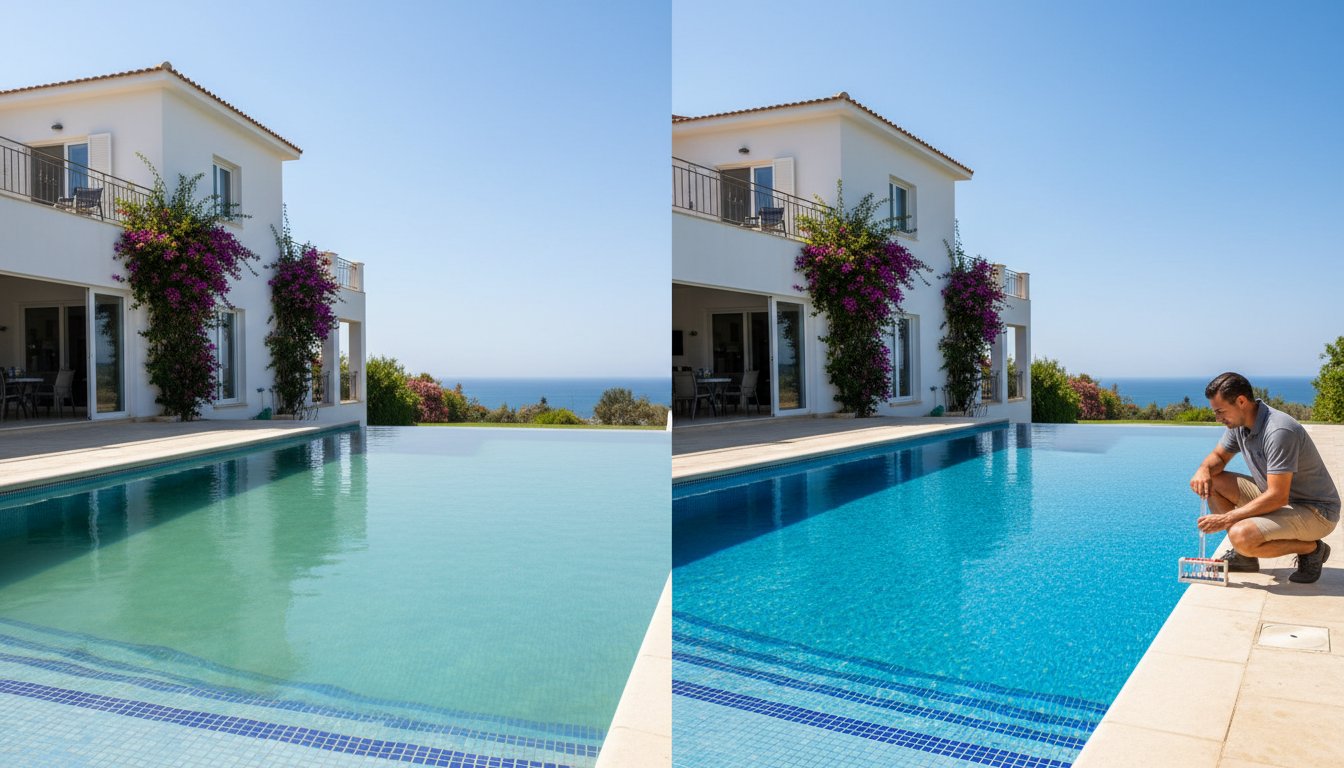
Last Tuesday, a homeowner in Coral Bay watched their pristine Mediterranean view get ruined by a pool that had turned a milky, uninviting white overnight. It’s a frustrating scenario we encounter daily at The Pool People, especially when the Paphos sun pushes temperatures toward 40 degrees. If you’re searching for how to clear a cloudy pool paphos experts know that guessing with expensive chemicals often leads to more confusion and wasted money. You deserve a pool that’s a source of pride, not a source of anxiety regarding health compliance and guest safety.
We believe that pool ownership should be stress-free, and that starts with understanding the technical science behind water clarity. This 2026 rescue guide provides our professional step-by-step protocol to transform your murky water back into a crystal-clear oasis using local expertise. We’ll examine the specific filtration and chemical balancing techniques required for the Cyprus climate to give you total peace of mind.
Key Takeaways
- Identify the unique Mediterranean environmental factors and high bather load challenges that specifically impact water clarity in the Paphos region.
- Master the essential water chemistry reset by balancing the critical relationship between pH and Alkalinity to ensure your sanitizers work at peak efficiency.
- Discover the professional step-by-step protocol on how to clear a cloudy pool paphos homeowners can follow to restore a crystal-clear, inviting oasis.
- Learn how upgrading your filtration media and implementing a disciplined maintenance schedule can prevent future cloudiness and protect your investment.
- Understand when to call in CPO-certified professionals to handle complex structural issues, ensuring long-term safety and total peace of mind.
Identifying the Causes of Cloudy Water in Paphos
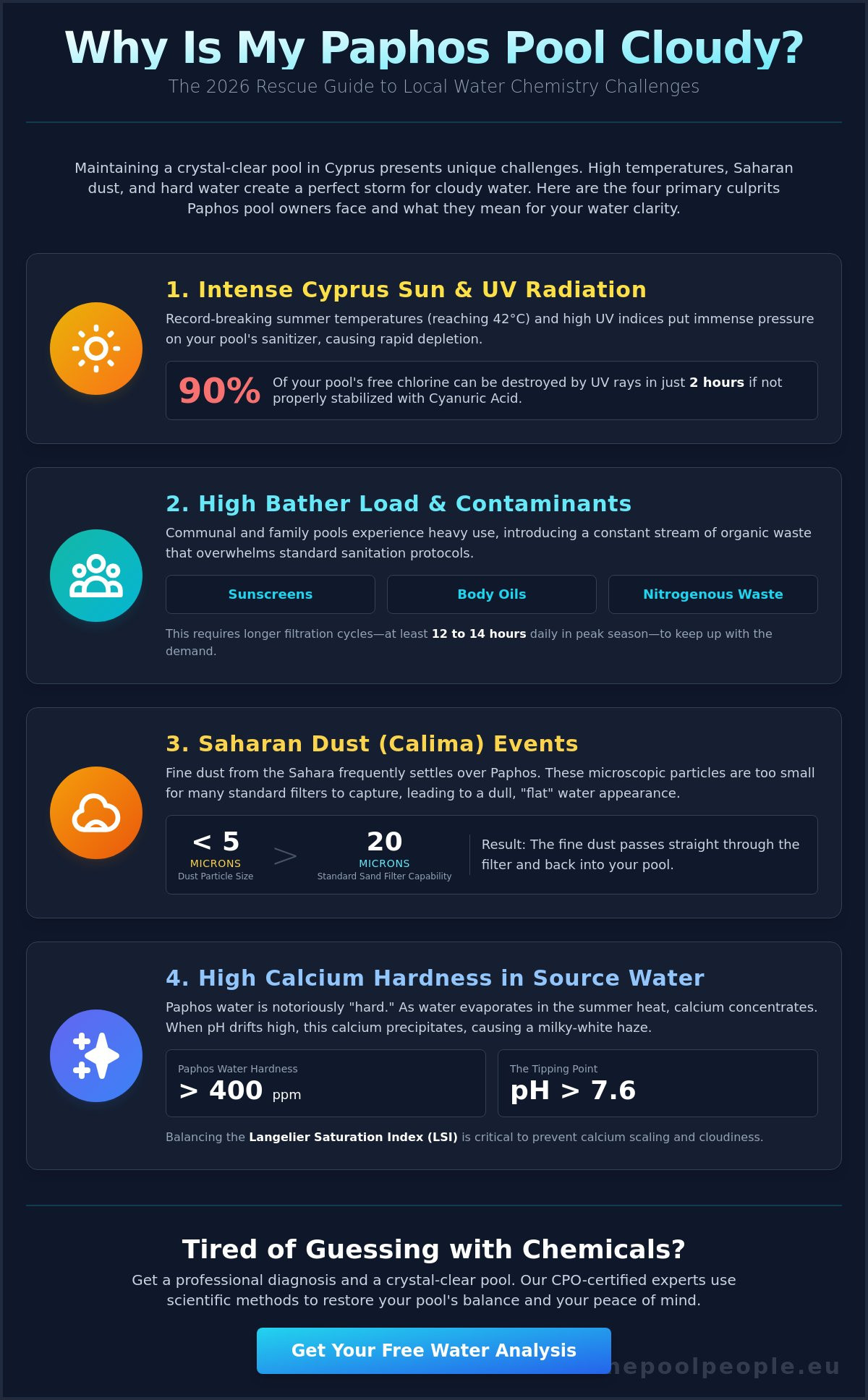
Maintaining a crystal clear pool in the Paphos district requires a deep understanding of the local environment. In 2026, we’re seeing record-breaking summer temperatures consistently reaching 42°C, which puts immense pressure on your water chemistry. Learning how to clear a cloudy pool paphos starts with recognizing that our Mediterranean climate is unique. High UV indices in Cyprus can deplete free chlorine levels by up to 90% in just two hours if the water isn’t properly stabilized with cyanuric acid. This rapid depletion allows organic contaminants to thrive, resulting in that frustrating hazy appearance.
Public and communal complexes in areas like Universal or Chloraka face additional hurdles. High bather loads introduce oils, sunscreens, and nitrogenous waste that quickly overwhelm standard swimming pool sanitation protocols. When twenty or thirty residents use a shared pool daily, the demand for oxidizers skyrockets. If the filtration system isn’t running for at least 12 to 14 hours during the peak season, the water can’t stay ahead of the waste. Many older villas built between 2000 and 2010 still rely on original sand filters. Over fifteen years, the filter media often calcifies, creating channels where water passes through without being cleaned. This mechanical failure is a leading cause of persistent cloudiness that chemicals alone won’t fix.
The Saharan Dust (Calima) Effect
Paphos frequently experiences “Calima” events, where fine dust from the Sahara settles across the island. These particles are often smaller than 5 microns. Standard sand filters typically only capture debris down to 20 microns, meaning the dust passes directly through the media and back into your pool. You’ll notice the water looks dull or “flat” after a storm. Brushing the pool walls is essential because this dust contains minerals that can feed algae or react with your sanitisers. Without a professional-grade flocculant to clump these microscopic particles together, your filter simply won’t be able to clear the haze.
High Calcium Hardness in Cyprus Water
The water supply in Paphos is notoriously hard, with calcium hardness levels often exceeding 400 parts per million (ppm). During the summer, evaporation can remove 10cm of water per week from an 8x4m pool, leaving the minerals behind. This process concentrates the calcium. When your pH rises above 7.6, which happens quickly due to the alkalinity of local water, the calcium precipitates out of the solution. This creates a “milky” look that won’t disappear until you balance the Langelier Saturation Index. It’s a technical challenge that requires precise testing to ensure your pool remains an inviting, stress-free environment for your family.
The Water Chemistry Reset: Balancing Your Cyprus Pool
Achieving a crystal clear pool starts with a precise diagnosis. You shouldn’t guess when it comes to chemical dosages because over-treating often compounds the cloudiness. In Paphos, our source water is frequently “hard,” meaning it contains high levels of calcium carbonate. This makes the initial testing phase critical. We utilize professional-grade photometers to ensure accuracy that basic test strips cannot match. Understanding these chemical interactions is the most reliable way to learn how to clear a cloudy pool paphos residents often struggle with during the peak summer months.
The Langelier Saturation Index (LSI) is the gold standard we use to determine if your water is corrosive, balanced, or scale-forming. By calculating the LSI, we can predict if calcium will precipitate out of the water, which is a leading cause of that milky appearance. Maintaining an LSI score between -0.3 and +0.3 ensures your water remains stable even as temperatures soar past 38°C in July and August. This scientific approach provides the peace of mind that your pool isn’t just clear, but also safe for your family and your equipment.
Mastering pH and Alkalinity
For Paphos pools, the target pH range is 7.2 to 7.4 for maximum chlorine efficiency, while Total Alkalinity should sit between 80 and 120 ppm. If your Alkalinity is too high, your pH will “lock” at a high level, rendering your chlorine up to 80% less effective. To lower Alkalinity without crashing your pH, add dry acid to the deep end with the pump turned off. This creates a localized environment to break down bicarbonates effectively. The intense Cyprus heat often causes pH to drift upward, so weekly monitoring is a non-negotiable part of professional maintenance.
Total Dissolved Solids (TDS) and Cyanuric Acid
Total Dissolved Solids (TDS) represent the sum of all organic and inorganic materials dissolved in the water, and the 2026 recommended limit for Paphos pools is 1,500 ppm above your starting tap water level. Once TDS or Cyanuric Acid (stabiliser) levels climb too high, you’ll experience Chlorine Lock. This means your test kit might show plenty of chlorine, but it’s chemically bound and unable to kill algae or clear debris. If your stabiliser exceeds 100 ppm, no amount of chemical intervention will work. A partial drain and refill is the only professional solution to restore clarity. If you’re unsure of your current levels, a professional water analysis can provide the data you need to move forward with confidence.
Step-by-Step Guide to Clearing Cloudy Pool Water
Restoring clarity to your water requires a methodical approach that combines mechanical action with precise chemical science. When you are learning how to clear a cloudy pool paphos homeowners often find that the intense Mediterranean sun and local dust levels demand more than a simple filter cycle. The process begins with the filtration system. If your sand filter’s pressure gauge shows a reading of 0.5 bar or higher above its normal “clean” baseline, perform a thorough backwash and rinse cycle immediately. For systems struggling with persistent turbidity, we recommend a professional chemical filter clean once per season to dissolve the calcium deposits and body oils that standard backwashing cannot reach.
Mechanical removal is your next priority. Use a stiff pool brush to scrub the walls and floor, focusing on corners where circulation might be sluggish. This action suspends settled particles, allowing your chemicals to work more effectively. If you can see a thick layer of silt or Saharan dust on the floor, set your multiport valve to “Waste” and vacuum the debris directly out of the pool. This prevents the filter from becoming instantly clogged and bypassing the very particles you are trying to remove.
Clarifiers vs. Flocculants: Which Fix Do You Need?
Choosing the right additive depends on the severity of the cloudiness. A clarifier is a coagulant used for mild dullness; it gathers microscopic particles into slightly larger clumps that your filter can eventually trap. It’s a “business as usual” solution that allows you to keep swimming. In contrast, a flocculant is the “heavy rescue” option for severe contamination. It acts quickly to bind all suspended matter, causing it to sink to the floor in a thick cloud. You must then vacuum this sediment to waste. Be aware that flocculants are generally incompatible with cartridge filters; using them can permanently clog the polyester fibers, necessitating an expensive replacement of the filter element.
The 24-Hour Recovery Protocol
To achieve a professional-grade result, follow this disciplined three-step sequence:
- Step 1: Balance pH to 7.2. High pH is a common cause of cloudiness in Cyprus. Chlorine is approximately 50% less effective when pH rises above 8.0. Dropping the level to 7.2 ensures your shock treatment works at peak efficiency.
- Step 2: Oxidize organic contaminants. Add a high-quality chlorine shock to break down combined chloramines and organic matter. This provides the “snap” needed to return the water to a sparkling state.
- Step 3: Continuous circulation. Run your filtration pump for a full 24-hour cycle. Monitor the pressure gauge every 4 to 6 hours. If the pressure spikes, backwash again to remove the trapped debris and maintain optimal flow rates.
This structured approach provides the peace of mind that comes from knowing the underlying cause of the cloudiness is being treated, not just masked. Following these steps is the most reliable way how to clear a cloudy pool paphos
Preventing Future Cloudiness: Filtration and Dust Management
Clearing the water is only half the battle. To master how to clear a cloudy pool paphos homeowners must shift their focus toward long-term prevention. The Paphos climate, specifically the intense UV levels and Saharan dust influxes, puts extreme stress on standard filtration systems. Relying on basic sand filters often leads to a cycle of cloudiness that wastes both time and expensive chemicals. Maintaining a crystal-clear environment requires a proactive approach to equipment and scheduling.
- Upgrade to Glass Media: Replace old silica sand with activated glass for 30% better turbidity removal.
- Rigid Maintenance: Test your water twice weekly during the peak July and August heat.
- Evaporation Control: Use a thermal cover to stop chemicals from gassing off in the midday sun.
- Monitor Clarity: If you can’t see the screw heads on the main drain clearly, your filtration is falling behind.
Optimising Your Filtration System
Traditional silica sand captures particles down to about 20 microns. In contrast, high-quality recycled glass media filters down to 5 microns, making it far superior for trapping the fine airborne silt common in the Paphos district. If your water remains hazy despite perfect chemistry, your pump might be underpowered. A pump should circulate the entire pool volume at least twice every 24 hours to ensure no dead spots remain. Investing in professional-grade pool equipment Paphos ensures your system has the hydraulic efficiency to handle high bather loads and heatwaves without failing.
Proactive Dust Storm Preparation
When a Calima or dust event is forecast, don’t wait for the sky to turn orange. Boost your chlorine levels by 2 parts per million (ppm) and ensure your pool cover is securely fastened. Once the storm passes, perform an immediate backwash and “First Aid” shock treatment to neutralise organic contaminants before they bloom into algae. For 2026, the industry standard for filter run-times in Paphos is a minimum of 12 hours per day during the peak season from June to September. This consistent circulation prevents the stagnation that allows fine dust to settle and bond with the pool surface.
Watch for “the dullness” as an early warning sign. If the water loses its sparkle or the pool walls feel slightly slimy to the touch, your sanitiser is losing the war. Evaporation also concentrates minerals and salts, which can lead to scale-induced cloudiness. To combat this, use a 400-micron thermal cover to reduce evaporation by up to 95%. This keeps your chemical balance stable and prevents the need for constant, cold-water top-ups that disrupt your pH levels and increase your long-term costs.
When to Call the Paphos Pool Professionals
While DIY methods solve many common clarity issues, some cloudiness stems from deep-seated mechanical failures or structural degradation. If you’ve followed the standard recovery steps and visibility hasn’t improved within 48 hours, you’re likely facing a complex filtration or hydraulic problem. Professional intervention becomes essential when you suspect a leak or notice fine cracks in the pool shell. These issues require specialized pressure testing and thermal imaging that standard home kits simply can’t provide. Our team at The Pool People specializes in these high-stakes rescues, ensuring your investment remains protected through every season.
For those managing apartment complexes or holiday resorts, the stakes are significantly higher. This is where CPO training Cyprus becomes a critical asset. Certified Pool Operators understand the nuances of high-load bather demand and the stringent health regulations enforced by Cypriot authorities. We provide this elite training to ensure communal managers move beyond guesswork. By employing a professional with PHTA certification, you ensure that your facility meets the 2026 safety standards required for public and communal use in Paphos.
The Risks of “Cowboy” Cleaners
Hiring uncertified individuals often leads to “chemical soup” scenarios where the water looks clear but is actually corrosive or unsafe. These uncertified cleaners frequently over-stabilize water with excessive cyanuric acid, which eventually locks the chlorine and forces a total drain and refill. In Cyprus, communal pool regulations are strict; failing to meet these standards can lead to legal liability for a management committee. Investing in professional pool maintenance Paphos ensures total compliance. It prevents the long-term cost of replacing pumps or liners damaged by poor chemical balancing, saving you thousands of Euro over the life of the pool.
Requesting a Technical Audit
When you’re struggling with how to clear a cloudy pool paphos, a technical audit provides the definitive roadmap to recovery. Our experts perform a 15-point water quality inspection, checking everything from LSI (Langelier Saturation Index) balance to filter media efficiency. We don’t just dump chemicals. We create a customized dosing plan based on your pool’s specific volume and bather load. This methodical approach is why we’re the trusted partner for hundreds of property owners across the region.
Contact The Pool People today for a comprehensive site survey. We’ll restore your water to its crystal-clear potential and provide the “peace of mind” that only the island’s leading experts can deliver.
Reclaim Your Crystal Clear View
Restoring your swimming environment starts with mastering the specific challenges of the Cyprus climate. You’ve learned that consistent chemical balancing and advanced filtration are your best defenses against Saharan dust and hard water minerals. While the steps to resolve turbidity are logical, the precision required for long term water health is where professional expertise becomes invaluable. Our team brings over 20 years of local experience and PHTA/NSPF Certified Pool Operator status to every project, ensuring your water remains safe and inviting.
Understanding how to clear a cloudy pool paphos residents can be proud of doesn’t have to be a source of stress. By focusing on high quality filtration management and maintaining a balanced pH, you protect both your equipment and your family’s safety. When the local elements become overwhelming, trusting the experts provides the peace of mind you deserve. We specialize in Saharan dust recovery and complex hard water management to keep your investment in peak condition.
Restore your pool to perfection with the Paphos experts; contact us today
It’s time to stop worrying about water quality and start enjoying the refreshing, crystal clear lifestyle you’ve worked hard to create.
Frequently Asked Questions
Is it safe to swim in a cloudy pool in Paphos?
It’s not safe to swim in a cloudy pool because it indicates a lack of sanitizer or a failure in the filtration system. Low visibility poses a significant drowning risk, and the water likely contains pathogens like E. coli or Pseudomonas. According to PHTA standards, pool water should maintain a turbidity level below 0.5 NTU. If you can’t see the bottom drain clearly, stay out of the water to protect your health.
How long does it take to clear a cloudy pool after a dust storm?
Clearing a pool after a Saharan dust storm usually takes 24 to 48 hours with continuous filtration. These weather events often deposit up to 20 grams of fine particulate matter per square meter in Paphos. You’ll need to run your pump for a full 24-hour cycle and use a professional clarifier to bind microscopic particles together. This ensures your filter can effectively trap the debris and restore the water’s clarity.
Why is my pool still cloudy after I shocked it?
Your pool remains cloudy because the shock treatment killed the algae, but the dead organic matter is still suspended in the water. High Total Dissolved Solids (TDS) levels, often exceeding 1,500 ppm above your starting tap water, can also prevent the water from clearing. If your calcium hardness is above 400 ppm, the shock might have caused a precipitation of calcium carbonate. Check your filter’s efficiency to resolve this issue quickly.
Can I use a flocculant with a sand filter in Cyprus?
You can use a flocculant with a sand filter, provided you have a multiport valve with a “waste” setting. Flocculants clump particles together and sink them to the floor, so they must be vacuumed out of the pool entirely. Since 95% of Paphos residential pools utilize sand filters, this is a common practice. Never let flocculant enter the filter media itself, as it can gum up the sand and require a full replacement.
How much chlorine should I add to clear a cloudy pool?
To learn how to clear a cloudy pool paphos experts recommend reaching “breakpoint chlorination,” which is 10 times the level of combined chlorine. For most Paphos pools, this means raising free chlorine levels to between 10 ppm and 20 ppm. Always check your Cyanuric Acid (CYA) levels first. If CYA is above 100 ppm, the chlorine becomes ineffective, and you’ll need to drain a portion of the water to reset the chemistry.
Does high pH cause cloudy water in Paphos?
High pH is a primary cause of cloudiness in Cyprus because it forces calcium to precipitate out of the water. When your pH exceeds 7.8, the water becomes alkaline, leading to scale formation and a milky appearance. We recommend maintaining a pH between 7.2 and 7.4. This range ensures your chlorine works at 60% efficiency while keeping the water comfortable for swimmers and protective of your pool equipment.
What is the best filter media for fine Saharan dust?
AFM (Activated Filter Media) is the superior choice for capturing fine Saharan dust in Paphos. While traditional silica sand only filters particles down to 20 microns, AFM is certified to remove particles as small as 1 micron. This bio-resistant glass media prevents the formation of biofilm in the filter bed. Upgrading to AFM provides a permanent solution that keeps your water inviting and reduces the chemical demand by up to 30%.
How often should I backwash my filter in the Paphos summer?
You should backwash your filter once a week during the peak Paphos summer or whenever the pressure gauge rises 10 psi above its normal operating level. High bather loads and wind-blown dust quickly clog the filter media. Frequent backwashing for 3 minutes ensures the system operates at peak performance. This simple maintenance task is essential to how to clear a cloudy pool paphos and maintain long-term peace of mind.


Leave A Comment