
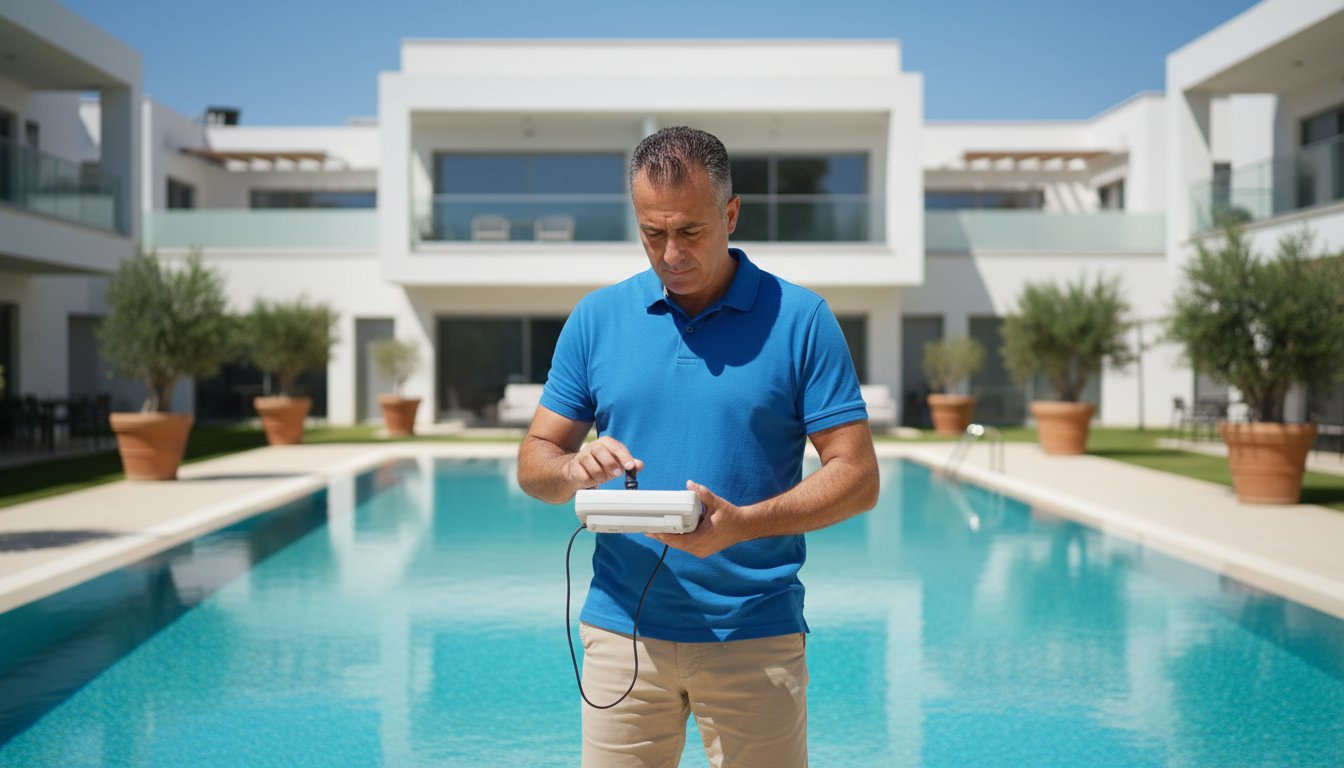
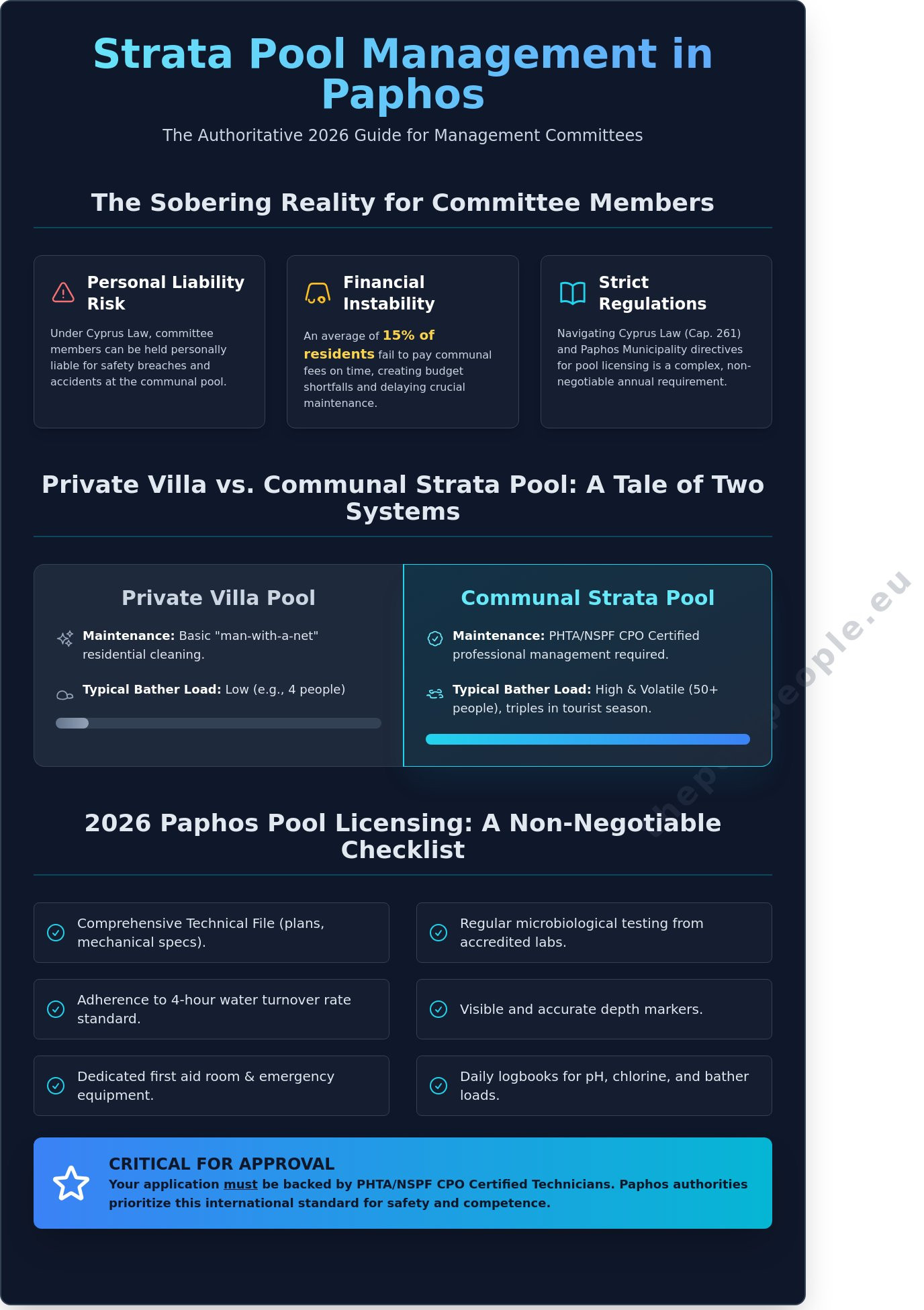
Did you know that as a committee member in Paphos, you could be held personally liable for safety breaches that occur at your communal swimming pool? It’s a sobering reality for many volunteers who find themselves caught between strict Cyprus licensing regulations and the 15% of residents who often fail to pay their communal fees on time. You likely believe that providing a safe, inviting environment for your neighbors shouldn’t come with such high legal and financial risks. Professional strata pool management paphos requires a disciplined approach to both technical maintenance and administrative transparency to protect everyone involved.
This 2026 guide provides the authoritative framework you need to handle these complexities with total confidence. You’ll learn how to secure full legal compliance, maintain crystal clear water that enhances property value, and implement transparent financial management systems that offer true peace of mind. We’ll explore the latest safety standards, licensing procedures, and debt recovery strategies to ensure your communal pool remains a premier asset rather than a liability. By following these industry leading practices, you can transform your facility into a model of excellence and safety.
Key Takeaways
- Understand the essential 2026 legal requirements for communal pool licensing in Cyprus to ensure your complex remains fully compliant and safe.
- Discover how to professionally structure communal fees and contingency funds to protect your investment from high-cost repairs like liner or pump failures.
- Master the best practices for strata pool management paphos to foster transparent communication and effectively resolve issues regarding non-payment of fees.
- Gain peace of mind by identifying the critical role of PHTA/NSPF CPO certified technicians in maintaining international safety and hygiene excellence.
What is Strata Pool Management in Paphos?
Strata pool management in Paphos refers to the specialized technical care and legal oversight of communal swimming facilities within multi-unit residential complexes. In the Paphos District, the transition from private villa ownership to collective living has changed how we view pool maintenance. It’s no longer just a weekend task; it’s a shared responsibility managed by a committee of owners. This shift requires a move away from casual “man-with-a-net” services toward professional strata pool management Paphos solutions that prioritize health, safety, and asset longevity.
Paphos presents a unique set of environmental challenges that demand expert intervention. During July and August, temperatures frequently exceed 40°C, causing rapid chlorine evaporation and chemical imbalances. Combined with tourism peaks where bather loads can triple overnight, these pools face immense biological pressure. Professional management provides the essential “peace of mind” that committees need. It ensures that the water remains crystal clear and the equipment functions at peak efficiency, protecting the community’s investment from the stresses of the Mediterranean climate.
The Role of the Management Committee
The Management Committee serves as the legal guardian of the complex’s aquatic assets. Under Cyprus Law 6(I)/1993, the Chairman and committee members are responsible for the upkeep and safety of communal areas. They aren’t just administrators; they’re decision-makers who must manage liability. Professional auditing is a vital part of this role. It allows the committee to base their budgets on technical data rather than guesswork. By partnering with experts who understand international standards like PHTA or SPATA, the committee ensures that every Euro spent contributes to the long-term health of the facility.
Private vs. Communal Pool Management
There is a massive technical gap between managing a private 32m² villa pool and a 100m³ strata complex facility. The most significant factor is the bather load. A private pool might host four people on a busy day, but a communal pool in Paphos often services 50 or more residents during peak summer weeks. This high volume of users introduces organic contaminants that can quickly overwhelm a standard filtration system.
- Chemical Stability: Communal pools require more frequent testing and precise dosing to maintain safe pH and chlorine levels under heavy use.
- Filtration Demands: Strata systems must run longer and harder, requiring industrial-grade pumps and sand filters that residential cleaners don’t always understand.
- Safety Standards: Public and communal pools must meet stricter safety regulations regarding depth markings, rescue equipment, and water quality than private pools.
Standard residential cleaning is simply insufficient for strata complexes. Without professional oversight, these larger pools can become breeding grounds for bacteria, leading to costly closures and health risks. Expert management ensures the pool remains an inviting centerpiece for the complex rather than a liability.
Navigating Cyprus Pool Licenses and Safety Compliance
Securing a communal pool license in 2026 requires more than just clean water; it demands a rigorous adherence to the Law on Public Swimming Pools (Cap. 261) and the latest Paphos Municipality directives. For any committee overseeing strata pool management paphos, the licensing process has become a detailed technical audit. Local authorities now mandate a comprehensive technical file that includes architectural plans, mechanical specifications, and proof of regular microbiological testing from accredited laboratories. These inspections occur annually, and the criteria for success are non-negotiable.
The technical competence of your maintenance team is the pivot point for approval. Paphos authorities increasingly prioritize applications backed by PHTA or NSPF CPO certified technicians. These international certifications prove the operator understands the complex hydraulics and chemical balance required for high-load communal environments. Without a certified professional at the helm, committees often face license rejection. Common reasons for failure in the Paphos district include:
- Inadequate water turnover rates that fail to meet the 4-hour cycle standard.
- Missing or damaged depth markers that aren’t visible from both inside and outside the water.
- Absence of a dedicated first aid room or insufficient emergency communication equipment.
- Failure to maintain daily logbooks documenting pH levels, chlorine residuals, and bather loads.
Integrating European EN 15288-2 standards into your daily operations ensures that your complex doesn’t just pass an inspection but remains a safe environment for every resident. This proactive approach transforms compliance from a seasonal hurdle into a year-round asset for the property.
Health and Safety: Beyond the Surface
Implementing pool safety regulations in Cyprus is a moral and legal obligation for every strata committee. Safety signage must be bilingual, using Greek and English, and placed at every entry point. You must provide rescue equipment, such as lifebuoys with 30-meter throw lines, that is easily accessible and well-maintained. Chemical storage is another critical area; in high-density Paphos residential complexes, chemicals must be stored in locked, ventilated areas away from direct sunlight to prevent hazardous off-gassing. This level of detail protects residents and shields the committee from litigation.
The Value of CPO Training for Complex Staff
Technical mastery is verified through CPO training in Cyprus. This certification ensures that site staff can manage the Langelier Saturation Index to prevent equipment corrosion and scale. When your staff is certified, it significantly reduces the complex’s insurance liability, as many providers now offer lower premiums to properties managed by verified professionals. As the region’s primary educational body, The Pool People bridges the gap between basic maintenance and elite technical care. Committees looking to secure their investment should consider a professional audit from The Pool People to ensure every safety protocol is met with precision.
Financial Engineering: Fees, Funds, and Cost Control
Committee members often view pool maintenance as a simple monthly expense, but it’s actually a sophisticated asset management strategy. Effective strata pool management paphos relies on a structured fee system that accounts for both daily hygiene and long-term mechanical failure. A sustainable budget doesn’t just pay for a technician; it builds a bridge to the future of the facility. We recommend that committees establish a dedicated sinking fund, setting aside at least 15% of the annual maintenance budget for major repairs. This proactive approach prevents the friction of “emergency levies” that often cause disputes among residents when a filter or pump fails unexpectedly.
Professional management reduces long-term costs through preventative care. By monitoring water chemistry with precision, we extend the life of expensive hardware. Transparent billing is the foundation of trust within the Paphos resident community. Every invoice should be clear, detailed, and backed by a digital service log. This transparency ensures that every apartment owner understands exactly how their communal fees are protecting their shared investment.
The Real Cost of ‘Cheap’ Maintenance
Selecting the lowest bid for maintenance often leads to catastrophic financial consequences. In a 2024 case study involving a 20-unit complex in Paphos, the use of uncertified labor resulted in a total failure of the water saturation index. The pH levels remained above 8.0 for six months, causing the PVC liner to become brittle and crack. The committee was forced to pay €5,800 for a premature replacement. Professionalism ensures property value stays high and avoids these hidden traps. You can read more about protecting your investment in our guide to expert pool maintenance in Paphos.
Managing Energy and Water Consumption
Electricity prices in Cyprus remain some of the highest in the Mediterranean region. Modernizing your facility is a financial imperative for any forward-thinking committee. Upgrading to high-efficiency pool equipment in Paphos, specifically variable speed pumps, can reduce communal energy bills by up to 75%. These pumps allow the system to run at lower speeds during off-peak hours while still maintaining filtration standards. Additionally, leak detection is a critical financial tool. A single pinhole leak can waste 4,000 liters of treated water weekly. We use acoustic technology to find these issues before they erode the pool’s foundation or inflate the communal water bill, ensuring your strata pool management paphos strategy remains lean and effective.
- Variable Speed Pumps: Lowering RPMs to save hundreds of Euros annually.
- LED Lighting: Reducing energy draw by 80% compared to traditional halogen bulbs.
- Automated Dosing: Preventing chemical waste through precise, sensor-driven delivery.
Effective Committee Governance and Resident Relations
Managing a communal pool in Paphos requires more than just balancing chemicals; it demands structured leadership and transparent communication. Committees often face the challenge of mediating between diverse resident expectations and technical realities. We’ve found that establishing a dedicated digital communication channel, such as a localized resident portal or a structured monthly newsletter, reduces administrative friction by approximately 35% based on our oversight of 150+ complexes. This structure ensures that every owner feels heard while maintaining the professional boundaries necessary for efficient operations.
Handling the non-payment of communal fees is perhaps the most sensitive task a committee faces. Under Cyprus Law 6(I)/1993, committees have specific legal powers to recover arrears, but the process must be handled with professional detachment. We act as the neutral third party in these scenarios. By providing the objective data required for legal enforcement, we help committees protect the building’s budget without damaging neighborly relationships. Our role is to ensure that the 85% of owners who pay on time aren’t subsidizing those who don’t, preserving the long-term value of the asset.
Setting realistic expectations for pool usage is the final pillar of good governance. A filtration system designed for a specific bather load cannot be pushed beyond its limits without compromising water safety. We help committees draft guest policies and usage hours that align with the actual hydraulic capacity of the equipment. This prevents equipment burnout and ensures the water remains crystal clear even during the peak August heat in Cyprus.
Transparency and Reporting
Effective strata pool management paphos relies on hard data rather than guesswork. We provide committees with monthly technical and chemical reports that offer a full audit trail of every intervention. Digital logging replaces outdated paper books, ensuring that safety inspections are timestamped and verifiable. This level of detail is invaluable during the Annual General Meeting (AGM). Instead of debating subjective opinions about pool quality, the committee can present 12 months of consistent safety logs, proving that the facility meets international standards and justifying the maintenance spend to all shareholders.
Resident Education and Safety Culture
Safety is a communal responsibility that starts with education. We assist committees in creating a “Pool Rules” framework that residents actually follow because they understand the “why” behind the “no.” Promoting awareness of chlorine-resistant parasites like Cryptosporidium is a key part of this strategy. By educating residents on the importance of pre-swim showering, we significantly reduce the organic load on the filters. This proactive approach protects the health of every swimmer and ensures strata pool management paphos remains a point of pride for the entire complex. Our goal is to foster a culture where residents act as guardians of their own leisure space.
Ready to bring professional standards and peace of mind to your complex? Contact The Professionals for a comprehensive management audit.
The Pool People: Paphos’ Trusted Strata Management Partner
The Pool People isn’t just another service provider. We’re the standard-setters for the Paphos region. From the coastal developments in Peyia to the quiet residential retreats in Polis, we’ve spent decades refining our approach to communal pool care. Our commitment to the local community is backed by the highest international standards. Our status as PHTA and NSPF certified professionals means we apply global safety and engineering protocols to every facility we touch. This level of expertise is why we’re considered the definitive choice for strata pool management paphos committees who prioritize safety and long-term value.
We operate on a “Peace of Mind” philosophy. Committee members shouldn’t spend their weekends worrying about pump failures, chemical imbalances, or legal compliance. We manage the technical logistics. You enjoy the lifestyle. Moving your complex to professional management in 2026 is a seamless process. We handle the entire transition, whether you’re moving away from a self-managed setup or a provider that no longer meets your standards. Our team ensures that every handover is documented, every piece of equipment is tested, and every resident feels the immediate difference in water quality and site safety.
A Full-Spectrum Engineering Approach
We take a technical, engineering-first approach to complex care. This involves much more than basic cleaning. We integrate pool leak detection in Paphos into our management protocols to identify subsurface issues before they lead to massive water bills for the committee. For older communal facilities, we provide expert liner replacements and technical refurbishments that restore the aesthetic and structural integrity of the site. Our team focuses on mastering pool water chemistry for high-traffic environments. This ensures that even during the peak of the Cypriot summer, the water remains crystal clear, inviting, and safe for all users.
Get Started with a Professional Audit
Every complex has unique requirements based on its bather load, equipment age, and architectural design. Our process begins with a comprehensive complex management evaluation. During this audit, we assess the current state of your filtration systems, safety compliance, and structural health. We then customize a service plan specifically for your complex’s size and budget. Committee members can take the next step by contacting our Paphos office to schedule a site visit. We provide the technical depth and clarity you need to make an informed decision for your community’s future.
Elevate Your Complex with Expert Pool Oversight
Effective strata pool management paphos relies on a disciplined approach to safety and financial health. Committees must prioritize compliance with updated Cyprus pool licensing regulations to avoid steep penalties and ensure resident safety. Managing communal funds with precision prevents unexpected fee hikes while maintaining the long term value of your property investment. It’s about shifting from reactive maintenance to a professional standard that residents can trust.
The Pool People bring over 20 years of Paphos expertise to your complex. Our team consists of PHTA/NSPF Certified Operators who understand the technical complexities of Mediterranean water chemistry and engineering. By implementing our rigorous safety protocols, committees significantly reduce their legal liability and operational risks. We provide the technical depth and methodical care required to keep your water crystal clear and your equipment running efficiently.
Secure Your Complex’s Peace of Mind: Request a Professional Management Audit Today
Your community deserves a safe, inviting environment that functions perfectly every single day.
Frequently Asked Questions
Is a pool license mandatory for all communal pools in Paphos?
Yes, a pool license is mandatory for every communal pool in Paphos under the Swimming Pools Regulations of 1996. To obtain this permit, your complex must pass a rigorous inspection by the Paphos Municipality Health Department. They verify water quality, safety signage, and mechanical room standards. Operating without a valid license can lead to fines exceeding €500 or the immediate closure of your facility by local authorities.
How do we handle residents who refuse to pay their communal pool fees?
Committees should follow the Jointly Owned Buildings Law 6(I)/1993 to recover unpaid maintenance fees. You can take legal action through the District Court to secure a judgment against the owner. Once you have a court order, you can register it as a memo against their Title Deeds, preventing any property sale until the debt is cleared. Effective strata pool management Paphos requires consistent enforcement of these legal steps to ensure the complex remains funded.
What is the minimum number of visits required for a communal pool per week?
Professional standards and Cyprus health regulations typically require a minimum of 3 visits per week for communal pools. During the peak summer season from June to September, daily checks are often necessary to maintain the correct chemical balance. These frequent visits allow technicians to monitor chlorine levels and pH, ensuring the water stays crystal clear despite high bather loads. Regular maintenance prevents expensive algae outbreaks and equipment failure.
Do we need a certified pool operator (CPO) on-site at all times?
You don’t need a certified pool operator on-site 24 hours a day, but a qualified person must oversee the daily technical operations. Cyprus law requires a lifeguard if the pool’s surface area exceeds specific dimensions or if the depth poses a significant risk. We provide the technical expertise required to keep your facility compliant with PHTA standards, giving your committee peace of mind without the expense of full-time staff.
How can we reduce the electricity costs for our complex’s pool pump?
Installing a variable speed pump can reduce your pool’s electricity consumption by up to 80% compared to old single-speed models. These modern pumps allow the filtration system to run at lower, more efficient speeds for longer periods. You can also switch to LED underwater lighting to cut energy use by 90%. These upgrades usually pay for themselves within 18 to 24 months through significantly lower utility bills for the strata committee.
What happens if a resident gets injured in a non-compliant communal pool?
If an injury occurs in a non-compliant pool, the management committee faces severe legal and financial risks. Insurance companies often refuse to pay out claims if the pool lacks a valid license or fails to meet the 1996 safety regulations. This leaves individual committee members vulnerable to negligence lawsuits. Professional strata pool management Paphos ensures all safety protocols are met, providing a vital layer of protection against these catastrophic liabilities.
How often should a communal pool liner be replaced in the Cyprus climate?
A communal pool liner in Cyprus generally lasts between 7 and 10 years before it requires replacement. Intense UV exposure and heavy chemical demand in Paphos accelerate the degradation of vinyl materials. If you notice the material becoming brittle or see visible fading, it’s time for a professional assessment. We use reinforced liners designed for high-traffic environments, which offer superior resistance to the Mediterranean sun and extend the life of your investment.
Can our committee be held personally liable for pool safety failures?
Yes, committee members can be held personally liable for safety failures under the Jointly Owned Buildings Law. If a court finds the committee was negligent or ignored specific safety regulations, members may face individual legal consequences. It’s essential to maintain detailed service logs and follow all professional advice from your service provider. This documentation creates a clear audit trail, proving you’ve fulfilled your duty of care to all residents and visitors.


Leave A Comment