
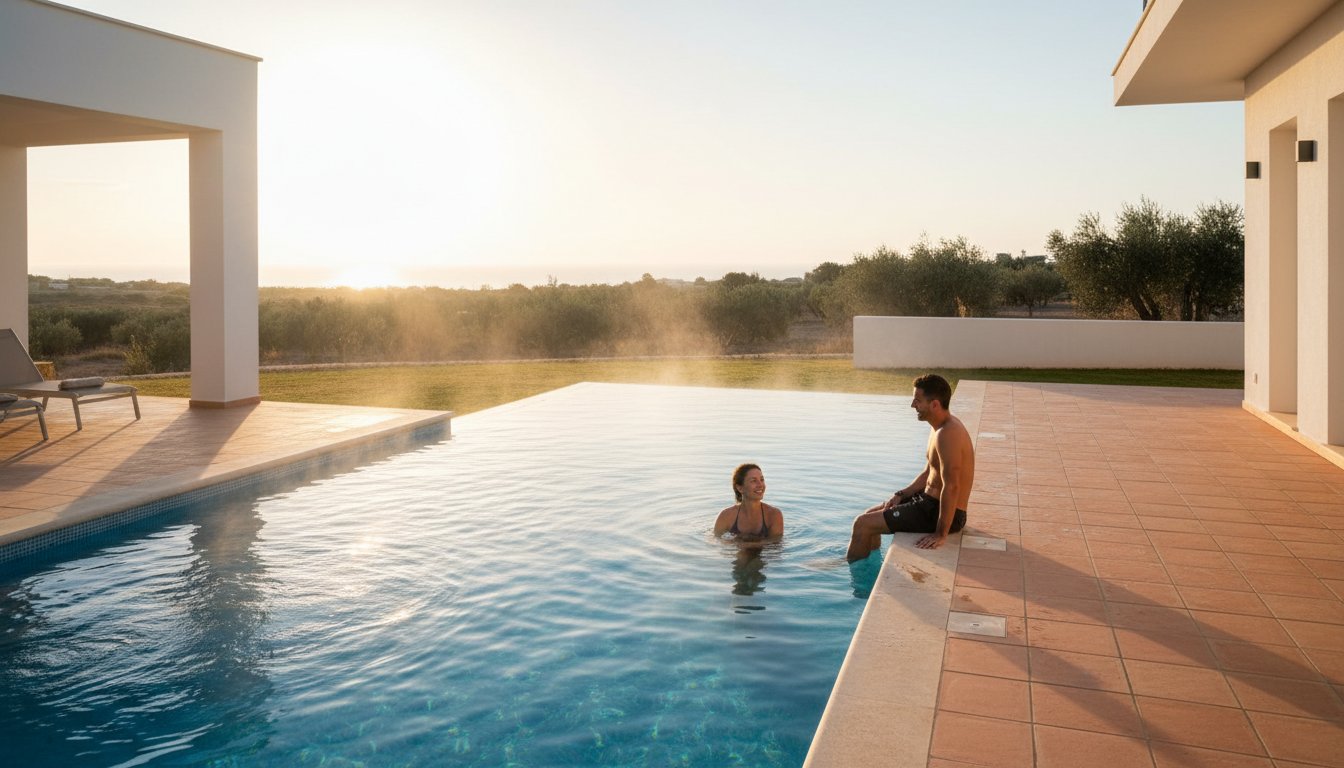
Why should your most expensive home investment sit idle for 150 days of the year? Most homeowners in Cyprus accept that their swimming season ends in October, yet the Mediterranean sun stays bright well into December. Installing a high-efficiency pool heat pump Paphos residents can rely on transforms your outdoor space from a summer-only luxury into a year-round sanctuary. It’s frustrating to watch your crystal clear water go to waste during the beautiful shoulder months simply because the temperature has dipped below a comfortable 28°C.
You likely worry that heating a pool in 2026 will lead to astronomical electricity bills or that the salt air will corrode your equipment within two seasons. We agree that the technical side of pool ownership should never be a source of stress. Our mission is to provide the definitive expert guidance you need to maintain a perfect environment without the guesswork. This article explains how modern inverter technology and corrosion-resistant components ensure your pool remains inviting regardless of the season while maintaining total peace of mind.
We will break down the specific COP ratings that matter for the Cypriot climate and show you how to achieve low monthly running costs through professional installation. Discover the exact steps to secure a warm, inviting pool for your family while protecting your long-term investment and safety.
Key Takeaways
- Learn how to extend your swimming season beyond the standard four months and enjoy your water during the beautiful Paphos shoulder seasons.
- Discover why a high-efficiency pool heat pump Paphos residents prefer is up to six times more cost-effective than traditional electric heaters.
- Understand the reliability gap between heating methods and why air-source technology provides consistent warmth even during Cyprus’s cloudy winter weeks.
- Gain professional insights into correctly sizing your unit and evaluating your property’s electrical capacity to ensure a seamless, high-performance installation.
- Find out how PHTA-certified expertise and professional maintenance protocols protect your investment and guarantee long-term peace of mind.
Why Your Paphos Pool Needs a Heat Pump in 2026
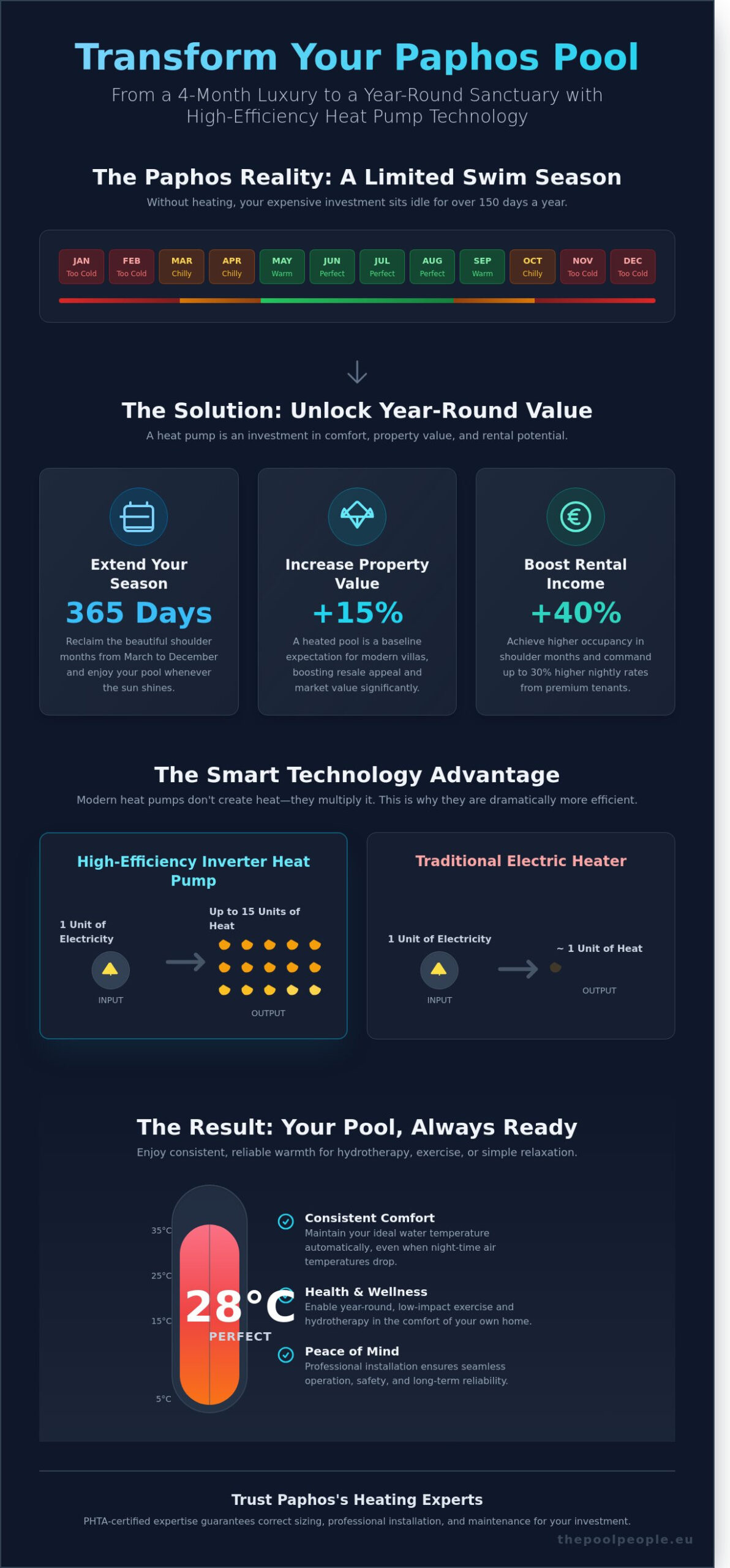
For most homeowners in the Paphos district, the swimming pool represents the crown jewel of their outdoor living space. However, there is a stark reality that many residents only discover after their first year in Cyprus. Without a dedicated heating solution, a standard outdoor pool remains comfortably warm for only 120 to 150 days a year. By the time late October arrives, water temperatures typically dip below 22°C. This makes a morning swim an endurance test rather than the relaxing ritual you envisioned. Installing a pool heat pump Paphos residents can rely on transforms this seasonal asset into a year-round wellness center.
The transition from “luxury” to “standard” is already visible across the hillsides of Peyia and Tala. In 2026, a climate-controlled pool is no longer a niche upgrade; it is a baseline expectation for any modern villa. Property market data from the Paphos region indicates that homes equipped with reliable heating systems maintain a 15% higher resale appeal. Buyers now prioritize “peace of mind” and functional year-round facilities over simple aesthetics. They want to know that the pool is ready for use on a sunny Tuesday in February without a second thought.
The shoulder seasons of March to May and October to December offer the most beautiful weather in Cyprus. These months provide crisp air and clear skies, perfect for outdoor activity. Unfortunately, the water remains trapped in a winter chill or loses its summer heat rapidly. A heat pump bridges this gap efficiently. It allows you to reclaim these six months of the year, ensuring your investment does not sit idle while the sun is shining.
The Paphos Climate Challenge
While Paphos enjoys over 300 days of sunshine, the thermal mass of pool water reacts slowly to rising air temperatures. In January and February, unheated pool water can drop as low as 15°C. Even as the air warms up in April, the water often lags ten degrees behind. This is where technical efficiency becomes critical. Understanding how air-source heat pumps work reveals why they are perfectly suited for the Paphos climate. These systems extract ambient heat from the air and transfer it to your water. Because Paphos rarely sees freezing temperatures, the units operate at peak efficiency. You can maintain a consistent 28°C with minimal energy consumption, providing the psychological comfort that your pool is always inviting.
Extending the Rental Season
For property investors in Coral Bay and the Sea Caves, the financial incentive is significant. Holiday lets featuring a pool heat pump Paphos tourists can utilize during the winter months command nightly rates up to 30% higher than unheated counterparts. Local property management statistics show that villas with heated pools experience a 40% increase in occupancy during the shoulder months. High-value tenants who visit Cyprus for golf or wellness during the winter specifically filter their searches for heated facilities. By providing a guaranteed water temperature, you move your property into a premium bracket, ensuring it remains a high-yielding asset throughout the entire calendar year rather than just the peak summer weeks.
- Consistent Comfort: Maintain 28°C water even when night temperatures drop to 12°C.
- Energy Efficiency: Modern inverter technology provides up to 15 units of heat for every 1 unit of electricity consumed.
- Property Value: Aligns your villa with the 2026 standards of luxury real estate in the Paphos district.
- Health and Wellness: Enables low-impact exercise and hydrotherapy during the cooler winter months.
How Air-Source Heat Pumps Work in the Cyprus Sun
Choosing a pool heat pump Paphos homeowners can rely on starts with understanding that these systems don’t actually create heat. They move it. An air-source heat pump functions like an air conditioner in reverse. It utilizes a fan to draw in the warm ambient air surrounding your property, passes it over an evaporator coil containing eco-friendly refrigerant, and then compresses that gas to generate intense heat. This thermal energy is then transferred directly into your pool water through a heat exchanger. Because the electricity is only used to run the fan and compressor rather than to create the heat itself, the process is incredibly cost-effective.
The efficiency gap between traditional heating methods and modern heat pumps is staggering. A standard electric heater operates at a 1:1 ratio, meaning 1kW of electricity produces 1kW of heat. In contrast, a high-performance heat pump is 4 to 6 times more efficient. This efficiency is amplified by the specific climate in Paphos. While dry climates can struggle with heat transfer, the coastal humidity in Cyprus actually assists the process. Moist air holds more latent heat than dry air. When this humid air hits the cold evaporator coils, it releases significant energy, allowing the system to work less while producing more warmth for your water.
Residential areas in Paphos require solutions that don’t disrupt the Mediterranean peace. Modern units feature an “Air-Flow” design that prioritizes a minimal footprint and near-silent operation. Most units now operate at noise levels as low as 40dB, which is quieter than a modern refrigerator. This allows for installation in tight side-passages or near outdoor dining areas without disturbing your afternoon frappe. When planning your upgrade, Sizing your heat pump pool heater correctly is the first step toward achieving this quiet, efficient performance.
Understanding COP (Coefficient of Performance)
COP is the metric that defines your return on investment. It represents the ratio of heat output to energy input. In Paphos, where daytime temperatures frequently stay above 20°C for nine months of the year, a quality heat pump often achieves a COP of 5.0 or higher. This means you get 5kW of heat for every 1kW you pay for. By 2026, “Full Inverter Technology” will be the mandatory gold standard for efficiency. Unlike older “on/off” models that consume massive surges of power, inverter systems vary their motor speed in 1% increments. This precision maintains a constant temperature while reducing energy consumption by up to 30% compared to non-inverter models.
Corrosion Resistance for Coastal Paphos
Location matters when selecting hardware. If your villa is located in Sea Caves, Chloraka, or Kato Paphos, your equipment faces a constant barrage of salt-laden air. This salt is a primary cause of premature equipment failure in Cyprus. Standard copper heat exchangers will often corrode and leak within three to five years in these conditions. The Pool People set a strict standard for durability, insisting on 100% titanium heat exchangers for every pool heat pump Paphos installation. Titanium is chemically inert and immune to the corrosive effects of salt and pool chemicals. We believe that professional-grade hardware is the only way to ensure the long-term “peace of mind” our clients deserve. If you’re ready to upgrade your system, you can request a technical site survey to determine which titanium-reinforced model fits your garden layout.
Heat Pump vs. Solar Heating: Which is Best for Paphos?
Choosing between solar thermal and a mechanical heat pump is the most frequent debate we encounter among Paphos homeowners. While Cyprus enjoys over 300 days of sunshine annually, the “free” energy from solar panels often comes with hidden compromises that affect your swimming experience. For a truly reliable swim season that starts in March and ends in November, a pool heat pump Paphos residents can depend on offers a level of consistency that solar simply cannot match.
Reliability is the deciding factor during the transition months. In January and February, Paphos often experiences localized cloud cover and shorter daylight hours. Solar thermal systems rely entirely on direct UV radiation to transfer heat. If the sun isn’t shining intensely, your pool temperature will drop by 2 or 3 degrees daily, leaving the water too cold for a comfortable morning swim. Heat pumps operate on a different principle; they extract heat from the ambient air. Even when it’s a crisp 15°C outside, a high-efficiency heat pump generates enough thermal energy to keep your water at a steady, inviting temperature.
Installation aesthetics also play a role in your property value. Solar heating requires a significant amount of roof space, often demanding a collector area equal to 50% or even 100% of your pool’s surface. These bulky black mats or glass tubes can clutter the clean lines of a Mediterranean villa. In contrast, a heat pump occupies a small footprint at ground level, tucked away behind landscaping or near your existing filtration plant. This keeps your roof clear for photovoltaic panels, which can then power your heat pump, creating a more efficient and visually pleasing energy loop.
The Limitations of Solar Thermal in Cyprus
Solar thermal systems often struggle to reach “swim-ready” temperatures of 28°C or 29°C during the early spring. Because they’re passive, you’re at the mercy of the weather. Maintenance is another concern we frequently address. Roof-mounted systems are prone to leaks caused by the intense Cypriot summer sun degrading rubber seals and plastic piping. Accessing these leaks involves climbing onto the roof, which increases service costs. While solar has a low operational cost, a modern heat pump is cost competitive with solar heaters when you account for the 10 to 15 year lifespan and the reduced need for specialized roof repairs.
The Heat Pump Advantage
Precision is the hallmark of a professional pool setup. With a heat pump, you gain total control over your environment. You can set your desired temperature to 29°C on a digital interface and the system will maintain it regardless of the time of day. This includes night-time heating, a feat solar cannot achieve. Modern units also integrate seamlessly with your existing infrastructure. Many of our clients sync their heating schedules with robotic pool cleaners and automated dosing systems. This “set and forget” approach provides the peace of mind that your pool is always ready for a dip. We’ve seen a 40% increase in heat pump installations in the Paphos region over the last three years, as owners move away from the unpredictability of older solar technology.
A hybrid approach is sometimes viable for larger estates. You can use solar to provide a base level of warmth and a pool heat pump Paphos professionals have calibrated to “top up” the temperature to your exact preference. This ensures maximum efficiency while guaranteeing that your €40,000 to €60,000 investment in a swimming pool doesn’t sit idle for six months of the year. For the majority of residential pools, the heat pump remains the elite choice for performance and reliability.
Sizing and Installing Your Heat Pump in Paphos
Selecting the right hardware is only half the battle; the technical execution of the installation determines whether your investment actually delivers a warm pool. At The Pool People, we follow a rigorous four-step process to ensure your pool heat pump Paphos installation is efficient and reliable.
- Step 1: Precise Sizing. We don’t guess. We calculate your pool’s volume and, more importantly, its surface area. A standard 8m x 4m pool contains roughly 48 cubic meters of water, but the heat loss happens at the surface. We factor in local Paphos wind speeds and average night temperatures to determine the exact kilowatt (kW) output required to maintain 28°C.
- Step 2: Electrical Assessment. A heat pump is a high-draw appliance. We evaluate if your home runs on a single-phase or three-phase electrical supply. For larger pools requiring units over 17kW, a three-phase connection is often necessary to prevent tripping your main circuit breaker when the air conditioning is also running.
- Step 3: Strategic Placement. Airflow is the “fuel” for your heater. We identify a location with at least 3 meters of clear space in front of the fan to prevent “cold air recirculation,” which kills efficiency. We also prioritize noise reduction, ensuring the unit’s 40dB to 52dB operating hum doesn’t disturb your relaxation areas.
- Step 4: System Integration. We plumb the unit directly into your existing pool pump system. The heater is installed after the filtration stage to ensure only debris-free water enters the heat exchanger, preventing internal damage and maintaining the manufacturer’s warranty.
The Importance of Pool Covers
Running a pool heat pump Paphos without a safety pool cover is like running central heating with all your villa’s windows wide open. Evaporation accounts for 70% of total heat loss. By installing a high-quality cover, you reduce your daily running costs by 50% or more. In the Paphos district, where coastal winds can strip heat from the water surface overnight, a reinforced cover is essential. It acts as a thermal blanket, trapping the energy you’ve paid for and keeping the water temperature stable even when the mercury drops in November.
Professional Installation Standards
Attempting a DIY or unlicensed installation is a significant risk that often voids your product warranty immediately. Our team utilizes a professional bypass valve system, which allows you to isolate the heater during the peak of summer or for routine maintenance without shutting down the entire pool. This flexibility is vital for the Cyprus climate. Every installation we perform includes our signature 5-point check: electrical load verification, flow rate calibration, hydraulic pressure testing, refrigerant level confirmation, and controller optimization for local conditions. This methodical approach is why we’re trusted to train other technicians across the island.
Ready to secure your year-round swimming comfort with an expert installation? Contact The Pool People today for a professional site survey and sizing quote.
Why The Pool People are Paphos’s Trusted Heating Experts
Choosing the right partner for your pool heating project involves more than just picking a model from a catalog. In the Cyprus market, where temperature fluctuations and hard water conditions are common, technical precision is the only way to ensure a return on your investment. We’ve operated from our base in Peyia for over 19 years, establishing ourselves as the definitive authority in the region. We aren’t just a website or a middleman; we’re a team of localized experts who understand exactly how the Mediterranean climate affects your pool chemistry and equipment performance.
Our approach centers on providing total peace of mind. When you install a pool heat pump Paphos weather patterns must be accounted for to ensure the unit operates at peak efficiency. We don’t believe in aggressive sales tactics. Instead, we focus on engineering solutions that deliver a warm, inviting swim while keeping your monthly energy bills predictable. Every installation we perform adheres to strict European health and safety standards, ensuring your family enjoys excellence in water quality and equipment safety.
Certified Expertise You Can Trust
We take our role as industry leaders seriously. Our engineers hold prestigious PHTA (formerly NSPF) and CPO certifications, which are the gold standard in pool operations worldwide. We don’t just apply these standards; we teach them. The Pool People have trained approximately 85% of the professional pool technicians currently working across the Paphos district. This deep level of technical competence ensures your system is sized correctly from day one. You’ll receive a transparent quote in Euro that covers every component of the installation. We’ve eliminated the “Cyprus extras” that often surprise homeowners, providing a clear, fixed cost for your upgrade.
A CPO certification means your technician understands the complex relationship between water temperature and calcium saturation. Heated water is naturally more aggressive. Without the specialized knowledge our team provides, a new heater could inadvertently cause scale buildup or copper erosion. We prevent these issues through methodical testing and precise calibration, protecting your pool’s internal surfaces and extending the life of your machinery by up to 35% compared to amateur installations.
Your Journey to a Perfect Pool
Your transition to a year-round swim season begins with a comprehensive site audit. We examine your existing filtration system, electrical capacity, and wind exposure to recommend the most efficient pool heat pump Paphos can support. Once the installation is complete, our relationship doesn’t end. We provide ongoing technical support and specialized chemical balancing. It’s a fact that heated water requires more frequent monitoring to remain crystal clear and safe for your skin.
To protect your investment, our monthly pool maintenance programs are designed to catch minor issues before they become expensive repairs. We monitor your heat exchanger and salt chlorinator cells to ensure they aren’t being degraded by imbalanced water. This proactive philosophy is what sets us apart as the professional mentors of the Cyprus pool industry. We handle the logistics so you can focus on the lifestyle benefits of a warm, stress-free swim.
Ready to transform your swimming experience? Our team is standing by in Peyia to provide the technical clarity you need for a successful installation.
Secure Your Perfect Swim Temperature for 2026
Investing in a pool heat pump Paphos ensures your swimming season doesn’t end when the Mediterranean breeze cools in October. Modern air-source units now achieve COP ratings above 13.0; this means they provide 13kW of heat for every 1kW of electricity consumed. This level of efficiency makes them a superior choice over traditional solar heating if you want consistent 28°C water temperatures throughout the year. We understand that Paphos pool owners require durable equipment, which is why we focus on salt-air resistant hardware that survives the unique coastal conditions of Cyprus.
Since 2005, The Pool People have served as the region’s technical leaders. Our team consists of PHTA and NSPF Certified Pool Operators who prioritize precision and long-term reliability. We don’t just sell equipment; we provide the peace of mind that comes from professional installation by experts who also train the rest of the industry. Don’t let your investment sit idle for six months of the year when a tailored heating solution is within reach. Take the first step toward a more comfortable lifestyle today.
Get Your Free Pool Heating Quote from The Professionals
You deserve a crystal clear, warm pool that’s ready for you and your family whenever you want to dive in.
Frequently Asked Questions
How much does it cost to run a pool heat pump in Paphos?
Running a pool heat pump costs between €2 and €4 per day for a standard residential pool during the shoulder seasons. These figures are based on current electricity rates of roughly €0.30 per kWh and the use of modern inverter technology. Because these units achieve a Coefficient of Performance (COP) of 10, they’re incredibly efficient. Using a thermal cover reduces these costs by 50% by preventing heat loss overnight.
Can a heat pump really heat my pool in the middle of a Cyprus winter?
Yes, modern pool heat pumps maintain comfortable temperatures of 28°C even during the coldest weeks of a Cyprus winter. While basic units struggle when air temperatures drop, the high-performance models we install operate efficiently down to -7°C. In Paphos, where winter nights rarely fall below 8°C, a correctly sized pool heat pump Paphos owners select ensures year-round swimming. We recommend a 17kW unit for consistent warmth during December and January.
How long does it take for a heat pump to warm up a Paphos pool?
It typically takes 24 to 48 hours to raise your water temperature by 5°C to 10°C from a cold start. The initial lift in March or April requires the pump to run continuously for about two days to reach the 28°C mark. Once achieved, the inverter technology scales back to maintain that level efficiently. Using a 400-micron solar cover during this period is essential; it speeds up the heating process by 30%.
Do I need a special electrical permit for a heat pump installation in Cyprus?
No special permit from the EAC is required for standard residential installations, but a dedicated circuit is mandatory. Most domestic heat pumps require a 16-amp to 32-amp breaker depending on the unit’s power draw. Our certified technicians ensure the installation meets 17th Edition IET Wiring Regulations. We install a rotary isolator switch within two meters of the unit to comply with safety standards and ensure your manufacturer warranty remains valid.
What size heat pump do I need for a standard 8x4m Paphos pool?
An 8x4m pool with an average depth of 1.5m requires a heat pump with a minimum output of 13kW for standard use. For homeowners wanting to swim through the entire winter, we recommend stepping up to a 17kW inverter model. This provides a 25% power buffer that allows the machine to run at lower, quieter speeds while still maintaining 28°C. This specific sizing ensures the unit doesn’t overwork, which preserves the compressor’s operational life.
How long do pool heat pumps typically last in the Paphos climate?
A high-quality pool heat pump lasts between 10 and 15 years in the Paphos coastal environment. The salt air in areas like Chloraka or Peyia can be corrosive, so we prioritize units with titanium heat exchangers and treated evaporator coils. Annual professional servicing increases longevity by 20% by preventing calcium buildup and checking refrigerant levels. Our peace of mind maintenance plans ensure your investment remains protected against the high UV levels and humidity.
Does the heat pump also cool the pool during the hot Paphos summers?
Yes, most modern inverter units feature a reversible cycle that can cool water by 5°C to 8°C. During July and August, Paphos pool temperatures often climb above 32°C, making the water feel unrefreshing. A pool heat pump Paphos residents use can be switched to cooling mode to bring the water down to a crisp 26°C. This dual functionality ensures your pool remains a comfortable sanctuary regardless of the 40°C peak summer heat.



Leave A Comment