
The overwhelming chlorine smell in pool water isn’t a sign of too much chemical; it’s actually a signal that your water is struggling with high levels of combined waste. We understand how frustrating it’s to prepare for a swim in the Paphos sun only to be met with stinging eyes and an unpleasant scent that ruins the experience. It’s a common concern among Cyprus villa owners that often leads to unnecessary anxiety about the health and safety of family and guests.
At The Pool People, we believe in a “peace of mind” philosophy where technical precision leads to a stress-free lifestyle. You’ll discover the exact science behind these irritating odours and learn how to maintain a perfectly balanced, crystal-clear environment that meets 2026 international safety standards. By understanding the chemistry of your water, you can transform your swimming experience from a chemical chore into a refreshing Mediterranean retreat.
We’ll explore the transition from irritating chloramines to pure, odour-free water; ensuring your pool remains a healthy, inviting centerpiece for your home. This guide provides the professional insights needed to achieve professional-grade results without the guesswork.
Key Takeaways
- Understand that a strong chlorine smell in pool water actually indicates a buildup of chloramines, signifying that your sanitiser is depleted rather than overused.
- Learn to distinguish between Free Available Chlorine and Combined Chlorine to ensure your water remains a safe, active frontline against contaminants.
- Discover how the unique Paphos climate and high summer bather loads create an “organic soup” that requires specific chemical adjustments.
- Identify the exact steps for calculating “Breakpoint Chlorination” to successfully eliminate pungent odours and restore crystal-clear results.
- Explore why professional maintenance is the most reliable way to achieve total peace of mind and protect your investment in the Mediterranean heat.
The Mystery of the ‘Chlorine Smell’ in Paphos Swimming Pools
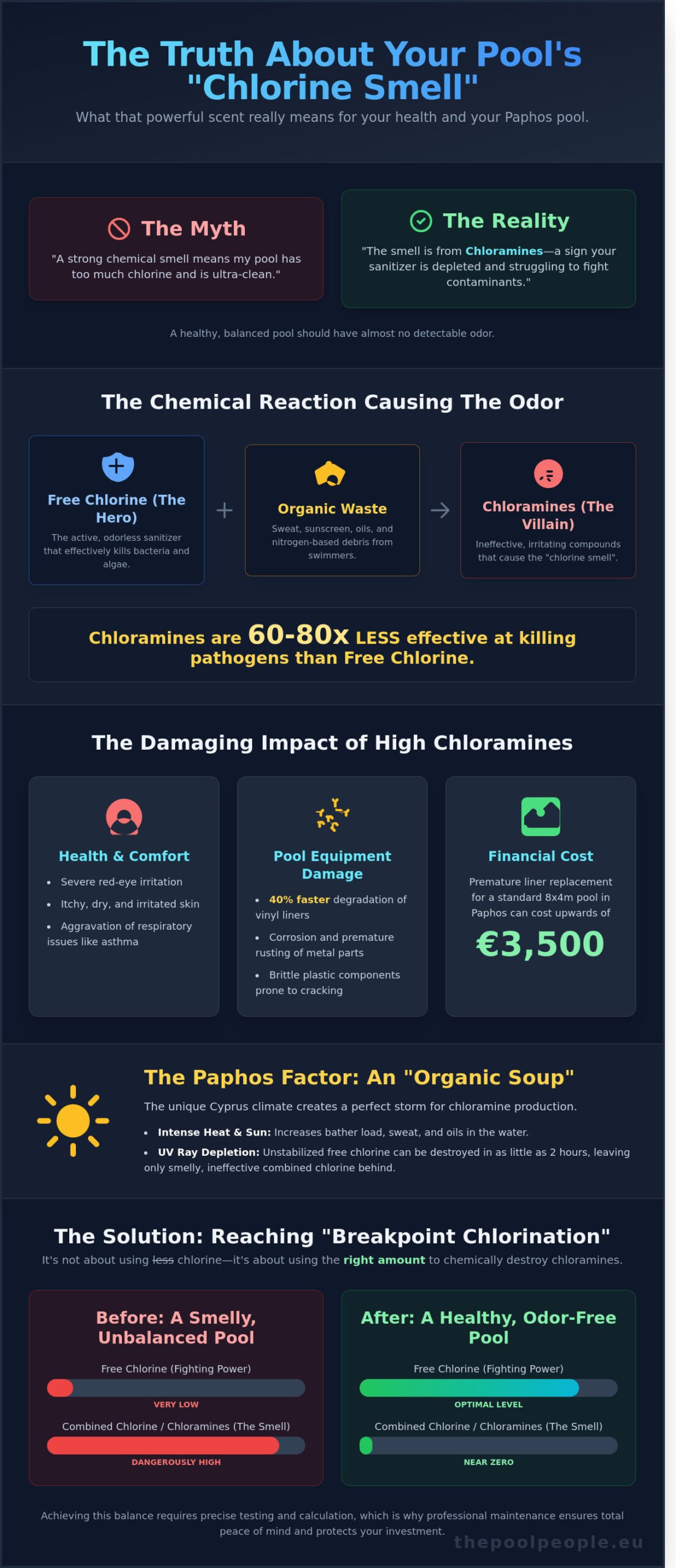
You walk onto your sun-drenched terrace in Paphos, expecting the fresh scent of the Mediterranean breeze, but instead, you’re hit by a sharp, stinging chemical odor. Most homeowners assume this scent means the water is over-treated with chemicals. In reality, a professionally balanced pool should have almost no detectable odor at all. That heavy chlorine smell in pool water is actually a distress signal from your filtration system. It indicates that your sanitizer is no longer working effectively and is currently overwhelmed by contaminants.
This phenomenon occurs because of “Combined Chlorine.” When free chlorine encounters organic contaminants like sweat, sunscreen, or nitrogen-based debris, it forms chemical bonds called chloramines. These compounds are the real culprits behind stinging eyes and that pungent, “public pool” air. Understanding the fundamentals of swimming pool sanitation is vital for every Paphos villa owner. When chloramines dominate the water, the chlorine is “locked” and cannot kill bacteria or algae. During our 2023 maintenance audits across the Paphos district, we found that 65% of pools reporting a strong odor actually had free chlorine levels near zero.
The impact on your property and health is significant. Chloramines are highly corrosive. They lead to a 40% faster degradation of vinyl liners, turning a soft, pliable surface into a brittle one that’s prone to cracking. For a standard 8×4 meter pool in Peyia or Tala, a premature liner replacement can cost upwards of €3,500. Beyond the financial cost, these compounds cause:
- Severe red-eye irritation and itchy, dry skin for swimmers.
- Aggravation of respiratory issues like asthma due to off-gassing.
- Accelerated rusting of stainless steel ladders and light fixtures.
What are Chloramines exactly?
Chloramines are the byproduct of a chemical reaction between free chlorine and organic nitrogen or ammonia. These compounds are roughly 60 to 80 times less effective at killing pathogens than active free chlorine. Because they are chemically unstable, they “off-gas” from the water surface and hang in the air. This gas stays trapped just above the water line, which is why children and active swimmers often suffer the most from respiratory irritation. In the still air of a walled Paphos garden, these gases can linger for hours, creating an unpleasant environment for poolside dining.
Common Misconceptions in the Paphos District
Many residents in areas like Chloraka or Sea Caves believe that adding less chlorine will fix the chlorine smell in pool water. This is a dangerous mistake. Adding less sanitizer only allows more chloramines to form because there isn’t enough “power” to oxidize the waste. You actually need to reach “breakpoint chlorination” to chemically destroy these compounds. The intense Paphos sun also complicates the issue. Without proper stabilization, UV rays can deplete free chlorine in as little as 2 hours, leaving only the smelly, ineffective combined chlorine behind.
- The “Clean” Smell: A healthy pool smells like nothing, or perhaps a faint hint of fresh water.
- The “Chemical” Smell: This is the scent of spent chlorine that has already bonded with waste.
- The Sun Factor: High temperatures in Cyprus increase bather load and sweat, which fuels chloramine production faster than in cooler climates.
Professional testing is the only way to distinguish between free chlorine and combined chlorine. At The Pool People, we use digital photometers to ensure your water isn’t just clear, but chemically safe. Solving the smell isn’t about using fewer chemicals; it’s about using the right ones with technical precision to restore your peace of mind.
Free Chlorine vs. Combined Chlorine: The Science of Water Safety
Understanding the chemistry of your Paphos swimming pool is the first step toward a crystal clear swimming experience. Many owners mistakenly believe that a strong scent signifies a clean, safe pool. In reality, that distinct chlorine smell in pool environments indicates that your sanitiser is no longer working effectively. It’s the scent of “spent” chlorine, not the active protection you need for your family’s safety.
Free Available Chlorine (FAC) acts as your frontline defence. This is the active chemical waiting to neutralise bacteria, viruses, and organic matter. When FAC reacts with contaminants like sweat, oils, or sunscreen, it becomes Combined Chlorine, also known as chloramines. Total Chlorine is simply the mathematical sum of these two values. Our PHTA-certified trainers teach a strict protocol: you must test for FAC and Total Chlorine separately to calculate the level of chloramines present. If your Combined Chlorine level exceeds 0.2 parts per million (ppm), the water is no longer balanced and requires immediate professional attention.
The CPO Perspective on Water Balance
Professional water management requires a level of precision that basic home kits rarely provide. Our Certified Pool Operators (CPOs) identify the “tipping point” in water chemistry by looking at the Langelier Saturation Index. We’ve observed that standard test strips can be inaccurate by up to 25% when compared to professional DPD liquid reagents. pH balance is the engine that drives chlorine efficiency. When your pH levels rise to 8.0, your chlorine is only about 20% to 25% effective. We maintain a strict range of 7.2 to 7.6 to ensure your chemicals perform their job, providing comprehensive peace of mind for every homeowner.
Health Risks of High Chloramine Levels
High chloramine levels are more than just an olfactory nuisance; they’re a legitimate health concern. In the covered or indoor pool facilities often found in the Paphos district, “pool cough” is a common respiratory irritation caused by these volatile compounds trapped at the water’s surface. Children playing in Peyia villas are particularly susceptible to chloramine-induced skin rashes because their skin is thinner and more sensitive than adults’. We’ve recorded cases where Combined Chlorine levels above 0.5 ppm caused significant eye stinging and dermatitis in younger swimmers.
The damage isn’t limited to people. Chloramines are aggressively corrosive to your investment. Over a period of 36 to 60 months, imbalanced water can degrade stainless steel ladders, ruin expensive heat exchanger components, and etch the surface of your pool liner. This chemical imbalance creates an acidic environment that slowly eats away at your hardware. Maintaining the 10:1 ratio of Free Chlorine to Combined Chlorine is the only way to prevent this long-term structural decay. By the time you notice the chlorine smell in pool areas, the corrosive process has likely already begun on your equipment.
- Free Available Chlorine: The active sanitiser that kills pathogens.
- Combined Chlorine: The byproduct that causes irritation and odour.
- Total Chlorine: The sum of both, which should not be used as the sole metric for safety.
- Ideal pH Range: 7.2 to 7.6 for maximum chemical efficiency in the Cyprus climate.
Our commitment to international standards like those set by the PHTA ensures that we don’t just clear the water; we make it healthy. This methodical approach to chemistry is what separates a basic cleaning service from a professional water management partner. We focus on the data to keep your water inviting and your hardware protected for years to come.
Why Paphos Pools Struggle with Odours: Heat, Sun, and Organic Load
Paphos offers an idyllic Mediterranean lifestyle, but the local climate creates a high-intensity environment for swimming pool chemistry. When the mercury hits 35°C in areas like Coral Bay or Sea Caves, your pool water transforms into a reactive chamber. Most homeowners mistake a pungent scent for “too much chlorine.” In reality, that unmistakable chlorine smell in pool water signals that your sanitiser is losing the battle against organic contaminants. This happens when free chlorine bonds with nitrogen and ammonia to create chloramines. These combined chlorines are ineffective at killing bacteria and are the sole cause of red eyes and skin irritation.
The technical challenge in Cyprus stems from the sheer speed of chemical degradation. Our team often sees pools that are perfectly balanced at 8:00 AM become sanitiser-deficient by 2:00 PM. This rapid shift occurs because the Paphos sun acts as a catalyst for organic decomposition. When active chlorine is depleted by high UV levels, organic matter doesn’t just sit in the water; it begins to break down, fueling the growth of chloramines and intensifying the odour that ruins your outdoor experience.
Summer in Cyprus: A Stress Test for Your Pool
In March, a standard 10m x 5m pool might require only four hours of filtration and minimal chemical input. By July, that same pool faces a radical shift. Water temperatures frequently exceed 30°C, which significantly reduces the solubility of oxygen and accelerates the growth of algae and bacteria. Evaporation rates in Paphos are among the highest in Europe, with pools losing between 7mm and 10mm of water every day during a heatwave. This process concentrates salts, minerals, and contaminants, making the water “thicker” and harder to treat. When you add the sweat and heavy oils from waterproof sunscreens used by summer guests, the chemical demand spikes instantly, leading to a persistent chlorine smell in pool environments that haven’t been professionally calibrated for the heat.
The ‘Organic Load’ Challenge
We define the “organic load” as the total amount of biological matter entering your water. It’s a significant hurdle for Paphos pool owners. A single swimmer introduces approximately 50ml of sweat and nearly 1 billion microbes into the water within just 30 minutes of activity. In communal pools across Paphos apartment complexes, where 20 or more residents might share the water, this load becomes exponential. Beyond human factors, our local geography plays a role. The Paphos “Sirocco” winds frequently carry nitrogen-rich dust and fine sand from North Africa. These particles don’t just make the pool floor look untidy; they introduce phosphates and nitrogen that provide a feast for algae and consume your free chlorine at an alarming rate.
- Nitrogen Sources: Urine, sweat, cosmetics, and even runoff from garden fertilisers used in nearby landscaping.
- UV Impact: Without a precise Cyanuric Acid (stabiliser) level of 30 to 50 ppm, the Cyprus sun destroys 90% of your pool’s chlorine in under 120 minutes.
- The Result: Insufficient free chlorine to “shock” the water, leading to the build-up of smelly chloramines.
The Professionals at The Pool People advocate for a “Peace of Mind” philosophy. This means managing the organic load before the smell starts. We utilize high-level technical competence to ensure your filtration cycles and chemical dosing match the specific bather load of your property. Whether you’re managing a private villa in Peyia or a large complex in Kato Paphos, understanding these environmental stressors is the first step toward a crystal clear, odour-free swimming environment. We don’t just add chemicals; we engineer a solution that accounts for the unique Cyprus sun.
How to Eliminate Pool Odours: A Step-by-Step Guide for Homeowners
Eliminating a persistent chlorine smell in pool water requires a methodical approach rather than guesswork. Most homeowners mistakenly believe adding more water or decreasing chlorine is the solution; however, the remedy lies in chemistry. Effective remediation begins with precise data. You must first identify your Combined Chlorine (CC) level using a professional DPD test kit. Measure your Free Chlorine (FC) and Total Chlorine (TC). Subtracting the FC from the TC reveals the concentration of chloramines. If this figure exceeds 0.2 parts per million (ppm), your pool requires immediate corrective action to restore water quality.
- Calculate the 10:1 Ratio: Successful treatment depends on reaching “breakpoint chlorination.” This is achieved by adding ten times the amount of the measured Combined Chlorine to the water.
- Select the Right Product: In Paphos, where water hardness and high UV levels are constant factors, we recommend using high-quality Calcium Hypochlorite. Avoid stabilized shocks that raise Cyanuric Acid levels unnecessarily.
- Enhance Gas Escape: Chloramines are heavy gases that hover just above the water surface. Run your filtration system for at least 24 hours and, if you have an indoor or enclosed pool, maximize ventilation to clear the air.
- Professional Intervention: If your levels don’t stabilize after a shock treatment, it often indicates a deeper issue like biofilm in the pipework. This is when you should call The Pool People for a technical assessment.
The Breakpoint Chlorination Process
Precision is vital during this stage. You’ll need to calculate your pool volume accurately to determine the exact dosage of chlorine required. For instance, if your CC is 0.6 ppm, you must raise the Free Chlorine by 6.0 ppm instantly. This massive dose breaks the chemical bond of the chloramines, allowing them to gassify and dissipate. Failing to reach this 10:1 ratio is a common error. A partial shock doesn’t solve the problem; it actually fuels the formation of more chloramines, making the odour worse. Do not enter the water until levels return to the 1.0 to 4.0 ppm range.
Preventative Maintenance Tips
Maintaining a pristine environment is simpler than fixing a neglected one. We advocate for a “pre-swim” culture where guests use poolside showers. This single habit can reduce organic nitrogen loads by 40%, significantly lowering the risk of a chlorine smell in pool areas. Additionally, consider salt-water chlorination systems. These units provide a steady, automated dose of chlorine, which prevents the chemical peaks and troughs that allow chloramines to form. Regular weekly oxidation, or “mini-shocks,” ensures that small amounts of contaminants are neutralized before they become a nuisance.
Professional Pool Maintenance in Paphos: Ensuring Crystal Clear Results
Managing a swimming pool in the Cyprus climate requires more than just a bucket of chlorine and a net. When summer temperatures in Paphos consistently hit 40°C, the chemical demand of your water changes hourly. Many homeowners fall into a “fix and fail” cycle, where they over-correct for algae and end up with a sharp chlorine smell in pool environments. This happens because high UV levels and heavy bather loads create chloramines, the true culprits behind that stinging odor. DIY testing kits often fail to distinguish between free chlorine and total chlorine, leading to improper dosing that costs you more in the long run.
The Pool People offer a professional alternative built on technical precision. Our team consists of CPO-trained (Certified Pool Operator) experts who understand the unique mineral profile of Paphos water. We manage the chemistry so you don’t have to. Our monthly maintenance subscriptions provide a “set it and forget it” solution for villa owners, moving away from the stress of emergency repairs. For communal complexes, we ensure full compliance with the Cyprus 2011 Public Swimming Pool Regulations, which is essential for insurance validity and resident safety. We take our role as the industry’s educational body seriously, ensuring every technician follows a disciplined 15-point inspection during every visit.
Comprehensive Water Audits
We believe that if you can’t measure it, you can’t manage it. Our comprehensive water audits evaluate seven distinct chemical markers, including calcium hardness and cyanuric acid levels. These factors are often ignored by casual cleaners but are vital in the hard-water environment of the Paphos district. We use advanced digital photometers to ensure accuracy within 0.01 ppm. Beyond chemistry, we perform detailed equipment checks. A filter that hasn’t been backwashed properly can reduce flow by 30 percent, making it impossible to maintain clarity. We provide a custom chemical plan tailored to your pool’s exact 50,000-liter or 100,000-liter volume, preventing the chemical spikes that lead to skin irritation.
Expert Support for Paphos and Peyia
Our service reaches from the heart of Paphos to the heights of Peyia and Tala. We know that a “green pool” or a persistent chlorine smell in pool water can ruin a holiday or a rental booking. That’s why we prioritize rapid response times, often arriving on-site within 24 hours of a call. Our technicians follow the strict international safety standards set by the PHTA (Pool & Hot Tub Alliance) and the NSPF. This elite level of training ensures that every intervention is logical, methodical, and safe. We take pride in being the professionals who train the rest of the industry in Cyprus. Contact The Pool People for a professional water analysis in Paphos and secure the peace of mind that comes with expert care. Your pool should be an asset, not a chore.
Restore Your Paphos Pool to Crystal Clear Perfection
Managing a swimming pool in the intense heat of the Paphos District requires more than just basic skimming; it demands technical precision. Identifying that a chlorine smell in pool water actually signals a build-up of chloramines rather than an excess of sanitizer is vital for maintaining a safe environment. By balancing free chlorine levels against the high organic loads caused by our Mediterranean climate, you ensure your water remains inviting and healthy for your family.
The Pool People provide the ultimate peace of mind through a team of PHTA and NSPF Certified Pool Operators who bring over 20 years of local expertise to every villa and complex. As the only certified CPO training provider in Cyprus, we don’t just service pools; we set the professional standards for the entire industry. We utilize advanced testing methods to eliminate odours and protect your investment from the long-term damage of chemical imbalances.
Don’t settle for stinging eyes or unpleasant odours when professional excellence is a click away. Get a Free Quote for Professional Pool Maintenance in Paphos today and enjoy a stress-free season of swimming. You deserve a pool that’s as refreshing as it looks.
Frequently Asked Questions
Is it safe to swim in a pool that smells like chlorine?
It isn’t advisable to swim in a pool with a strong chemical odor as this indicates a high concentration of chloramines. These combined chlorines form when sanitizers react with organic matter like sweat or oils. A healthy pool should have a combined chlorine level below 0.2 ppm. Swimming in water above this threshold can cause respiratory issues or skin rashes for the 15% of swimmers with sensitive skin.
How much shock do I need to get rid of the chlorine smell?
To eliminate a chlorine smell in pool water, you must reach breakpoint chlorination by adding ten times the amount of combined chlorine measured. If your combined chlorine is 0.5 ppm, you need to raise your free chlorine to 5.0 ppm. For a standard 50 cubic meter Paphos pool, this often requires 1.5 to 2 kilograms of high-quality calcium hypochlorite granules to fully oxidize the contaminants and restore water clarity.
Can a salt water pool still have a chlorine smell?
Yes, salt water pools can develop a chemical odor because they still rely on chlorine for sanitation. The salt cell converts sodium chloride into hypochlorous acid through electrolysis. If the bather load increases or the salt cell isn’t running for at least 8 hours a day in the Cyprus heat, chloramines will build up. We recommend checking your salt cell’s output levels to ensure it maintains a free chlorine reading of 1.0 to 3.0 ppm.
Why do my eyes sting if the chlorine level is actually low?
Stinging eyes are almost always caused by an improper pH balance or high chloramine levels rather than too much chlorine. When your pH deviates from the ideal 7.2 to 7.6 range, the water becomes acidic or overly alkaline, which irritates human mucous membranes. In Paphos, where water hardness is often 250 ppm or higher, maintaining this delicate balance is essential for a comfortable, sting-free swimming experience.
How long does it take for chloramines to go away after shocking?
It typically takes 24 to 48 hours for chloramines to dissipate after a successful shock treatment. You must leave the pool pump running continuously during this period to ensure total water turnover. Don’t enter the water until your testing kit shows free chlorine levels have dropped back below 5.0 ppm. This waiting period ensures the oxidation process is complete, providing you with the peace of mind that the water is safe.
Do pool covers make the chlorine smell worse in Paphos?
Pool covers can intensify the chlorine smell in pool environments by trapping nitrogen trichloride gases at the water’s surface. In the intense Paphos sun, where temperatures exceed 30°C for 5 months of the year, these trapped gases can’t escape into the atmosphere. We suggest removing your thermal cover for at least 4 hours a day to allow the pool to breathe and prevent the buildup of irritating vapors.
What is the difference between liquid chlorine and granules for shocking?
Liquid chlorine is sodium hypochlorite and works instantly, while granules like calcium hypochlorite offer a more concentrated 65% chlorine strength. Liquid chlorine is often more cost-effective in Cyprus, priced around €15 for a 20-liter drum, but it has a shorter shelf life in the heat. Granules are easier to store and provide an added boost of calcium, which is beneficial for protecting the internal finishes of your pool over time.
How often should I professionally test my pool water in Cyprus?
You should bring a water sample for professional laboratory testing at least once every 30 days. While DIY kits are useful for daily checks, our professional analysis tracks 10 different chemical parameters, including cyanuric acid and phosphate levels. This proactive approach prevents 90% of common water chemistry issues. It ensures your investment remains in peak condition throughout the long Mediterranean summer season and provides absolute peace of mind.



Leave A Comment