
Last Tuesday, a villa owner in Tala watched as their water level dropped three centimeters in just twenty-four hours. If you find your swimming pool losing water paphos, you are likely caught between the frustration of rising utility bills and the fear of silent structural damage to your property. We understand that your pool is a significant investment. Seeing it lose its crystal clear appeal to a mysterious leak is unsettling, especially when you aren’t sure if the Mediterranean heat is simply playing tricks on your water line.
You probably already know that the intense Cyprus sun can claim up to 50mm of water per week through evaporation during the peak of July and August. It’s a common concern for homeowners across the island who want to maintain their investment without overspending on monthly water costs. This guide provides our definitive 2026 diagnostic framework to help you identify whether you have a genuine leak or a natural evaporation issue. We will walk you through a professional-grade “Bucket Test” and explain how non-invasive sonar technology can pinpoint problems to restore your peace of mind and protect your villa’s foundation.
Key Takeaways
- Distinguish between the Paphos ‘baseline’ evaporation and genuine leaks to avoid unnecessary worry during the peak summer heat.
- Master the exact 24-hour DIY diagnostic framework used by professionals to confirm if your swimming pool losing water paphos is a mechanical or structural issue.
- Uncover the hidden financial traps of “topping up,” including the rising cost of chemical re-balancing and the long-term risk to your villa’s structural integrity.
- Identify common failure points unique to Cyprus installations, such as UV-induced seal deterioration and Mediterranean-specific plumbing vulnerabilities.
- Gain total peace of mind by learning how non-invasive diagnostic technology can pinpoint invisible leaks with surgical precision without the need for destructive digging.
The Paphos Climate Factor: Evaporation vs. Real Water Loss
Every pool owner in Cyprus faces the same mid-summer anxiety. You notice the water level has dropped below the skimmer line and wonder if you’re looking at a standard environmental reaction or a costly repair. Identifying a swimming pool losing water paphos requires a clear understanding of local environmental baselines. In 2026, we’ve recorded some of the highest sustained temperatures in the Paphos District, making it harder than ever to distinguish between thirst and a leak.
The “5mm Rule” is our professional benchmark for the Paphos region. On a typical July day, a standard 8x4m pool can lose between 4mm and 6mm of depth purely through natural processes. If your water level drops more than 3.5cm in a single week without heavy use from kids or guests, you’ve crossed the line from normal evaporation into a suspicious loss category. This threshold is the first step in protecting your investment and ensuring long-term peace of mind.
The Mediterranean Evaporation Rate
The science of water evaporation is driven by three main factors: temperature, surface area, and airflow. In Paphos, these elements align to create a high-loss environment. During the 2026 heatwaves, pool surface temperatures frequently hit 32°C. When water is this warm, the molecules move faster and escape into the air more readily. This is especially true for villas in Peyia and Tala, where coastal winds and hillside breezes act like a giant hair dryer across your pool’s surface.
- Infinity Edges: These features increase surface area exposure by up to 15%, significantly boosting evaporation rates compared to traditional skimmer pools.
- Water Features: Cascades and fountains break water into smaller droplets, accelerating the transition to vapor.
- Humidity Levels: While Paphos is coastal, dry heat spikes can cause a 25% increase in daily water loss compared to humid days.
When to Worry: Recognizing the Red Flags
If you suspect your swimming pool losing water paphos is more than just a climate issue, look for mechanical and structural indicators. Don’t wait for a massive flood to take action. Small signs often point to manageable repairs before they evolve into major excavations. The Professionals at The Pool People recommend a weekly walk-around to check for these specific anomalies.
Watch for air bubbles returning through the jets; this usually indicates a suction-side leak in the pipework. Check your garden for unexplained soggy patches or lush green grass that seems out of place during the dry season. Finally, monitor your Paphos Municipality water bill. A sudden, unexplained spike in consumption is often the most honest indicator that your pool’s structural integrity or plumbing has been compromised. Catching these signs early saves thousands of liters of water and protects the structural foundations of your home.
DIY Diagnostics: The Bucket and Pump Tests for Homeowners
If you suspect your swimming pool losing water paphos sun isn’t the only culprit, you need hard data. Guesswork leads to wasted money and unnecessary stress. We recommend a 24-hour diagnostic window to separate environmental factors from structural or mechanical failures. By following these professional steps, you’ll provide our technicians with the precise information needed to resolve the issue quickly.
How to Perform the 24-Hour Bucket Test
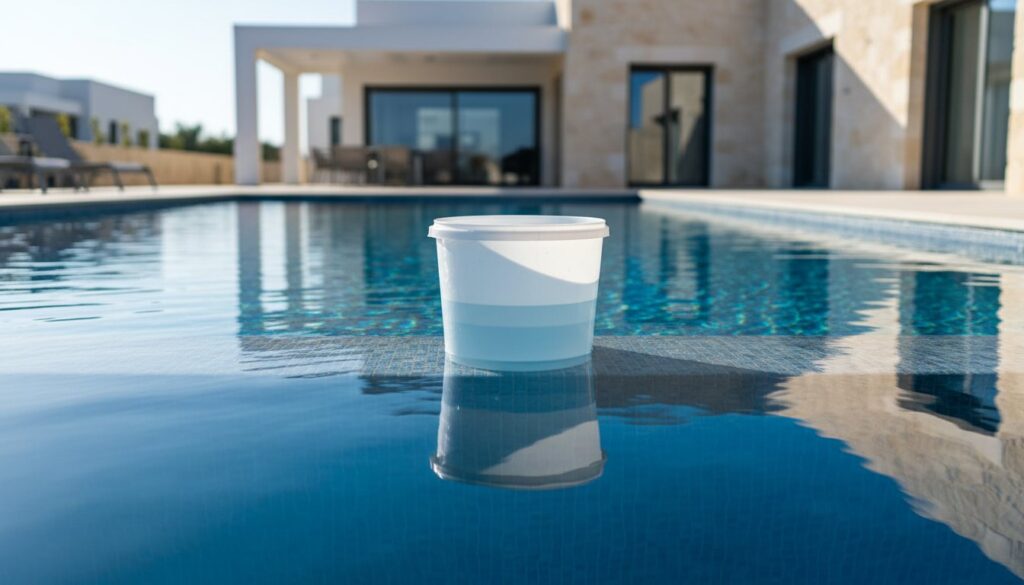
The bucket test remains the industry standard for verifying a leak. Place a large plastic bucket on the top step of your pool and fill it with water until the level inside matches the pool level outside. Mark both levels with waterproof tape or a marker. It’s vital to place the bucket in the pool so the water temperatures stay identical; this ensures the evaporation rate is the same for both bodies of water. After 24 hours, measure the change. If the pool water has dropped 1cm more than the water in the bucket, you’ve confirmed a leak. You can find more detailed visual cues on how to perform a bucket test to ensure your setup is perfect.
The Pump-On vs. Pump-Off Method
Once a leak is confirmed, you must determine if it’s in the plumbing or the pool shell. This requires two separate 24-hour observation periods. First, run your filtration system continuously and record the water loss. Next, turn the system off for a full day and compare the results. A leak that only occurs when the pump is on indicates a pressure-side plumbing issue. If the water loss is greater when the pump is off, the problem usually lies in the suction lines or the pool’s structure. This simple distinction helps narrow down the search area from the entire pool to specific pipe runs.
Safety is our priority during these checks. Don’t open the pump basket or manipulate valves while the system is under high pressure. When you inspect the equipment pad for visible drips or damp soil, keep your hands away from moving parts and electrical connections. Document your findings by noting the exact millimeter loss for both ‘pump on’ and ‘pump off’ cycles. This data allows The Pool People to fast-track your repair and restore your peace of mind. Providing these measurements during your initial consultation ensures we arrive with the correct specialized equipment for your specific swimming pool losing water paphos scenario.
The Invisible Costs: Why ‘Just Topping It Up’ is a Financial Trap
Many villa owners in Paphos view a minor drop in water level as a seasonal nuisance rather than a technical emergency. They drag the garden hose out, refill for twenty minutes, and assume the problem is managed. This habit is a significant financial drain that compounds over time. When a swimming pool losing water paphos goes untreated, you aren’t just losing H2O. You’re flushing expensive chemicals, energy, and the structural integrity of your property down the drain.
The “just top it up” mentality ignores the compounding nature of pool physics. A leak is a symptom of a system under stress. By masking the symptom, you allow the underlying cause to grow into a catastrophic failure. Our team often sees owners spending hundreds of Euros on “quick fixes” that cost five times more than a professional diagnostic service would have cost in the first place.
Chemical Dilution and the ‘Green Pool’ Risk
Every liter of fresh tap water added to your pool dilutes your carefully managed chemical balance. In Paphos, where summer temperatures regularly exceed 35°C, maintaining the correct level of Cyanuric Acid (stabilizer) is vital. This chemical acts as a sunblock for your chlorine. Constant refilling strips away this protection, leaving your chlorine vulnerable to burn-off by the Mediterranean sun in as little as two hours.
Saltwater chlorinators also suffer significantly. As salt levels plummet due to dilution, the electrolytic cell must work twice as hard to produce the same amount of sanitizer. This leads to premature cell failure, a replacement that typically costs between €400 and €800. Without these stabilizers and consistent salt levels, your water quickly becomes a breeding ground for algae. It’s significantly harder to keep your water crystal clear and inviting when you’re fighting a losing battle against constant dilution.
Structural Erosion and Paphos Soil Movement
Paphos is characterized by reactive clay soils that expand and contract based on moisture content. When a pool leaks, that water doesn’t simply vanish. It saturates the ground surrounding your pool shell and pipework. This creates “washouts,” where the soil supporting your pool is literally rinsed away, leaving hollow voids beneath the concrete or liner.
The weight of a standard 10×5 meter pool is roughly 75 tonnes. When the soil underneath shifts or disappears, the shell loses its support. This leads to structural cracking or sinking terraces that are incredibly expensive to remediate. Securing a professional pool leak detection Paphos assessment is the only way to ensure swimming pool losing water paphos issues don’t undermine your villa’s foundation.
- Liner Longevity: Constant exposure to imbalanced fresh water makes PVC liners brittle, leading to premature splitting.
- Equipment Stress: If a leak occurs in the suction line, the pump may draw in air, causing the motor to overheat and seize.
- Water Bills: With Paphos water rates tiered by usage, a hidden leak can easily push your quarterly bill into the highest price bracket.
Common Culprits for Pool Leaks in Cyprus Villas
Identifying why a swimming pool losing water in Paphos occurs requires an understanding of the unique environmental stresses in Cyprus. Our Mediterranean climate, while perfect for outdoor living, creates a challenging environment for pool infrastructure. High UV levels and localized ground movement are the primary drivers of structural fatigue in local installations.
Paphos sits in a seismically active zone. Frequent minor tremors, which often go unnoticed by residents, apply significant stress to rigid PVC pipework buried beneath your terrace. These micro-movements cause small fractures at the weakest points, typically where the pipes meet the pool shell. When you combine this with the 320 days of intense sunshine we experience annually, the materials reach their breaking point faster than in cooler climates.
Liner Failures and Seal Deterioration
Vinyl liners in Cyprus face a constant battle against UV degradation. When the UV index hits 11 during July and August, the plasticizers in the liner begin to evaporate. This process makes the material brittle. You’ll recognize the signs when the liner feels “crispy” above the waterline or shows visible wrinkles and fading. These aren’t just cosmetic issues; they indicate the material can no longer flex with water pressure.
Gaskets around skimmers and return jets are equally vulnerable. The extreme heat causes expansion and contraction cycles that eventually flatten these seals. We use a professional “Dye Test” to confirm these leaks. By injecting a specialized heavy dye near the seal while the pump is off, we can see if the water’s suction pulls the color into the fitting. It’s a precise way to identify a failing gasket without unnecessary excavation.
Skimmer Cracks and Light Niche Leaks
The underwater light niche is the most frequent source of “mystery” leaks we encounter in Paphos villas. The leak rarely happens through the glass of the lamp. Instead, it occurs in the conduit, the pipe that carries the electrical cable from the pool to the junction box. If this conduit isn’t properly sealed with a professional-grade cord stopper or internal epoxy, water will steadily exit the pool through the back of the niche.
In areas like Peyia, where many villas are built on sloped terrain, ground movement is a major factor. The “throat” of the skimmer, where the plastic unit joins the concrete pool beam, often develops hairline cracks as the ground shifts. A simple ink test can confirm this. We apply a small amount of reagent to the suspected crack; if the ink disappears into the fissure, we’ve found the culprit. These structural leaks require professional resin injections to ensure a long-term fix and restore your peace of mind.
Don’t let a hidden leak damage your property’s foundation. Contact the experts at The Pool People for a professional leak detection and repair service today.
Professional Leak Detection and Repair in Paphos
Locating a leak used to mean excavating large sections of a pool deck based on guesswork and intuition. In 2026, those days are gone. Modern diagnostics have transformed how we handle a swimming pool losing water in Paphos, moving away from destructive digging toward surgical precision. At The Pool People, we prioritize a “peace of mind” philosophy that focuses on identifying the root cause of water loss before any physical repair begins. This technical accuracy protects your property and ensures that the structural integrity of your terrace remains intact.
When you book a professional diagnostic visit, you aren’t just paying for a technician’s time; you’re investing in a comprehensive site audit. Our experts evaluate the entire circulation system, from the plant room to the furthest underwater light fitting. This methodical process ensures that no secondary leaks are missed, providing a clear roadmap for long-term restoration rather than a temporary patch.
Non-Invasive Technology: Acoustic and Dye Testing
We utilize ultrasonic microphones to pinpoint pipe failures with incredible accuracy. These sensitive devices allow our team to “hear” the specific frequency of water escaping through a breach, even when that pipe is buried under 2 meters of reinforced concrete or decorative tiling. To ensure we understand the exact path of your pool’s infrastructure, we use electronic trackers to map the plumbing layout. Once the layout is clear, we perform manifold pressure testing. This allows us to isolate specific zones, such as the skimmer lines or the return jets, to confirm exactly where the pressure drop occurs. This data-driven approach means we only ever disturb the ground exactly where the problem exists.
Restoring Your Peace of Mind
Choosing PHTA-certified technicians is the only way to guarantee that repairs meet international safety and engineering standards. Whether your pool requires targeted epoxy injections for structural cracks or a full high-grade liner replacement, the quality of the execution determines how long the fix will last. Professional detection saves you thousands of Euros over time. A swimming pool losing water in Paphos can waste over 15,000 liters of water annually from a leak as small as 5mm per day. This doesn’t just impact your water bill; it dilutes your chemicals and forces your pump to work harder.
The next step for any concerned owner is to secure a professional assessment. Our team provides expert pool maintenance in Paphos that removes the stress of ownership. By scheduling a comprehensive site audit in the Paphos District, you ensure your investment is protected by the most trusted names in the Cypriot industry. We don’t just fix pools; we restore the crystal-clear excellence you expect from your home environment.
Protect Your Pool Investment for 2026 and Beyond
Ignoring a leaking pool doesn’t just waste water; it risks the structural integrity of your property and leads to mounting costs in chemicals and electricity. While the Mediterranean heat accounts for some evaporation, a swimming pool losing water paphos homeowners often experience is frequently linked to hidden pipe failures or liner issues. Identifying these problems early with simple diagnostics can save you from a financial trap, but precision repair requires technical expertise.
The Pool People bring over 20 years of local experience to every diagnostic. Our PHTA/NSPF Certified Technicians use non-invasive detection technology to pinpoint leaks without unnecessary excavation. We focus on providing a clear, technical solution that restores your pool to its crystal clear, inviting state. Don’t let a minor leak turn into a major renovation.
Stop the leak and restore your peace of mind—Book an expert diagnostic today
Taking action now ensures your villa remains a stress-free sanctuary for the upcoming season.
Frequently Asked Questions
How much water loss is normal for a pool in Paphos?
Evaporation is the primary cause of water loss in the Mediterranean climate. In Paphos, where summer temperatures frequently exceed 35°C, a typical pool loses between 3 mm and 6 mm of water daily. During peak heat in July and August, this can total 50 mm per week. If your water level drops by more than 1 cm in a 24-hour period, it’s likely you have a structural or mechanical issue rather than simple evaporation.
Can I fix a pool leak myself without calling a professional?
You can perform basic diagnostic checks like the bucket test or inspecting the pump room for visible drips. However, most leaks occur in underground pipework or within the pool shell, requiring specialized acoustic equipment for accurate detection. Attempting DIY repairs on liners or concrete often leads to further damage. Trusting The Professionals ensures that every repair meets PHTA standards, providing long-term reliability and protecting your property’s value.
Is it dangerous to leave a pool leaking for a long time?
Leaving a leak unresolved can undermine the structural integrity of your entire pool and the surrounding patio. A minor leak of 5 mm per day can waste over 10,000 liters of water annually, saturating the ground and potentially causing soil subsidence. This creates voids under the pool deck that lead to expensive cracks and “sinkholes.” Addressing the issue early provides the peace of mind that your home’s foundation remains stable and safe.
How much does professional pool leak detection cost in Paphos?
Professional leak detection in the Cyprus market typically starts from €250 to €450 depending on the pool’s size and complexity. This investment covers a comprehensive diagnostic report using ultrasonic technology and pressure testing to locate the exact source of the problem. While prices vary among providers, choosing an expert with international certifications like SPATA ensures the job is done correctly the first time. This diagnostic fee is a small price for significant water savings.
Does a pool cover help reduce water loss from a leak?
A pool cover only reduces water loss caused by evaporation, not by a physical leak in the structure or plumbing. High-quality covers can reduce evaporation by 95%, which is excellent for heat retention and chemical stability. If your swimming pool losing water paphos issues persist while the cover is securely in place, the problem is definitely mechanical. Covers are a great maintenance tool, but they won’t mask a hole in a liner or a cracked pipe.
Will my home insurance in Cyprus cover pool leak repairs?
Most standard Cyprus home insurance policies cover “escape of water” damage but rarely the actual repair of the leak itself. This means the insurer might pay to fix a water-damaged retaining wall, but not the specific pipe that burst. Review your policy for “trace and access” cover, which often pays for the cost of finding the leak. We recommend checking your specific policy wording from 2024 or 2025 to confirm your level of protection.
What is the fastest way to tell if my pool has a leak?
The bucket test is the industry standard for a quick, 24-hour diagnostic check. Place a bucket of water on the pool step and mark the water level both inside and outside the container. After 24 hours, compare the two marks. If the pool level dropped more than the bucket level, a leak is present. This simple method separates natural evaporation from structural issues, allowing you to take action before the damage worsens.
Can a small leak cause my pool to turn green?
A constant leak makes it nearly impossible to maintain correct chemical balancing in your water. As you add fresh tap water to replace what’s lost, you dilute the chlorine and stabilizers required to keep the water safe. In the 30°C+ Paphos heat, algae can bloom within 12 hours if sanitizer levels drop too low. Fixing the leak is the only way to ensure your water remains crystal clear, inviting, and healthy for your family.