
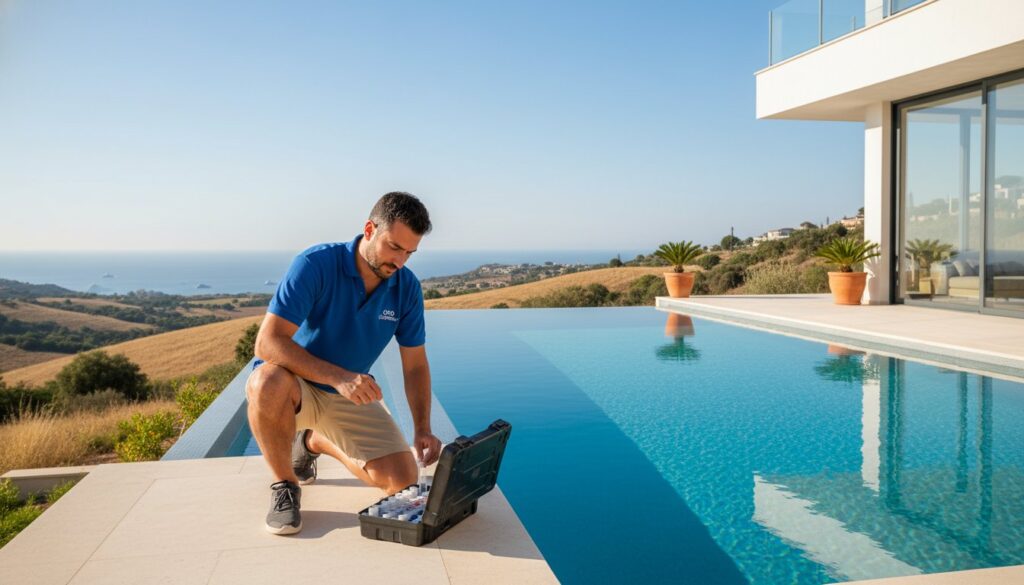
Last July, a villa owner in the Peyia Hillside area discovered their pristine pool had turned a murky shade of green in just 48 hours after a sudden 38°C heat spike and a heavy Calima dust storm. It’s a frustrating reality for many residents who realize that the Mediterranean climate demands more than a basic DIY approach. You’ve likely felt the same pressure to keep your water inviting while worrying about the strict Cyprus communal pool regulations that now govern rental properties.
Choosing professional pool maintenance Peyia residents can trust is about more than just aesthetics; it’s about protecting your health and your investment. In this 2026 guide, you’ll discover how CPO-certified technical care prevents rapid algae growth and why our methodical approach to chemical balancing provides the ultimate peace of mind. We’ll outline the exact steps to lower your long-term repair costs and ensure your villa remains fully compliant with the latest safety standards, helping you avoid potential fines of over €2,000 for non-compliance.
Key Takeaways
- Understand how the intense Mediterranean sun and Calima dust storms impact your filtration system and learn the professional strategies to counter them.
- Discover the technical importance of CPO certification and how international standards prevent common maintenance failures in the Paphos region.
- Navigate the complex legal landscape of Cyprus pool regulations, ensuring your private villa or communal complex remains fully compliant and safe.
- Follow an expert seasonal guide for pool maintenance Peyia to manage high-intensity chemical demands and maintain a crystal-clear environment year-round.
- Learn how to protect your property investment and achieve total peace of mind by employing the same standards used to train the entire Cypriot pool industry.
The Reality of Pool Maintenance in Peyia: Climate and Challenges
Peyia’s stunning hillsides offer some of the most sought-after views in Cyprus, but they also present a unique set of environmental variables that can quickly compromise your swimming water. Professional pool maintenance Peyia homeowners rely on requires more than a casual skimming of the surface. The intense Paphos sun provides over 3,000 hours of sunshine annually. This high level of UV radiation acts as a catalyst for chlorine degradation, often depleting free chlorine levels by up to 90% in just two hours of direct exposure. Without precise chemical balancing, these conditions trigger rapid algae blooms that turn a crystal clear basin into a green health hazard overnight.
Maintaining water quality is about more than aesthetics; it’s about ensuring healthy conditions in swimming pools to protect bathers from harmful pathogens. In the Akamas region, the bather load factor is a critical consideration for holiday rental owners. A villa hosting 8 guests creates a significantly higher organic demand than a private residence used by two people. This increased load requires a calibrated approach to sanitation to prevent the water from becoming dull or unsafe during peak occupancy periods in August.
The Mediterranean Heat Factor
During July and August, water temperatures in Peyia frequently exceed 30°C. High temperatures accelerate chemical consumption and provide the perfect breeding ground for bacteria. A standard once-a-week cleaning schedule often fails during these peak months because the evaporation rate can reach 5 to 7 centimeters per week. If the water level drops below the skimmer mouth, the pump will draw in air. This leads to immediate overheating and potential pump burnout, a repair that can cost upwards of €400 for a quality replacement unit.
Dealing with Local Environmental Debris
Proximity to the Akamas Forest introduces organic challenges like pine needles and fine forest dust. These small particles bypass basic filtration if the equipment isn’t maintained to international standards. Calima dust storms from North Africa can deposit several kilograms of fine silt into a 10m x 5m pool in a single afternoon. This influx spikes the Total Dissolved Solids (TDS) levels. Total Dissolved Solids (TDS) represents the total weight of all soluble minerals, salts, and metals dissolved in the water, and it peaks in Cyprus due to high evaporation rates and the constant addition of treatment chemicals.
Peyia’s water supply is notoriously hard, often exceeding 300 parts per million (ppm) of calcium hardness. This leads to rapid calcium scaling on tiles and liners, which acts like a magnet for dirt and algae. Our approach to pool maintenance Peyia focuses on proactive management of these specific local factors. We ensure your system handles the 40% increase in chemical demand seen during heatwaves while protecting your equipment from the abrasive effects of Saharan dust and hard water deposits. This professional oversight provides the peace of mind that your investment remains a safe, inviting feature of your home.
The Professional Standard: Why CPO Certification Matters in Cyprus
Maintaining a swimming pool in the Mediterranean climate requires more than a basic understanding of chlorine levels. The industry benchmark for excellence is the Certified Pool Operator (CPO) status, a qualification managed by The Pool & Hot Tub Alliance (PHTA). This global standard ensures that technicians understand the complex physics and chemistry of water volume, filtration rates, and chemical interactions. Without this foundation, pool maintenance Peyia often descends into a cycle of “reactionary” care, where chemicals are added only after the water turns green or cloudy.
There’s a significant distinction between a pool cleaner and a professional pool technician. A cleaner might remove debris and add a few tablets, but a technician monitors the structural health of your investment. In the Paphos district, where summer temperatures regularly exceed 35°C, the margin for error is slim. We’ve seen hundreds of cases where improper chemical handling led to “green pool” disasters that required expensive drainage and acid washing. The Pool People don’t just follow these standards; we are the primary CPO trainers for the entire Paphos region, educating other companies to raise the bar for safety across Cyprus.
Science-Based Water Chemistry
Basic dip-tests only tell a fraction of the story. Our technicians utilize the Langelier Saturation Index (LSI) to determine if your water is corrosive, balanced, or scale-forming. This mathematical formula considers pH, temperature, and calcium hardness to protect your hardware. In Cyprus, the 300+ days of annual sunshine lead to rapid evaporation, which concentrates minerals and increases the risk of “Cyanuric Acid lock.” When stabilizer levels exceed 100ppm, your chlorine becomes ineffective regardless of how much you add. Professional balancing prevents this lock, potentially saving you over €2,500 in premature liner replacements and pump failures caused by calcification.
Health and Safety Compliance
Visible clarity doesn’t guarantee biological safety. Water that looks “crystal clear” can still harbor pathogens like Cryptosporidium or E. coli if the disinfection rates aren’t precisely managed. For the 5,000+ holiday villas and commercial complexes in the Peyia area, health and safety compliance is a legal and moral necessity. We implement rigorous risk assessment protocols that differ significantly between private residences and high-traffic commercial installations. Every technician we deploy follows the methodology taught in CPO Training Cyprus, ensuring your family and guests swim in water that meets international sanitization benchmarks.
Our team treats every pool as a critical piece of engineering rather than a simple tank of water. By focusing on preventative diagnostics, we eliminate the stress of equipment breakdowns during the peak of August. If you want to ensure your water remains biologically safe and your equipment stays under warranty, you can request a professional assessment from our certified team. This methodical approach provides the peace of mind that only comes from true technical expertise.
Private Villas vs. Communal Complexes: Navigating Peyia Regulations
Understanding the distinction between private and communal pool requirements is essential for every property owner in Peyia. Cyprus law treats these two categories with very different levels of scrutiny, particularly regarding safety and hygiene. For owners of private villas, the focus is often on lifestyle and efficiency; however, for communal committees, the priority shifts toward strict legal compliance and liability reduction. Since the 1992 and 1996 Swimming Pools Regulations, any pool shared by more than five residential units is classified as a public pool. This classification brings a set of rigorous standards that, if ignored, can lead to legal action or the closure of the facility by Paphos health inspectors.
Managing the high bather loads of Peyia holiday rentals requires a proactive strategy rather than a reactive one. During the peak months of July and August, a pool serving a 10-unit complex might see 40 different swimmers in a single afternoon. This influx of organic matter can deplete chlorine levels in less than 4 hours. Professional pool maintenance Peyia ensures that your water chemistry stays within the safe parameters of 1.0 to 3.0 mg/l for chlorine and a pH of 7.2 to 7.6. Adhering to CDC’s healthy swimming guidelines is a core part of our methodology, as it provides the scientific foundation for preventing recreational water illnesses in high-traffic environments.
Communal Pool Management Standards
Communal committees in Peyia must maintain a daily logbook that records pH levels, chlorine concentrations, and water clarity twice every 24 hours. Paphos health inspectors frequently conduct unannounced audits to verify these records. Beyond chemistry, safety infrastructure is non-negotiable. This includes clearly marked depth indicators at 0.5-meter intervals and prominent safety signage in English, Greek, and Russian. Our professional engineering support helps complexes install the required access control gates and non-slip surfaces, reducing the committee’s liability by 100% through documented adherence to local safety codes. This structured approach provides the peace of mind that every resident and guest is protected by international standards.
Private Villa Efficiency
For the 65% of Peyia villa owners who use their properties as “lock-up-and-leave” second homes, maintenance must be both reliable and automated. We specialize in tailoring schedules that keep water crystal clear even when the villa is vacant for 30 days or more. Salt water chlorination is a primary recommendation for these owners. By converting salt into a steady stream of pure chlorine, these systems eliminate the “peaks and troughs” of manual dosing. To further enhance efficiency, we integrate robotic cleaners into our service packages. These units operate independently of the main filtration system, removing 95% of surface debris and fine particles. This reduces the need for manual backwashing by 30%, saving water and ensuring the pool is always inviting for your next visit. Investing in high-quality pool maintenance Peyia means your home is a source of relaxation, not a logistical burden.
- Daily Logbooks: Mandatory for all Peyia complexes to meet Paphos municipal standards.
- Salt Water Systems: Reduces chemical handling for 85% of modern private villas.
- Access Control: Self-closing gates are a 2024 safety requirement for communal areas.
- Robotic Cleaning: Decreases wear on pool pumps by up to 20% over a 5-year period.
Actionable Seasonal Guide for Paphos Pool Owners
Owning a swimming pool in the Paphos district requires a strategy that respects the unique Mediterranean climate. Our local environment transitions from intense, dust-heavy summers to rainy winters, meaning your approach to pool maintenance Peyia must evolve with the calendar. Maintaining a pristine environment isn’t about luck; it’s about executing the right technical steps at the right time to ensure your investment remains a source of relaxation rather than a chore.
Spring serves as the critical transition period. After the winter rains, which can deposit significant organic matter and alter your water chemistry, you must prepare for the “Big Splash.” This involves a deep clean of the filtration system and a professional chemical recalibration. We typically see phosphate levels spike during this time due to runoff. Addressing these early prevents the aggressive algae blooms that often catch owners off guard as the temperatures rise in May.
When summer arrives, the focus shifts to high-intensity management. In July and August, temperatures in Peyia frequently exceed 35°C, causing rapid chlorine degradation through UV exposure. To keep your water crystal clear and safe, you should increase your filtration cycles to at least 10 or 12 hours per day. This ensures that the entire volume of water is processed and sanitized during the peak heat hours. Autumn then brings a different challenge: debris. As the winds pick up, keeping skimmer baskets clear is vital to prevent pump cavitation and maintain hydraulic efficiency.
Winter Maintenance: The Year-Round Myth
Many homeowners believe they can simply turn off their systems from December to March. This is a costly mistake in the Cyprus climate. Even in winter, the sun provides enough energy for algae to grow if the water remains stagnant. Neglecting your pool during the rainy season often leads to permanent liner staining from mineral deposits and organic debris. To protect your pool while managing costs, we recommend switching to “winter mode.” You can reduce your pump run time to approximately 4 hours daily, which keeps the water moving and chemicals distributed without the high electricity costs of summer settings. Maintaining a basic chemical balance through the winter ensures you won’t face a massive repair bill come April.
Upgrading for Efficiency
Energy costs in Cyprus are among the highest in Europe, making efficiency a priority for every villa owner. Upgrading to a variable speed pump is the most effective way to lower your overheads. These units allow you to run the pool at lower speeds for longer periods, often reducing electricity consumption by up to 80% compared to traditional single-speed motors. This technical shift provides a significant return on investment within just two or three seasons.
Beyond the mechanical room, consider the atmosphere of your outdoor space. Modern LED lighting upgrades allow for evening entertaining with minimal power draw, transforming your pool into a visual centerpiece after sunset. However, efficiency also means vigilance. If you notice your water levels dropping by more than 1cm per day beyond normal evaporation, it’s time to call the experts for pool leak detection Paphos to prevent structural damage and water waste. Expert pool maintenance Peyia ensures that these small issues are caught before they become expensive emergencies.
Ensure your pool stays in peak condition throughout every season with a bespoke care plan. Request your professional maintenance quote from The Pool People today.
Why The Pool People are Peyia’s Trusted Maintenance Partners
Choosing a partner for your pool maintenance Peyia isn’t just about finding someone to scoop out leaves. It’s about protecting a significant financial asset. Since 2004, The Pool People have served the Paphos and Peyia districts with a level of technical rigor that most local contractors simply cannot match. We don’t just clean pools; we engineer environments that are safe for your family and efficient for your wallet.
Our status as the only PHTA (Pool & Hot Tub Alliance) and NSPF (National Swimming Pool Foundation) certified training providers in the region is a critical differentiator. This means we literally set the standards that other companies try to follow. Every technician on our team operates under international safety protocols, ensuring that chemical balances are precise and mechanical systems are optimized for the harsh Cyprus sun. When you hire us, you’re hiring the educators of the industry.
We believe in a “Peace of Mind” philosophy. This isn’t a vague marketing promise; it’s a commitment to professional engineering. Whether we’re conducting ultrasonic leak detection or managing a full structural refurbishment, our approach is methodical. We understand the unique geological conditions in Peyia, from the coastal humidity to the specific soil types that can affect pool shells, allowing us to provide solutions that last decades rather than months.
Beyond Basic Cleaning
Our expertise extends far past the pool brush. We specialize in complex technical interventions including reinforced PVC liner replacements and the installation of energy-efficient salt chlorination systems. For residents who prefer a hands-on approach, our local Peyia storefront stocks professional-grade chemicals and hardware that you won’t find in a standard DIY shop. For those who want a completely hands-off experience, our “Set it and Forget it” maintenance subscriptions provide year-round stability. These packages ensure your water remains crystal clear and your equipment stays under warranty through regular, documented servicing. We currently manage over 500 pools across the region, maintaining a 98% client retention rate due to this reliability.
Get Your Professional Quote Today
A generic price list rarely reflects the reality of your pool’s needs. That’s why our quoting process begins with a site-specific survey. We identify potential issues, such as failing pump seals or rising calcium levels, before they turn into €1,000 repairs. Our pricing is transparent, with monthly maintenance rates and one-off repair costs clearly outlined from the start. We don’t believe in hidden fees or “emergency” surcharges for routine issues. Our goal is to provide a predictable, high-quality service that lets you enjoy your home without the stress of mechanical failure. Contact The Pool People for a professional Peyia pool assessment and see the difference that 20 years of expertise makes to your backyard oasis.
Secure Your Mediterranean Lifestyle with Professional Standards
Owning a pool in the Peyia hills offers an unmatched lifestyle, but maintaining crystal clear water requires more than basic skimming. The 2026 standards for Cyprus demand a technical approach to chemical balancing and equipment care, especially given our intense summer heatwaves. Since 2005, The Pool People has led the local industry as the exclusive providers of CPO training in Cyprus. We don’t just clean pools; we set the benchmark for safety and hygiene across the Paphos district. Our team of PHTA and NSPF Certified Pool Operators ensures your installation remains a healthy, inviting environment for your family or guests. Whether you manage a large communal complex or a private villa, choosing professional pool maintenance Peyia protects your property value and provides total peace of mind. We’ve spent 19 years refining our processes to handle the unique Mediterranean climate challenges. Let us manage the technical complexities so you can focus on enjoying your investment. Reliability is our standard, and your safety is our priority.
Get Your Free Pool Maintenance Quote in Peyia
Your perfect pool season starts with the right partner by your side.
Frequently Asked Questions
How much does monthly pool maintenance in Peyia typically cost?
Professional pool maintenance in Peyia typically costs between €90 and €150 per month depending on the pool size and visit frequency. Most homeowners opt for twice-weekly visits during the summer to maintain water safety and clarity. This fee usually covers labor and essential chemicals, providing a cost-effective way to protect your property investment and ensure peace of mind.
Is it better to have a salt water pool or a chlorine pool in Cyprus?
Salt water pools are the preferred choice for 65% of our clients in Cyprus because they offer a gentler swimming experience and automated sanitization. While the initial installation of a salt chlorinator costs roughly €1,200 more than a standard chlorine feeder, it reduces long-term chemical handling. Both systems are effective, but salt water provides a more consistent, skin-friendly environment in the Mediterranean heat.
How often should I backwash my pool filter during a Paphos summer?
You should backwash your sand filter every 7 to 10 days during the peak Paphos summer. High temperatures reaching 38°C and frequent Saharan dust events quickly clog the filtration media with debris. Regular backwashing keeps the filter pressure within the optimal 10 to 15 psi range, ensuring your pump operates efficiently and your water stays crystal clear.
What are the legal requirements for a communal pool in Paphos?
Communal pools must strictly comply with the Cyprus Public Swimming Pools Regulation Law N.55(I)/92 to operate legally. This law requires monthly chemical testing by an accredited laboratory and the presence of a qualified lifeguard if the pool serves more than 5 residential units. Our team ensures that communal facilities meet these 100% compliance standards to protect committee members from legal liability.
Why is my pool water turning green even though the pump is running?
Green water is usually caused by a chemical imbalance or high phosphate levels rather than a mechanical pump issue. Even with the pump running 9 hours a day, algae can bloom if your free chlorine levels drop below 1.5 ppm during a heatwave. We find that 85% of green pools in the region require a professional shock treatment and pH balancing to restore safety.
Can I maintain my own pool in Peyia, or do I need a professional?
You can maintain your own pool, but 80% of villa owners eventually switch to professional pool maintenance Peyia services to guarantee PHTA safety standards. Professionals have the technical expertise to balance complex water chemistry and identify equipment wear before it leads to a €600 pump failure. Hiring an expert saves you roughly 4 hours of labor every week.
How do I know if my Paphos pool has a leak or is just evaporating?
You can use the bucket test to determine if your water loss is due to a leak or natural evaporation. In July, a Paphos pool typically loses 6mm to 8mm of water daily through evaporation alone. If your water level drops by more than 12mm in a 24-hour period, you likely have a leak that requires professional pressure testing to locate.
What should I do with my pool when my Peyia villa is empty in winter?
You should switch to a winter maintenance schedule rather than draining the pool, which can cause structural damage. Reducing your pump run time to 4 hours daily saves about 60% on electricity while keeping the water healthy. One professional visit per week is enough to balance chemicals and prevent algae, ensuring the pool is ready for use the moment you return.