
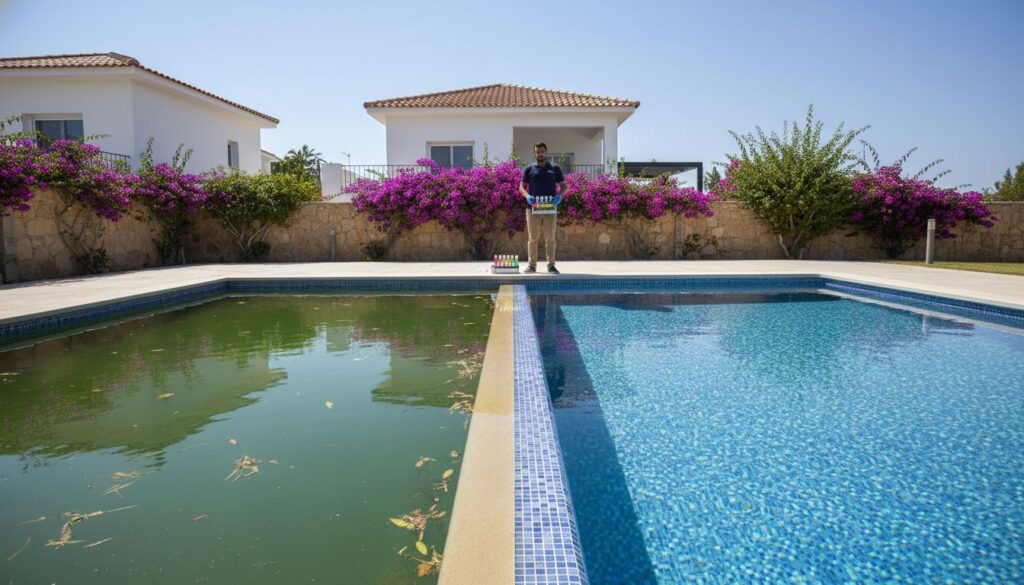
Just last week, as the Paphos sun beat down at a relentless 34°C, a client in Coral Bay called us in a panic. Overnight, their sparkling oasis had transformed into a murky, uninviting swamp. It’s a frustratingly common story here in Cyprus. You’ve likely spent a small fortune on chemicals from the local shop, only to watch the green return with a vengeance, all while worrying about the expensive liner you’re trying to protect. It’s enough to make anyone want to give up.
This guide is different. We’re not selling a magic potion; we’re giving you the professional, industry-certified process to permanently solve your green pool Paphos problem. You will learn the exact science behind the bloom and the precise, step-by-step method we use to restore crystal-clear, safe water without risking damage. We’ll walk you through everything from correctly identifying the algae to balancing your water chemistry for long-term prevention, giving you complete peace of mind.
Key Takeaways
- Understand why the intense Paphos heat and unique water chemistry can turn a pool green seemingly overnight, even with basic chemical use.
- Discover the concept of ‘Chlorine Lock’ and learn why simply adding more chlorine is often an ineffective and costly mistake for Paphos pool owners.
- Learn the professional 5-step recovery method to safely fix a green pool Paphos, focusing on foundational chemical balancing before adding shock treatments.
- Find out how to prevent permanent algae staining on your liner and implement a simple maintenance schedule to ensure crystal clear water all summer.
Why Your Paphos Pool Turned Green: Understanding the Local Algae Bloom
You went to bed with a crystal-clear pool and woke up to a green swamp. It’s a frustratingly common story for pool owners across Cyprus, especially during the peak summer months from June to September. This rapid transformation isn’t just dirt; it’s an uncontrolled algae bloom, a living organism that has found the perfect conditions to thrive in your water. Understanding what causes a green pool Paphos homeowners dread is the first, most critical step toward reclaiming your beautiful, inviting swimming environment.
The core issue is a combination of intense heat and imbalanced water chemistry. When Paphos temperatures consistently exceed 35°C, your pool becomes an incubator. Algae spores, which are always present in the air, find this warm water irresistible. If your pool’s chemical defenses are down, these spores can multiply exponentially, turning a pool green in less than 24 hours. This is why simply adding more chlorine often fails. If the foundational chemistry is wrong, the chlorine you add is either ineffective or consumed faster than it can work. Effective treatment requires a scientific approach, not guesswork.
The Role of the Paphos Climate in Algae Growth
Our beautiful Mediterranean climate presents unique challenges for pool maintenance. The very factors that make Paphos a paradise for people also make it a paradise for algae. Three local triggers are primarily responsible:
- Intense UV Radiation: The Cyprus sun is relentless. Without adequate stabiliser (Cyanuric Acid), the sun’s UV rays can destroy up to 90% of your free chlorine in under two hours. This leaves your pool completely unprotected for most of the day.
- Sahara Dust: Those hazy, orange skies aren’t just an aesthetic concern. Dust storms originating from the Sahara carry high concentrations of phosphates, which land directly in your pool. Phosphates are a primary food source for algae, and a sudden spike can fuel an explosive bloom, a problem we see frequently in elevated areas like Peyia.
- Coastal Humidity: High humidity, especially in coastal areas of Paphos, keeps the environment moist and warm, creating ideal conditions for airborne algae spores to reproduce and spread before they even reach your water.
Common Misconceptions About Green Water in Cyprus
One of the biggest hurdles in treating a green pool is overcoming common myths. Many owners believe a green pool is simply ‘dirty’ and that more filtering or vacuuming will solve the problem. While removing physical debris is important, it won’t stop the bloom. Algae is a microscopic plant that must be killed chemically. This is a fundamental aspect of proper pool sanitation principles, where biological contaminants require a targeted sanitiser, not just physical filtration.
It’s also crucial to distinguish between different types of green water. Is your water cloudy and green, or is it clear but green?
- Cloudy Green Water is the classic sign of an algae bloom. Millions of suspended algae particles are making the water opaque.
- Clear Green Water often points to a different issue: dissolved metals, typically copper, in your water. This can happen from overuse of copper-based algaecides or corrosion of copper plumbing components. Treating this requires a completely different approach than fighting an algae infestation.
Recognising the true cause of your green pool is the foundation for a fast, effective, and lasting solution, ensuring you get back to enjoying your pool with complete peace of mind.
The Science of Algae: Why Standard Treatments Fail in Paphos
You’ve woken up to a green pool. The typical response is to pour in more chlorine, but after days of effort and expense, the water remains a murky swamp. Why? Because a green pool in Paphos is rarely a simple chlorine problem. It’s a complex chemical imbalance driven by our unique local conditions. Standard off-the-shelf treatments often fail because they don’t account for the specific challenges of our water chemistry, leading to wasted money and prolonged frustration.
Before you can clear the water, you must understand what you’re fighting. Three specific factors in Paphos create a perfect storm for algae blooms:
- Chlorine Lock: Your chlorine is present, but it’s chemically handcuffed and can’t do its job.
- Water Hardness: Our extremely hard water works against your sanitiser, making it less effective.
- Algae Nutrients: Local dust and soil provide a constant food supply for algae.
Cyanuric Acid: The Silent Killer of Pool Clarity
Think of Cyanuric Acid (CYA) as sunscreen for your chlorine. Under the intense Cyprus sun, unstabilised chlorine can be destroyed in just a few hours. CYA, or stabiliser, protects it. The problem arises from “over-stabilisation,” a common issue here caused by the prolonged use of stabilised chlorine pucks or granules throughout the long Paphos summer. While the ideal CYA level is 30-50 parts per million (ppm), we frequently test pools with levels exceeding 100 ppm. When CYA levels climb above 120 ppm, your chlorine becomes almost completely bound to the stabiliser, rendering it 0% effective at sanitizing the water, no matter how much you add.
The Paphos Water Hardness Challenge
Paphos is notorious for its hard water. Municipal and borehole water sources often have calcium hardness levels exceeding 400 ppm (the ideal range is 200-400 ppm). This high mineral content naturally pushes the pH of your pool water upwards, often above the recommended maximum of 7.6. This is where the real problem begins. At a pH of 8.0, over 50% of your free chlorine is inactive and unable to kill algae. Adding a shock treatment to a pool with high pH is like trying to fight a fire with half a bucket of water. You’re simply not getting the chemical power you paid for, and you risk creating calcium scale, which can cloud your water and damage your equipment.
Finally, there’s the phosphate factor. Phosphates are algae’s favourite food, and in Paphos, they are everywhere. Dust from nearby agricultural fields and airborne particles from garden fertilisers constantly settle in your pool, providing a nutrient-rich buffet for algae to feast on. This is why balancing your water chemistry before adding sanitiser is non-negotiable. This principle of stabilising the environment first is a cornerstone of professional pool management, aligning with the CDC guidelines for pool operation, which confirm that proper water chemistry is the foundation for preventing germ growth. Tackling a stubborn green pool Paphos homeowners face requires a scientific approach, not guesswork.
Understanding these interconnected chemical reactions is what separates a fast, permanent solution from a frustrating and expensive battle. It’s why a professional water analysis is the most critical first step toward reclaiming your crystal-clear water and achieving genuine peace of mind.
DIY Recovery vs. Professional Pool Remediation in Paphos
When you first see a tinge of green in your pool, the temptation to handle it yourself is strong. A quick trip to a local shop for some chemicals seems like a fast, affordable fix. However, the true cost of DIY pool recovery often extends far beyond the initial €50-€70 spent on shock chlorine and algaecide. This approach frequently leads to multiple return trips, wasted chemicals from incorrect application, and a pool that remains stubbornly green. Even worse, improper chemical use, like adding acid incorrectly, can permanently damage a vinyl liner, turning a small problem into a repair bill exceeding €2,500.
One of the most underestimated risks of a DIY fix is permanent staining. When a large amount of algae is killed off, it doesn’t just vanish. The dead organic matter must be filtered and vacuumed out correctly. If left to settle, it can embed into your pool’s surface, creating unsightly green or brown stains that require a professional acid wash, costing upwards of €400, to remove. A CPO-certified technician understands the precise sequence needed to kill, coagulate, and remove algae without causing secondary damage. Getting it right the first time isn’t just faster; it’s significantly more cost-effective.
Safety is another critical factor, especially in the Cypriot heat. Handling high-strength liquid chlorine or muriatic acid requires training and proper personal protective equipment (PPE). These chemicals can cause severe skin burns and respiratory irritation if mishandled. Understanding the specific hazards and correct dosages, as outlined in this comprehensive university guide to pool chemicals, is essential for safe application. Our professionals are trained to manage these substances safely, protecting you, your family, and your property.
When to Call ‘The Professionals’ in Paphos
While some minor cloudiness can be a DIY task, certain situations demand immediate expert intervention. If you spot small, dark spots, you may have ‘Black Algae,’ a highly resistant strain with roots that penetrate pool surfaces, making it immune to standard shock treatments. A green pool in Paphos can also be a symptom of critical equipment failure, like a broken pump or a clogged filter. Finally, if you have guests arriving at your Peyia villa in 48 hours, a professional turnaround is your only guaranteed solution.
The Peace of Mind Factor
There is a vast difference between water that looks clear and water that is sanitized and safe. Our goal isn’t just clarity; it’s perfect water chemistry. We use professional-grade digital photometers and Taylor K-2000 test kits that measure up to seven key indicators, including cyanuric acid and calcium hardness. These provide precise data far beyond the vague colour-matching of cheap test strips. This scientific approach stops the endless cycle of adding chemicals and creates a stable, healthy swimming environment, saving you money and delivering true peace of mind.
The Paphos Green-to-Clear Protocol: A 5-Step Guide
Reclaiming your pool from an algae takeover isn’t about randomly adding chemicals; it’s a methodical process that requires precision. As Paphos’ leading pool care professionals, we use an internationally recognised protocol adapted for our unique climate. Follow these five critical steps to transform your pool from green to pristine and restore your peace of mind.
Step 1: Physical Debris Removal
Before any chemicals are added, you must manually remove as much organic debris as possible. Use a heavy-duty leaf rake to scoop out leaves, twigs, and any sunken matter from the pool floor. Algae is not the only thing your chlorine will attack. Every leaf left in the water consumes valuable sanitiser, distracting it from its primary mission of killing the algae bloom.
Step 2: Balance Your Water Chemistry Foundation
An effective shock treatment is impossible if the foundational chemistry is wrong. First, test and adjust your pool’s Total Alkalinity (TA) to a range of 80-120 parts per million (ppm). Next, lower the pH to between 7.2 and 7.4. A lower pH makes chlorine significantly more potent, ensuring your shock treatment delivers maximum impact. Don’t skip this step; it’s the bedrock of a successful recovery.
Step 3: The ‘SLAM’ Method for a Paphos Pool
SLAM stands for Shock, Level, and Maintain. This is an aggressive, multi-day chlorination process. Your goal is to raise the Free Chlorine (FC) to a specific shock level determined by your Cyanuric Acid (CYA) level and keep it there until the water is clear. This constant high chlorine level is what ultimately defeats a stubborn green pool Paphos residents often face.
- Test your CYA. If it’s over 80 ppm, a partial drain may be necessary for the shock to be effective.
- Brush the pool walls and floor vigorously at least twice a day to dislodge stubborn algae.
- Maintain the shock-level chlorine until you can see the bottom of the deep end clearly and your overnight chlorine loss is less than 1.0 ppm.
Step 4: Filtration and Flocculation
Once the algae is dead, it turns into a grey or white cloud, making the water murky. Your filter is now working overtime to remove these millions of tiny particles. To speed this up, you can use a chemical aid. This is where you’ll run your pump continuously, 24/7, until the water is clear.
Step 5: Post-Recovery Maintenance
After the water is crystal clear, it’s time to prevent a relapse. Deep clean your filter using a specialised chemical cleaner to remove any lingering oils and algae remnants. A simple backwash isn’t enough. Finally, re-test and re-balance all your chemical levels (pH, TA, Calcium Hardness, and CYA) to their normal operating ranges.
Step-by-Step Chemical Dosing
To perform the SLAM method, you must calculate the shock dose based on your CYA. For a common CYA level of 40 ppm in a Paphos pool, your target shock level for Free Chlorine is 16 ppm. For maximum impact in the Paphos sun, always add your shock treatment after sunset to prevent the UV rays from degrading the chlorine before it can kill the algae. Remember to keep the pump running 24/7 to ensure complete circulation and filtration throughout this entire phase.
Clearing the Cloud: Flocculants and Clarifiers
A clarifier is a coagulant that binds tiny particles into larger clusters your filter can more easily catch; it’s best for mild cloudiness. A flocculant is much stronger, binding dead algae into heavy clumps that sink to the floor. You must then vacuum these clumps directly out of the pool using the ‘waste’ setting on your multiport valve. While this means losing some expensive water, it removes the dead algae in under an hour instead of waiting 3-4 days for your filter to do it.
This multi-day process requires precision and constant testing. If you want guaranteed results without the stress, contact The Pool People for a professional green pool recovery service.
Long-Term Prevention: Keeping Your Paphos Pool Blue All Summer
You’ve successfully cleared the algae and restored your pool’s sparkle. Now, the real work begins: ensuring it stays that way. In Cyprus, the old saying “prevention is cheaper than cure” is a fundamental truth for pool owners. An emergency shock treatment to fix a green pool can easily cost over €150 in chemicals and hours of your time. Consistent, proactive care costs a fraction of that and saves you the stress. The intense Paphos sun and seasonal dust demand a disciplined approach to keep your water crystal clear.
For villa owners in Paphos and Peyia, a non-negotiable weekly schedule is the backbone of a healthy pool. This routine is your first line of defence against the conditions that cause a green pool Paphos emergency.
- Test & Balance (2-3 times weekly): Check pH and free chlorine levels. In summer, aim for a pH of 7.2-7.6 and free chlorine between 2.0-4.0 ppm. The high UV levels deplete chlorine rapidly.
- Clean Baskets (Weekly): Empty the skimmer and pump baskets to maintain strong water circulation. Clogged baskets are a primary cause of pump failure.
- Brush & Skim (Weekly): Brush the pool walls, steps, and floor to dislodge any nascent algae spores. Skim leaves and debris from the surface before they sink and decay.
- Filter Backwash (Every 2-3 weeks): During the high-use summer months, backwashing your filter regularly is essential to remove trapped contaminants and maintain optimal filtration.
While manual maintenance is effective, upgrading your equipment provides a level of stability that is difficult to achieve by hand, especially in our demanding climate. Modern systems like saltwater chlorinators and UV sanitisers automate sanitisation, giving you more consistent results and greater peace of mind.
The Benefits of Salt Water Chlorination in Cyprus
A salt water chlorinator is a game-changer for pool owners. It uses electrolysis to convert a low concentration of salt in the water into pure chlorine, providing a steady, automatic dose. This eliminates the “peaks and troughs” of manual chlorination that give algae a chance to bloom. The water also feels noticeably softer and is gentler on skin and eyes, a welcome relief in the dry Paphos air. While the initial installation for a typical 8x4m pool costs around €1,300, it pays for itself in 3-4 years by eliminating the annual €350+ expense of chlorine tablets.
Professional Maintenance: Your ‘Peace of Mind’ Solution
The most reliable way to prevent a recurring green pool is to entrust its care to certified professionals. Our CPO-trained technicians represent the gold standard in the Paphos district, operating with a level of precision that guarantees safety and pristine water quality. We understand the unique challenges of the local environment, from water hardness to dust storms. You can explore The Pool People’s maintenance packages to find a plan that fits your needs, from weekly checks to comprehensive year-round care.
Don’t let your summer be defined by chemical tests and algae battles. Your time in Cyprus is precious. Let the experts handle the details, so you can simply enjoy the perfect, inviting blue water you deserve. Contact us today and secure your peace of mind.
Your Path to a Permanently Blue Paphos Pool
Transforming your pool from green to pristine blue is about more than just adding standard chemicals. It requires a precise understanding of the unique algae that thrive in our Mediterranean climate. While our 5-step guide offers a strong foundation, solving a persistent green pool Paphos problem for good demands expert intervention to ensure safety and perfect chemical balance. Long-term prevention is always more effective than repeated, costly recovery efforts.
Don’t let algae ruin another day of sunshine. As PHTA/NSPF Certified Pool Operators with over 20 years of specialised experience in the Paphos district, we provide the professional assurance you need. We deliver guaranteed results and complete peace of mind. Get your Paphos pool back to crystal clear today with our professional recovery service and let our experts restore its beauty and safety.
Your sparkling, inviting oasis is waiting.
Frequently Asked Questions About Green Pools in Paphos
Is it safe to swim in a green pool in Paphos?
No, it’s absolutely not safe to swim in a green pool. The green colour indicates an algae bloom, which can harbour harmful bacteria like E. coli. This environment also creates dangerously slick surfaces on steps and ladders. Most importantly, the cloudy water makes it impossible to see a swimmer in distress at the bottom of the pool, creating a serious drowning hazard. For your family’s safety, the pool must be closed until it’s professionally treated and crystal clear.
How long does it take to turn a green pool blue again?
The time to clear a green pool typically ranges from 24 hours to five days. The exact duration depends on the severity of the algae, the efficiency of your filtration system, and the water temperature. A light green pool might clear in a day or two with a proper shock treatment. However, a very dark green pool, often called a “swamp,” could take up to a week of intensive chemical balancing, flocculant use, and filtration before it’s safe and inviting again.
Why did my pool turn green even though I added chlorine?
Your pool likely turned green because the chlorine was rendered ineffective by imbalanced water chemistry. A common issue here in Cyprus is high Cyanuric Acid (CYA), or “stabiliser,” which can “lock” your chlorine, preventing it from sanitising the water. A pH level above 7.8 also reduces chlorine’s power by more than 50%. A professional water test is required to identify the root cause, as simply adding more chlorine won’t solve the underlying problem.
Does the Sahara dust in Paphos cause algae to grow?
Yes, Sahara dust is a major contributor to algae growth in Paphos pools. The fine dust particles carry phosphates, which are a primary food source for algae. When this dust settles in your water after a storm, it provides the perfect nutrients for a rapid algae bloom. This is why it is critical to test your water and add a phosphate remover after a dust event to prevent the kind of green pool Paphos homeowners dread.
Can I use household bleach to fix my green pool?
We strongly advise against using household bleach to treat a green pool. While it contains sodium hypochlorite, the same active ingredient in liquid chlorine, its concentration is very low (typically 3-6%). You would need an impractical and costly amount to be effective. Professional-grade liquid chlorine has a concentration of 10-12% and is specifically formulated for pools, ensuring a powerful, safe shock treatment without the unwanted additives found in household products.
How much does it cost for a professional green pool recovery in Paphos?
A professional green pool recovery in Paphos generally costs between €150 and €400. The final price depends on factors like the size of your pool and the severity of the algae infestation. A smaller, light-green pool will be at the lower end of the range. A large, dark green pool requiring multiple visits and a high volume of specialised chemicals will be closer to the €400 mark. We always provide a fixed, transparent quote after an on-site assessment for your complete peace of mind.
Will a green pool damage my pool liner or equipment?
Yes, leaving a pool green for an extended period can cause significant damage. Certain strains of algae can leave stubborn stains on vinyl liners and plaster surfaces that are very difficult to remove. The dead organic matter will quickly clog your filter, putting immense strain on your pump motor and shortening its lifespan. The aggressive chemical shock needed for recovery can also be hard on seals and gaskets if not managed correctly. Prompt action protects your investment.
How often should I backwash my filter during the clearing process?
You should backwash your sand or DE filter whenever the pressure gauge reads 8-10 PSI above its clean, starting pressure. During a green pool recovery, your filter is capturing enormous amounts of dead algae, so you may need to backwash daily for the first 24-48 hours. Don’t follow a timer; watch the gauge. This ensures your system operates at peak efficiency, removing contaminants effectively and speeding up the journey back to a crystal clear pool.