
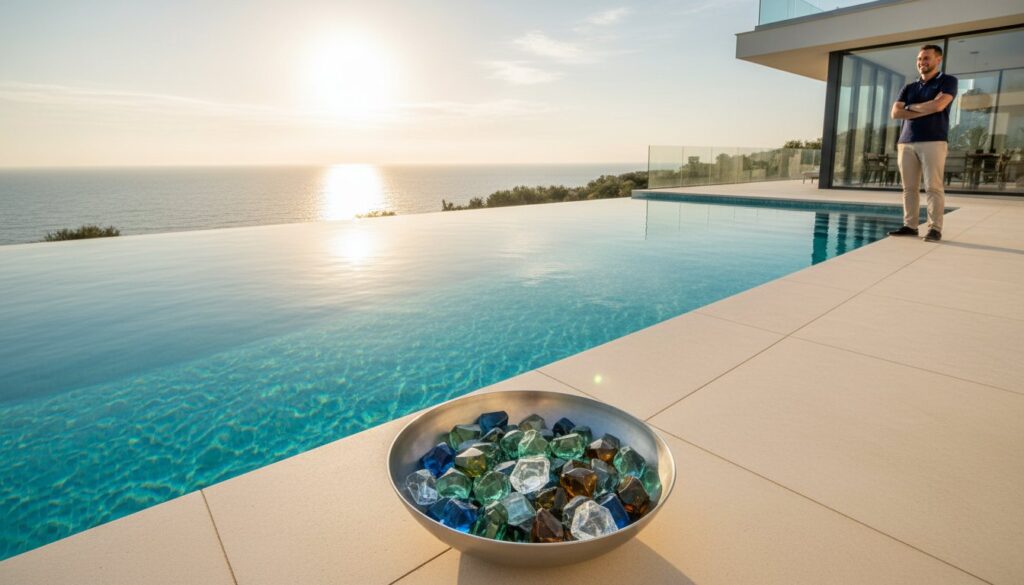
The affordable silica sand currently in your filter might actually be the most expensive component of your pool maintenance routine. While it appears budget-friendly, traditional sand frequently succumbs to Paphos’ notoriously hard water, leading to calcification and clumping that forces you to waste thousands of liters during backwashing. Upgrading to glass media for pool filter paphos systems isn’t just a luxury for 2026; it’s a critical engineering decision to ensure your water remains pristine under the intense Mediterranean sun.
You’ve likely felt the frustration of balancing your chemicals perfectly, only to find the water still looks dull or cloudy. It’s a common struggle, especially with the strict requirements of the Cyprus Swimming Pools Law of 2025 now in full effect as of January 25, 2026. This guide will demonstrate why switching to glass media is the most cost-effective way to lower your water bills, reduce chemical consumption, and achieve superior clarity. We’ll examine how this sustainable technology provides a lifespan of over ten years while ensuring your property stays fully compliant with modern safety and environmental standards.
Key Takeaways
- Discover why Paphos’ hard water causes traditional silica sand to fail and how to prevent filter calcification.
- Explore the electrostatic science behind glass media for pool filter paphos upgrades that keeps water clear without harboring bacteria.
- Identify the specific water and chemical savings you can expect when moving away from high-frequency backwashing.
- Learn the essential professional steps for a successful filter conversion, including the precise layering of different media grades.
- Find out how advanced filtration supports your compliance with the mandatory pool regulations effective from January 2026.
Why Traditional Sand Filters Struggle in the Paphos Climate
The Paphos climate presents a unique set of challenges for standard pool filtration. Our region’s high UV index doesn’t just mean warmer water; it creates a breeding ground for algae that places an immense load on your filtration system. When you use traditional silica sand, you’re relying on a medium that wasn’t designed for the specific mineral profile of Cyprus’ water. In these local conditions, sand filters typically lose their peak efficiency within just two to three years, far sooner than in cooler European climates.
The Problem with Silica Sand and Hard Water
Paphos is well known for its hard water, which contains high levels of dissolved minerals like calcium. Over time, these minerals precipitate inside the filter tank, binding individual grains of sand together. This process, known as calcification, eventually turns your loose filter bed into solid, concrete-like blocks. Once this happens, the water can no longer flow evenly through the media.
Instead, the water creates “channels” or literal holes through the sand blocks. Understanding how media filters work reveals why this is a critical failure; the water takes the path of least resistance, bypassing the filtration process entirely. This means debris and contaminants are pumped directly back into your pool. If you’ve noticed sand at the bottom of your pool or water that stays cloudy despite long pump run times, your media has likely reached its end of life. Upgrading to glass media for pool filter paphos installations is the most effective way to prevent this mineral bonding, as glass doesn’t react with calcium in the same way sand does.
Bio-fouling: The Invisible Threat to Pool Safety
Beyond the mechanical failure of calcification, there’s a biological issue called bio-fouling. Silica sand is naturally porous and has microscopic cracks on its surface. These tiny crevices provide the perfect anchor for bacteria to colonize and form “biofilms.” These slimy layers protect the bacteria from the chlorine in your water, making them incredibly difficult to kill. It’s a hidden drain on your maintenance budget.
Standard backwashing is often ineffective at removing these deep-seated colonies. As the biofilm grows, it consumes your pool’s free chlorine before it even reaches the swimming area. This is why many homeowners find themselves constantly adding more chemicals without seeing an improvement in water clarity. The rough surface of sand essentially acts as a nursery for pathogens, whereas the smooth, non-porous nature of glass media denies bacteria a place to hide. By switching, you’re not just improving clarity; you’re creating a fundamentally safer swimming environment for your family.
The Science of Glass Media: How it Outperforms Sand
Switching to glass media for pool filter paphos systems involves more than just swapping one material for another; it’s a significant upgrade in filtration physics. While silica sand relies purely on physical straining, recycled glass media utilizes advanced electrostatic properties. Each grain of glass carries a permanent negative surface charge. This charge actively attracts and captures fine particles and organic matter that would simply slip through a traditional sand bed. It’s the difference between a simple net and a high-tech magnet.
The physical structure of the media also plays a vital role. Unlike the rounded grains found in weathered sand, glass particles are angular and sub-angular. These sharp edges create a more complex path for water to travel, trapping debris more effectively across the entire depth of the filter. To achieve this, we use a specific depth-filtration method. We layer the tank with Grade 2 coarse glass at the bottom to protect the laterals and ensure high flow rates, topped with a thick layer of Grade 1 fine glass for precision polishing. If you’re concerned about your current system’s performance, our team at The Pool People can assess your filter’s internal components before a media upgrade.
Removing Microscopic Debris and Turbidity
The most visible difference between these materials is the size of the particles they can catch. Standard silica sand is generally effective at trapping debris down to 20 or 40 microns. In contrast, high-quality glass media is capable of filtering out contaminants as small as 5 microns. This level of precision is what gives the water a “polished” look that looks brilliant under Paphos’ bright sunlight. Turbidity is the measure of water cloudiness and glass reduces it by 30% compared to traditional sand methods. This means you aren’t just removing visible dirt; you’re removing the microscopic particles that make water look dull and “flat.”
Resisting Bio-Fouling and Clumping
In the previous section, we discussed how sand’s porous surface invites bacterial growth. Glass media solves this through its smooth, non-porous finish. Because bacteria cannot find a foothold on the glass, they’re unable to form the sticky biofilms that lead to clumping and “mud-balling.” This structural integrity is why glass media remains loose and effective for 10 to 15 years, whereas sand often requires replacement every 3 years in the Cyprus heat.
- Reduced Chloramines: By capturing more organic waste before it reacts with chlorine, glass media helps prevent the formation of chloramines, the compounds responsible for “pool smell” and eye irritation.
- Easier Backwashing: Glass is less dense than sand, meaning the filter bed expands more easily during backwashing. You’ll clear the filter in less time using significantly less water.
- Chemical Efficiency: Because the filter stays cleaner for longer, your primary sanitizers can focus on the water in the pool rather than fighting a “bio-factory” inside the filter tank.
ROI Analysis: Sand vs. Glass Media for Paphos Homeowners
While the initial cost of installing glass media for pool filter paphos systems is slightly higher than traditional silica sand, the return on investment is realized remarkably quickly. In the demanding environment of the Paphos district, where heat and water hardness accelerate media degradation, the financial benefits of glass become undeniable. You aren’t just buying a material; you’re investing in a decade-long solution that lowers your monthly operational costs across water, chemicals, and electricity.
Saving Water in a Water-Scarce Region
Cyprus faces significant water scarcity, making conservation both a financial and ethical priority for property owners. Traditional sand media is heavy and prone to clumping, often requiring lengthy backwash cycles of five to seven minutes to clear trapped debris. Glass media is approximately 15% less dense, which allows the filter bed to expand more fluidly during the backwash process. This efficiency means you can achieve a thorough clean in about half the time.
For a standard 10x5m Paphos pool, this reduction can save thousands of liters of water over a single swimming season. Beyond the direct savings on your water bill, choosing recycled glass media reduces the environmental impact of industrial sand mining. It’s a sustainable choice that aligns your home maintenance with the broader conservation goals of the Cyprus Mediterranean climate.
Reducing Your Chemical and Energy Footprint
A cleaner filter bed directly translates to lower chemical demand. As we explored in the previous sections, sand filters often harbor biofilms that consume chlorine before it ever reaches your pool. By eliminating these “chlorine thieves,” glass media allows you to maintain a safe sanitizing residual with less product. This also helps manage your Total Dissolved Solids (TDS) levels. Because you’re backwashing less frequently, you aren’t constantly introducing new minerals from the mains water into your system, keeping the water chemistry more stable.
Your pool pump also benefits from this upgrade. When sand calcifies or becomes clogged with organic matter, the “head pressure” within the tank increases. This forces the pump to work harder and consume more electricity to maintain the four-hour circulation renewal time mandated by the Cyprus “Swimming Pools Law of 2025.” Glass media maintains a consistent, open structure that allows water to pass through with less resistance. This reduces the strain on your equipment and lowers your energy footprint. While sand typically requires replacement every three years to maintain safety standards, high-quality glass media provides peak performance for ten years or more.
Upgrading to Glass Media: The Professional Process
Upgrading your system with glass media for pool filter paphos requires a methodical approach to ensure long-term reliability. It’s more than just a media swap; it’s an opportunity to inspect the heart of your filtration system. Before adding the new glass, the filter tank must be completely emptied of old, often calcified sand. This is a delicate process. Using high-pressure water or improper tools can easily shatter the internal laterals. Once the tank is clear, we perform a deep-clean and a thorough inspection of these small perforated pipes. These components are often brittle after years of exposure to chemicals and heat. If they’re cracked, your new media will simply wash back into the pool, leading to costly repairs.
The Layering Technique for Maximum Efficiency
Successful installation hinges on the precise layering of different media grades to achieve depth filtration. We place Grade 2 coarse glass at the base of the tank first. This larger media acts as a support bed, ensuring that the laterals aren’t blocked and maintaining a high flow rate for the pump. On top of this base, we add a thicker layer of Grade 1 fine glass. This fine layer performs the heavy lifting of filtration, capturing the microscopic debris and bacteria discussed in earlier sections. During this process, we also verify the integrity of the air bleed tube and the pressure gauge. These small but critical parts ensure the system operates within safe parameters and doesn’t build up dangerous internal pressure.
When to Make the Switch
The ideal time for this upgrade is during the spring or early autumn, just before or after the peak swimming season. This timing ensures your pool is ready for the intense summer demand without interrupting your usage. If you notice your filter tank has visible cracks, or if the multi-port valve is leaking, it might be time for a full equipment audit rather than just a media change. Professional oversight ensures that every component, from the pump to the filter housing, is working in harmony. You can learn more about maintaining high standards in our guide to Essential Pool Equipment in Paphos.
Once the media is correctly layered, we perform a commissioning backwash and rinse. This initial cycle is vital because it removes any fine glass dust from the manufacturing process. It also settles the media bed into its final, most efficient position. Our team follows strict safety protocols to handle the recycled glass correctly and protect your property throughout the installation. If you’re ready to modernize your filtration and enjoy the security of a professionally managed pool, contact our certified experts to schedule a professional media conversion.
Why The Pool People are Paphos’ Filtration Experts
The Pool People have been a cornerstone of the Paphos and Peyia communities since 2005. Choosing a partner for glass media for pool filter paphos upgrades involves more than just selecting a product; it’s about the technical proficiency of the team handling your equipment. We approach every filtration project through a lens of engineering and safety rather than simple maintenance. Our team doesn’t just swap media; we conduct a comprehensive health audit of your entire filtration circuit to ensure your investment is protected from the day the new glass is commissioned.
CPO-Certified Standards in Every Service
What sets our approach apart is a deep commitment to international standards. Our technicians are trained under the PHTA/NSPF framework, which is the global gold standard for pool management. This training ensures your pool doesn’t just look clear but meets rigorous European health standards for microbiological safety. We’re so dedicated to these benchmarks that we even provide Professional CPO Training in Cyprus for other industry professionals, cementing our role as the region’s educational authority.
Unlike the “splash and dash” approach common in the casual market, our engineering-led process accounts for flow rates, turnover times, and the specific chemical demands of the Paphos climate. We use high-quality recycled glass media that we’ve specifically tested against the mineral-heavy water of the Paphos district. This ensures the media we install performs exactly as promised, resisting the calcification that plagues inferior products and traditional sand.
Securing Your Investment and Safety
We understand your pool is a significant financial investment and a central part of your home life. Our goal is to provide psychological comfort by ensuring your water is biologically safe for your family and guests. This peace of mind comes from knowing your filtration system is managed by experts who understand the nuances of the Cyprus Swimming Pools Law of 2025. We take pride in our role as guardians of your safety, ensuring every test and treatment is performed with clinical precision.
Our relationship with clients doesn’t end with a single service call. We provide long-term support and maintenance schedules designed to maximize the lifespan of your equipment. Whether you’re a resident in Peyia or manage a communal complex in Paphos, our team is dedicated to maintaining the highest levels of water quality and operational efficiency. If you’re ready to experience the difference that professional expertise makes, Contact The Pool People for a Professional Filter Audit today.
Securing Your Pool’s Future for 2026 and Beyond
Transitioning away from silica sand is no longer just a recommendation for Paphos homeowners; it’s a strategic move toward long-term efficiency and regulatory compliance. You’ve seen how traditional media struggles with calcification and bio-fouling in our local hard water. By choosing glass media for pool filter paphos upgrades, you’re opting for a non-porous solution that eliminates bacterial hiding spots while providing unmatched water clarity for over a decade. This shift doesn’t just lower your monthly utility bills; it ensures your swimming environment remains fundamentally safe and inviting.
The Pool People have been Paphos’ trusted partner in aquatic safety since 2005. As PHTA/NSPF Certified Pool Operators, we specialize in engineering-led filtration solutions that stand up to the unique demands of the Cyprus climate. We’re ready to help you modernize your equipment and achieve the crystal-clear results your home deserves. Take the first step toward effortless maintenance and total peace of mind today.
Book Your Filter Media Upgrade with Paphos’ Leading Experts
Frequently Asked Questions
How often should I change the glass media in my Paphos pool filter?
You should expect high-quality glass media to last between 10 and 15 years before it requires replacement. This is a significant improvement over traditional silica sand, which typically degrades and clumps within three years in the Paphos climate. Because glass is much harder and resistant to the physical erosion caused by water flow, it maintains its filtration sharp edges for over a decade.
Can I use glass media in a standard sand filter tank?
Yes, glass media is designed as a direct, “drop-in” replacement for silica sand in any standard high-rate sand filter. You don’t need to modify your existing tank or plumbing to make the switch. However, it’s vital to have a professional inspect the internal laterals and the multi-port valve during the conversion to ensure the system can handle the improved flow characteristics of the new media.
Does glass media really save money on my Paphos water bill?
Upgrading to glass media for pool filter paphos systems typically reduces water consumption by 25% to 50% during the backwashing process. Because the glass particles are less dense and non-porous, they release trapped debris much faster than sand. This allows for shorter backwash cycles, which is a critical advantage in Cyprus where water conservation is both an environmental priority and a financial necessity.
Is pool filter glass sharp or dangerous to handle?
No, the glass media used in swimming pool filters is tumbled and heat-treated to remove all sharp edges. It feels similar to coarse sand or small pebbles and is entirely safe to touch with bare hands. This manufacturing process ensures the media won’t cut your skin during installation or damage the delicate plastic laterals inside your filter tank during operation.
Why is my pool still cloudy even after switching to glass media?
Cloudy water after a media change is usually caused by improper water chemistry or insufficient pump run times rather than the media itself. Ensure your pH is balanced between 7.2 and 8.0 as required by the 2026 Cyprus pool regulations. If the chemistry is correct, the issue may be “channelling” caused by an incorrect initial installation or a pump that isn’t running long enough to achieve a full turnover.
How much glass media do I need for a standard 24-inch filter?
A standard 24-inch (600mm) filter typically requires approximately 125kg to 140kg of glass media. Because glass is about 15% less dense than sand, you actually use less total weight to fill the same volume. It is essential to use the correct ratio of Grade 1 (fine) and Grade 2 (coarse) glass to ensure the depth-filtration effect works effectively without clogging the system.
Can I switch from sand to glass media myself?
While some homeowners attempt a DIY switch, we strongly recommend professional installation to avoid damaging the filter’s internal components. Removing old, calcified sand in Paphos often requires specialized vacuum equipment to prevent breaking the brittle plastic laterals at the bottom of the tank. A professional also ensures the air bleed and pressure gauges are commissioned correctly for the new media’s flow rate.
Does glass media help with the ‘chlorine smell’ in my pool?
Yes, glass media significantly reduces the “chlorine smell” by preventing the formation of chloramines. These unpleasant odors occur when chlorine reacts with bacteria trapped in the filter. Since glass is non-porous and resists the growth of biofilms, there’s less organic matter for the chlorine to react with. This makes glass media for pool filter paphos installations an excellent choice for swimmers with sensitive eyes or skin.