
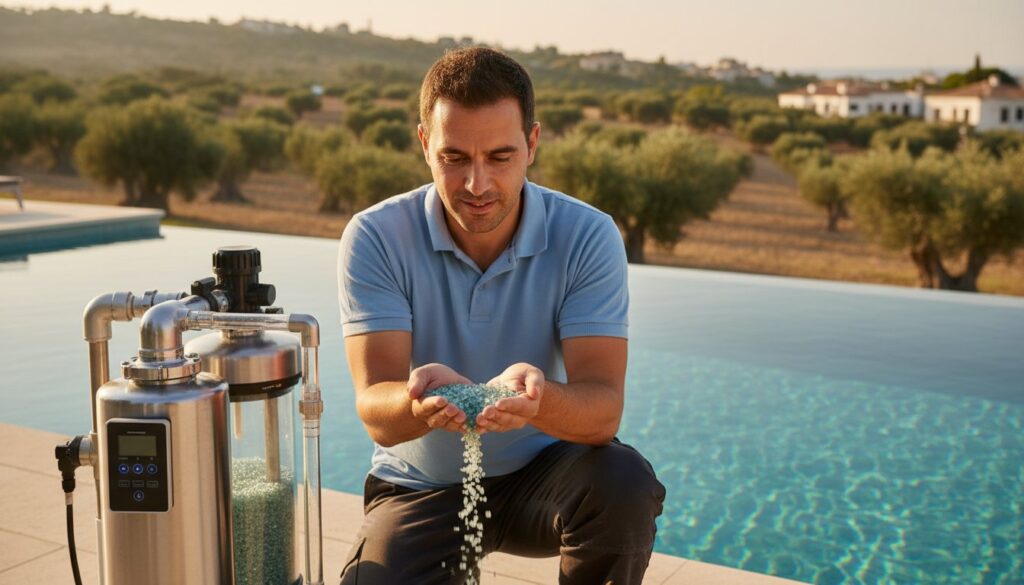
What if the expensive chemicals you’re adding to your pool are being rendered useless by five-year-old, calcified sand? In the Paphos region, where calcium carbonate levels often exceed 300ppm, filter media can quickly turn into a solid, brick-like mass that traps bacteria rather than debris. You likely already know the frustration of seeing cloudy water or finding fine grains on your pool floor despite your best maintenance efforts. It’s a common struggle that leads to higher electricity bills as your pump works harder to push water through a blocked system.
This guide provides the definitive roadmap for a sand filter change paphos property owners need to restore crystal-clear, inviting water and ensure long-term equipment health. We’ve compiled the latest 2026 industry standards to help you move away from maintenance stress toward a true peace of mind philosophy. You’ll learn exactly when to replace your media, how to identify calcification early, and why professional intervention is the key to protecting your investment in the Mediterranean climate.
Key Takeaways
- Understand why your filter media acts as the “kidneys” of your pool and how to identify “channeling” that compromises water clarity.
- Learn the five critical warning signs that indicate you need a professional sand filter change in Paphos, from persistent cloudiness to rapid pressure spikes.
- Discover why Activated Glass Media (AGM) has become the 2026 industry standard, offering superior filtration and a lifespan of over 10 years.
- Explore the technical risks of DIY replacement and why a professional inspection of internal laterals is essential for long-term equipment health.
- Benefit from the “peace of mind” provided by PHTA-certified experts who ensure your swimming environment remains crystal clear and safe.
The Science of Filtration: Why Sand Filter Media Fails in Paphos
Your swimming pool’s filter acts as the kidneys of the entire circulation system. Just as your body relies on internal organs to strip away toxins, your pool depends on the filter media to capture debris, skin cells, and microscopic contaminants. Understanding The Science of Sand Filtration is essential for any property owner in Cyprus. While the sand appears static, it’s actually engaged in a complex physical process of mechanical trapping and adsorption. However, this efficiency is not permanent.
Over several seasons, a phenomenon known as “channeling” occurs. Water is naturally lazy; it seeks the path of least resistance. As the sand grains become smooth or clogged, the pressurized water forces deep grooves or channels through the media. Instead of being filtered, the water simply bypasses the sand entirely and returns to the pool still carrying fine particles. This is often why homeowners seeking a sand filter change paphos notice their water remains cloudy despite running the pump for 12 hours a day.
The intense Cyprus heat, which frequently stays above 35°C for months, adds another layer of stress. High temperatures accelerate the growth of organic matter, placing an immense load on the filter. When combined with the high bather loads of the summer season, the media reaches a state of exhaustion much faster than in cooler European climates. This exhaustion isn’t just about dirt; it’s about the structural integrity of the sand grains themselves.
The Paphos Factor: Hard Water and Calcification
Paphos is famous for its hard water, which contains high levels of dissolved minerals. Over a period of 3 to 5 years, these minerals, primarily calcium, begin to bond the individual sand particles together. This chemical reaction essentially transforms your loose filter media into a solid block of sandstone inside the tank. Once calcification takes hold, filtration efficiency drops to near zero. You can mitigate this by mastering pool water chemistry in Paphos, but eventually, the physical degradation of the media makes a professional sand filter change paphos unavoidable for maintaining a safe swimming environment.
When Backwashing Is No Longer Enough
Many pool owners believe that frequent backwashing will solve all clarity issues. There is a point of diminishing returns where backwashing only removes surface debris but fails to clear deep-seated contaminants. Exhausted media becomes a breeding ground for pathogens. Biofilm is a resistant bacterial colony within filter media. This slimy layer protects bacteria from chlorine, meaning your pool could be chemically balanced but still biologically dirty. When you reach this stage, the only professional solution is to replace the media to restore the peace of mind that comes with truly clean water.
5 Signs Your Paphos Pool Needs a Media Change
Your pool filter is the heart of your circulation system, but even the best equipment faces the reality of wear. Over time, the silica sand inside your tank loses its ability to trap contaminants. While high-quality sand typically lasts between three to five years in the Cyprus climate, heavy bather loads or hard water can shorten this lifespan. Recognizing the early warning signs of media exhaustion prevents minor issues from turning into expensive equipment repairs. A professional sand filter change paphos property owners invest in is often the most cost-effective way to restore clarity and hygiene to your water.
One of the most telling signs is persistent cloudy water. If you’ve performed a “green pool” shock treatment and your chemical levels are perfectly balanced, yet the water remains hazy after 48 hours of constant filtration, the sand is likely “channeled.” This occurs when water carves permanent paths through the media, bypassing the filtration process entirely. Understanding how sand filters work reveals that their efficiency relies on the water passing through the jagged edges of the sand grains. When these edges round off, the media can no longer grab fine particulates.
Monitoring Pressure Gauges and Flow Rates
The pressure gauge on your multi-port valve is your filter’s primary communication tool. You should establish a “clean” baseline pressure immediately after a backwash. If the pressure rises to the “red zone” or increases by 10-12 PSI within just two or three days of cleaning, your sand is likely saturated with oils and calcification. This restricted flow creates immense back-pressure. It strains your pool pump motor, which can lead to premature failure and a replacement cost of several hundred Euro. If your flow rates feel weak at the inlet jets, it’s time for a professional assessment.
Visual and Chemical Red Flags
If you notice small piles of sand or fine debris returning to the pool floor through the inlet jets, it usually indicates a broken lateral or exhausted media that has become too fine to stay contained. Chemical struggles are also a major indicator. Old sand often harbors a “biofilm” of bacteria that consumes chlorine rapidly. This leads to a persistent musty smell or high combined chlorine levels that won’t budge regardless of how much shock you add. For those managing properties in Peyia or Tala, these “Chlorine Demand” issues are common due to high summer temperatures. You can find more troubleshooting tips in our ultimate guide to pool maintenance in Paphos.
Finally, try the “Hand Test” if you can safely access the tank. Healthy sand feels sharp and gritty. If the grains feel smooth like river pebbles or if the sand has formed hard, “mud-ball” clumps, it has lost its functional surface area. Scheduling a sand filter change paphos service ensures your system is emptied, inspected, and refilled with premium grade media. This simple maintenance step provides the peace of mind that your family is swimming in truly clean water. If you suspect your filtration is failing, contact our technical team for a professional pressure test and media inspection.
Sand vs. Glass Media: Making the Right Choice for 2026
When scheduling a sand filter change paphos owners often ask whether they should stick with traditional silica or upgrade to Activated Glass Media (AGM). While sand has served the industry for decades; AGM has emerged as the professional standard for 2026. A standard sand filter requires replacement every 3 to 5 years because the grains become rounded and lose their ability to trap debris. High-quality glass media maintains its angular integrity for 10 years or more. This longevity provides significant peace of mind for property owners who want to avoid frequent, disruptive maintenance cycles.
In the arid climate of Cyprus, water conservation is a priority for every responsible homeowner. Glass media is less dense than sand, which allows the filter bed to expand more easily during the cleaning cycle. This physical property means you use 25% less water during backwashing compared to traditional sand. PHTA-certified professionals increasingly recommend glass because it lowers the total cost of ownership while protecting the local environment. It is a logical choice for those who value both efficiency and sustainability.
Technical Advantages of Glass Media
The primary benefit of glass lies in its filtration fineness. Standard silica sand filters particles down to 30 microns, but glass captures particles as small as 5 microns. This level of precision creates the crystal clear water quality our clients expect. Beyond filtration fineness, glass is naturally resistant to the “clumping” and calcification often seen in Paphos water. Because our local water is high in calcium, sand is prone to forming hard blocks that lead to channeling. This is where water bypasses the media entirely, leaving your pool cloudy. While the initial price of glass is higher than sand, the reduction in chemical consumption and water waste ensures the system pays for itself within three years.
Choosing the Right Grade of Media
Achieving excellence requires more than just pouring glass into a tank. A professional installation involves specific layering of “Grade 1” and “Grade 2” media to ensure optimal flow and filtration depth. We often see DIY attempts using “cheap” sand from local hardware stores. These products frequently contain impurities and organic matter that can introduce phosphates into your pool. Investing in high-spec media is a core part of maintaining essential pool equipment in Paphos. Using the correct grades ensures your pump doesn’t work harder than necessary, which extends the life of your entire filtration system. When you book your next sand filter change paphos, choosing the right media grade is the most important decision you’ll make for your pool’s long-term health.
The Professional Media Change Process: Why DIY is Risky
Attempting a sand filter change paphos without the correct technical training often leads to expensive mechanical failures. It isn’t simply a matter of swapping old sand for new; it’s a precise engineering task that requires a methodical approach to protect your pool’s circulation system. Our team follows a rigorous five-step protocol to ensure your filtration system operates at peak efficiency for the next five years.
The process begins by safely draining the filter tank. Removing old, saturated media is physically demanding, as wet sand can weigh upwards of 150kg in a standard residential filter. Once the tank is empty, we perform a deep inspection of the internal laterals and the central standpipe. We look for hairline cracks that are invisible to the untrained eye but would allow sand to blow back into your pool. Before adding new media, we sanitise the internal tank walls to eliminate residual biofilm and bacteria colonies that survive the media removal process.
Precision is vital during the refill stage. We use a water-cushioning technique, filling the tank halfway with water before adding the new media. This prevents the heavy sand or glass from impacting and snapping the delicate laterals at the bottom. Finally, we service the multi-port valve, lubricating the internal gaskets and spider seals to ensure a leak-free, airtight seal that maintains system pressure.
The Risk of Lateral Damage
The plastic “fingers” at the base of your filter, known as laterals, are the most vulnerable component during a media change. If you pour heavy sand directly onto dry laterals, the impact weight can easily snap them. A single broken lateral will cause a constant stream of sand to enter your pool, requiring a total system drain and a complete restart. This mistake effectively doubles your costs in both time and materials. Professionals use specific pouring speeds and water levels to neutralise this risk entirely.
Safety and Compliance for Communal Pools
For complex managers in Paphos, maintaining a communal pool involves strict legal obligations. These facilities must meet European health and safety standards, specifically regarding turnover rates and filtration velocity. A certified professional ensures that the media grade and volume align with these regulatory requirements. If you manage a complex, staying informed through CPO training in Cyprus is the best way to ensure your facility remains compliant and safe for all residents. This level of oversight protects the committee from liability and ensures the water meets the high standards expected in 2026.
Don’t risk your equipment with a trial-and-error approach. Contact our experts to book a professional sand filter change and secure your peace of mind.
Peace of Mind: The Pool People Expertise in Paphos
For over 20 years, The Pool People has served as the technical backbone for property owners across the Paphos region. We don’t just swap out old materials; we apply two decades of local knowledge to every project we undertake. Our technicians hold PHTA (Pool & Hot Tub Alliance) and NSPF CPO (Certified Pool Operator) credentials, ensuring your equipment is handled by professionals who understand the intricate physics of water filtration and hydraulic flow. This level of expertise is rare in the local market and sets a benchmark for safety and performance.
We refuse to compromise on the quality of what goes inside your tank. Every sand filter change paphos residents entrust to us involves only high-grade, certified media. Whether you opt for traditional 16/30 grade silica sand or advanced activated glass media, our materials are sourced for their longevity and superior debris retention. We ensure the media is layered correctly to prevent channeling and maximize the surface area available for filtration.
A standard service with us includes a comprehensive Filter Health Check. This isn’t a simple visual inspection. We examine the following components:
- Internal Laterals: We check for cracks or blockages that could allow sand to enter your pool.
- Multiport Valve: We inspect gaskets and spiders for wear to prevent internal leaks.
- Pressure Gauges: We verify accuracy to ensure you can monitor your system correctly.
- Air Release Valves: We ensure these are functional to prevent dangerous pressure build-up.
Beyond the Change: Ongoing System Optimization
We focus on more than just clean water; we aim for total system efficiency. Our team calibrates your pump and filter settings to ensure maximum energy efficiency, which helps manage your electricity costs in the Cyprus heat. With dedicated teams stationed locally in Paphos and Peyia, we provide rapid response times for any technical needs. The Pool People provide a full technical report after every media change to ensure your peace of mind. This document outlines the condition of your hardware and provides a clear record for your maintenance history.
Book Your 2026 Filter Service
Timing is everything for a sand filter change paphos. We recommend scheduling your media replacement during the pre-season months of February or March, or immediately after the winter rains. This ensures your system is primed for the heavy bather loads of the peak summer season. Every pool is unique, so we provide bespoke quotes based on your specific filter diameter, pool volume, and location. Contact The Pool People today for a professional sand filter change in Paphos.
Secure Your Crystal Clear Water for 2026
Maintaining a swimming pool in the Mediterranean climate requires more than just skimming the surface. By 2026, property owners must prioritize high-efficiency filtration to manage the unique environmental challenges found in Cyprus. We’ve explored how traditional sand media loses its effectiveness after five years, often leading to calcification and compromised water quality. Upgrading to Activated Glass Media (AGM) provides superior filtration down to 1 micron, ensuring your water remains inviting and safe for every swim.
Choosing a professional sand filter change paphos service eliminates the risk of lateral damage and ensures your system operates at peak efficiency. Since 2005, our PHTA and NSPF CPO Certified technicians have served the Paphos and Peyia regions with technical precision and care. We focus on long-term value rather than quick fixes, providing the peace of mind you deserve as a homeowner. Don’t let a clogged filter compromise your investment or your health. Our team is ready to restore your pool’s clarity with the industry’s most advanced media solutions.
Request a Professional Filter Media Quote
Your perfect pool experience is just one professional service away.
Frequently Asked Questions
How often should I change the sand in my Paphos pool filter?
You should replace your pool filter sand every 3 to 5 years to maintain water clarity and hygiene. Over time, the sharp edges of the sand grains become rounded through constant erosion, which significantly reduces their ability to trap fine debris. In the Paphos climate, where pools often run for 10 to 12 hours a day during the peak July heat, 4 years is the recommended limit for optimal performance.
Can I change my pool filter sand myself?
While homeowners can technically perform this task, it’s a physically demanding process that carries a high risk of damaging internal components. The laterals at the bottom of the tank are fragile and easily cracked during sand removal. If these break, you’ll find media blowing back into your pool, leading to expensive repairs that far exceed the cost of a professional service.
Is glass media really better than sand for pools in Cyprus?
Glass media is significantly more effective than traditional sand because it filters particles down to 3 microns, compared to 20 microns for standard sand. It doesn’t suffer from “channeling” or calcification, which are common issues in the hard water areas of Paphos. Because glass is less dense, you use 15% less media by weight and require shorter backwash cycles, saving thousands of liters of water annually.
How much does a professional sand filter change cost in Paphos?
The cost of a professional service depends on the size of your filter tank and the type of media you select. Most residential pools in Cyprus utilize tanks ranging from 500mm to 750mm in diameter. The total investment covers the high-grade media, the removal and disposal of old sand, and a comprehensive multi-port valve inspection to ensure your entire system operates with technical precision.
Why is there sand at the bottom of my pool?
Sand at the bottom of your pool usually indicates a broken lateral or a cracked standpipe inside the filter tank. These plastic components become brittle over time and can snap, allowing filter media to bypass the filtration cycle and enter the return lines. If you notice this issue, it’s essential to book a professional sand filter change Paphos service immediately to prevent further debris from circulating through your plumbing.
What happens if I never change my pool filter sand?
Neglecting to change your filter media leads to “channeling,” where water carves direct paths through the sand without being filtered. Your pool water will become dull and cloudy, requiring more expensive chemicals to keep it safe for swimmers. Eventually, the sand can calcify into a solid block, putting immense pressure on your pump and potentially causing a total system failure that requires equipment replacement.
How long does a professional filter media change take?
A professional filter media change typically takes between 2 and 4 hours to complete. This timeframe includes the careful extraction of old media using specialized vacuum equipment, a thorough inspection of the internal laterals, and the controlled refilling of the tank. Our technicians follow a methodical process to ensure the tank is balanced and the multi-port valve is lubricated, providing you with immediate peace of mind.
Does a sand filter change help with green pool issues?
A sand filter change Paphos property owners invest in is a critical step in resolving persistent green pool issues. While chemicals kill algae, your filter must be efficient enough to remove the dead spores from the water. Fresh media ensures that the filtration system can catch these microscopic particles, preventing the “algae cycle” from restarting and helping your pool return to a crystal clear state much faster.