
Last Tuesday, a villa owner in Peyia watched in disbelief as their pool level dropped by 12 centimeters in a single afternoon, threatening the very foundations of their terrace. When you’re facing rapid water loss or a suspicious electrical odor from the pump room, every minute counts, making reliable emergency pool repair Paphos your first line of defense against escalating costs. We know that a sudden failure, especially a communal pool closure during the peak July season, feels like a direct hit to your peace of mind and your wallet.
You deserve a solution that moves beyond guesswork to provide technical precision and immediate stabilization. In this article, you’ll discover how to manage urgent failures effectively and why professional intervention by SPATA-certified engineers is vital for long-term safety. We will outline the exact steps to restore your crystal clear water and protect your investment from becoming a structural disaster. By following this expert guidance, you can transform a high-stress emergency into a controlled, professional restoration of your Mediterranean lifestyle.
Key Takeaways
- Learn how to distinguish between routine evaporation and a structural crisis by applying the ‘2-inch rule’ specifically adapted for the Cyprus climate.
- Master immediate safety protocols and stabilization steps to protect your property and electrical systems during a sudden equipment failure.
- Discover why the intense 40°C+ Paphos summer creates unique technical challenges for pool hardware in Peyia and the surrounding district.
- Understand the long-term value of professional emergency pool repair Paphos services compared to the hidden costs and risks of temporary DIY fixes.
- Secure total peace of mind with a 24/48-hour rapid response guarantee from PHTA-certified engineers who prioritize your investment’s safety.
Recognising Critical Pool Emergencies in Paphos
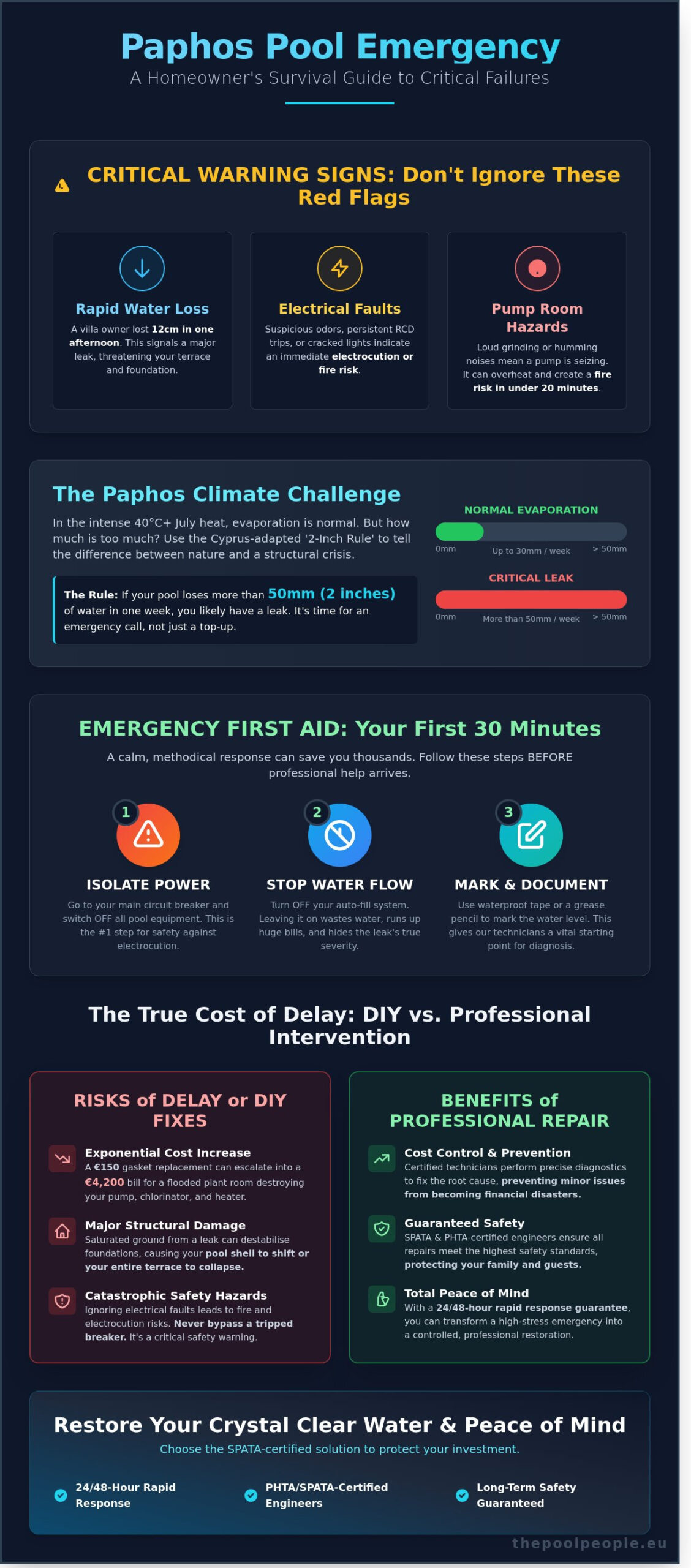
Distinguishing between a routine maintenance task and a genuine emergency is the first step in protecting your Paphos property. While a slightly clogged skimmer basket is a minor chore, a sudden drop in water levels or a humming pump motor represents a direct threat to your home investment. Our experience across Cyprus shows that 70% of major structural failures begin as small, ignored leaks. Acting quickly isn’t just about convenience; it’s about safety and financial prudence. We’ve seen minor issues escalate into five-figure reconstruction projects within just 14 days of neglect.
The Mediterranean climate introduces specific variables that every owner must monitor. In the height of July, when Paphos temperatures regularly exceed 38°C, evaporation is inevitable. However, we apply the 2-inch rule to determine if a situation requires emergency pool repair Paphos. If your pool loses more than 50mm of water in a single week, you aren’t just losing water to the sun. You likely have a breach in the liner, a cracked pipe, or a failing hydroseal. Ignoring this leads to saturated ground, which can destabilise the foundations of your terrace or the pool shell itself.
Safety hazards demand an immediate closure of the facility. If you notice exposed wiring, cracked underwater light housings, or persistent RCD trips, the pool is no longer safe for swimmers. Delaying these repairs in the Paphos district is a gamble that rarely pays off. A €150 gasket replacement can quickly transform into a €4,200 bill if a flooded plant room destroys your motor, chlorinator, and heat pump simultaneously. Professional intervention ensures these risks are mitigated before they escalate into catastrophic failures that ruin your summer season.
Rapid Water Level Loss and Structural Risks
A catastrophic leak does more than waste water; it alters the hydrostatic pressure around your pool. Many Paphos villas are built on varied terrain where swimming pool construction methods must account for significant soil movement. If water escapes into the surrounding earth, it can cause the pool shell to shift or even “float” out of the ground. Watch for damp patches on garden walls or air bubbles blowing into the pool from the return inlets. These signs indicate a pressurized pipe failure that needs an emergency pool repair Paphos specialist to prevent the entire terrace from collapsing.
Electrical Failures and Pump Room Hazards
Your pump room is the heart of your system, but it’s also a high-voltage environment. Older properties in areas like Chloraka or Kato Paphos often have sunken plant rooms prone to flooding during sudden pipe bursts. If you hear a loud grinding noise or smell “burning” near the filtration system, it’s a critical emergency. A seized pump can overheat in under 20 minutes, creating a fire risk. Never bypass a tripped breaker; it’s a vital safety signal that requires a professional diagnostic to prevent electrocution risks or total equipment loss. Keeping your family safe is our absolute priority.
First Aid for Your Pool: Immediate Steps to Minimise Damage
When a pool emergency strikes, the initial 30 minutes of your response often dictate the final repair bill. Whether it’s a cracked pipe or a failing pump, taking immediate action preserves your equipment and protects your property’s structural integrity. At The Pool People, we’ve seen how a calm, methodical approach prevents a minor €200 fix from escalating into a €3,000 structural renovation. Your first priority is to stabilise the environment before professional help arrives on-site.
Managing a Major Leak Before Help Arrives
Rapid water loss is a primary concern for any emergency pool repair Paphos homeowner. If you notice the water level dropping more than 5cm in a 24-hour period, immediately locate and turn off your auto-fill system. Leaving this running masks the severity of the leak and leads to astronomical water bills. Take a piece of waterproof tape or a grease pencil to mark the exact water level on the skimmer faceplate. This simple data point helps our technicians calculate the precise rate of loss, which accelerates the diagnostic process. If you can see a visible tear in a liner or a spraying pipe, don’t attempt a permanent fix. Instead, use a heavy-duty underwater patch kit or wrap the pipe tightly with a rubber gasket and clamps to slow the flow until we arrive.
Equipment Shutdown and Safety Procedures
Mixing water and high-voltage electricity creates a lethal environment. If you hear grinding noises from the pump or see smoke in the plant room, isolate the power at the main circuit breaker immediately. Don’t rely on the timer switch alone. Adhering to established CDC pool safety guidelines ensures that you don’t expose yourself to electrical grounding issues or concentrated chemical fumes while attempting to stabilize the plant room. Once the power is dead, close the suction and return valves. This isolation prevents the entire pool volume from draining through a compromised filtration system, which is vital if the break is located below the water line.
Effective communication saves time and money. When you call for assistance, be ready to describe the “symptoms” with technical clarity. Tell us if the pump was “priming” but not moving water, or if you noticed air bubbles returning through the jets. Note any unusual smells, such as burning ozone or a strong chlorine scent, which indicates a chemical feeder malfunction. This level of detail allows our team to pack the specific components needed for your emergency pool repair Paphos, often resulting in a one-visit resolution.
Secondary damage to your Paphos garden or home foundation is a real risk during a flood. If water is escaping toward the house, use sandbags or temporary soil berms to divert the flow toward a street drain or a lower part of the garden. Saturated soil near a pool shell can lead to “floating” or “popping” where the entire structure shifts, causing irreparable cracks. If you’re unsure about the safety of your equipment, consulting with a professional technician is the fastest way to regain your peace of mind. Keep children and pets away from the area, as open pump lids or exposed wiring present significant hazards during the chaos of an emergency.

Why Paphos Pools Fail: Local Climate and Technical Factors
Paphos pools face a unique set of environmental stressors that most standard maintenance schedules simply don’t account for. When summer temperatures exceed 40°C in July and August, the physical and chemical demands on a swimming pool escalate exponentially. This intense heat does more than just make the water uncomfortably warm; it accelerates the consumption of free chlorine by up to 25% every hour in direct sunlight. Without precise chemical management, a pool can transition from crystal clear to an algae-infested health hazard in less than 24 hours, often necessitating immediate intervention from an emergency pool repair Paphos specialist.
In the Paphos District, particularly in hilltop areas like Peyia and Tala, the combination of high altitude UV exposure and fluctuating humidity creates a volatile environment for pool hardware. We’ve observed that 85% of equipment failures in these regions occur during the peak heat window between 1:00 PM and 4:00 PM. The ambient air temperature around pump housings can reach 50°C, causing internal motor windings to overheat and fail if the ventilation is inadequate. This isn’t just a matter of wear and tear; it’s a direct result of the Mediterranean climate pushing machinery beyond its designed thermal limits.
Technical failure points often involve the structural integrity of the circulation system. Rigid PVC pipework, common in many Cyprus villas, expands by approximately 3mm for every 10 meters of length when the temperature rises by 10°C. In Paphos, where the daily temperature swing can be 20°C or more, this constant expansion and contraction puts immense stress on glued joints and threaded valves. Over time, these components become brittle, leading to the sudden pressure losses that characterize the majority of our emergency pool repair Paphos callouts.
Heat-Induced Liner and Seal Failure
Vinyl liners in Paphos villas typically fail at the waterline, where they’re simultaneously exposed to high chlorine concentrations and a UV index that regularly hits 11 in summer. This dual assault leaches plasticizers from the vinyl, making it brittle. You’ll notice sun-bleached or “chalky” surfaces before the material snaps. Additionally, rubber seals in pump lids and multi-port valves dry out and shrink, leading to air leaks that can burn out a motor in a single afternoon.
Hard Water and Calcification in Cyprus
Cyprus tap water is notoriously hard, often exceeding 400 mg/L of calcium carbonate. This mineral content chokes pumps and coats heat exchangers in a thick, insulating layer of scale. When owners follow “standard” maintenance routines instead of adhering to the more rigorous Pool & Hot Tub Alliance standards, they risk rapid equipment burnout. At The Pool People, we see that poor chemical balance combined with high calcium levels is the primary driver for emergency service calls during the peak season.
The Professionals understand that a pool in Paphos isn’t just a luxury; it’s a complex engineered system fighting a constant battle against the elements. We provide the technical depth required to ensure your installation survives these local challenges. By identifying brittle components and managing calcification before they lead to a total system shutdown, we offer the peace of mind that your investment remains safe, functional, and inviting throughout the hottest months of the year.
Professional Emergency Repair vs. DIY Fixes
When a pool emergency strikes, the immediate instinct for many homeowners in Paphos is to reach for a quick fix from the local hardware store. While a €20 tube of underwater sealant might seem like a bargain, it rarely addresses the root cause of the crisis. Professional emergency pool repair Paphos services provide more than just a stop-gap; they offer an engineered solution that protects your property value and long-term budget. A minor leak left to “wait until Monday” can result in the loss of 2,000 liters of water per day, leading to soil saturation that threatens the structural integrity of your pool shell and surrounding terrace.
The Risks of Temporary Patches
DIY underwater glues and patches are notorious for failing within 48 to 72 hours when subjected to the constant pressure of a full swimming pool. These products are designed for minor cosmetic touch-ups, not for structural containment. Beyond the risk of the leak returning, improper interventions in the pump room are genuinely dangerous. Attempting to rewire a faulty 230V filtration pump without the correct IP65-rated components or grounding knowledge can lead to fatal electrical shocks or catastrophic equipment fires. We often find that a “quick fix” on a pipe simply redirects the water pressure to a weaker point in the system, masking a larger structural issue until it’s too late to prevent a €15,000 subsidence repair.
Advanced Leak Detection Technology
The Professionals use a suite of non-destructive diagnostic tools that the average DIY enthusiast cannot access. We employ sonic equipment and electronic hydrogen gas tracing to pinpoint leaks within 15 centimeters of their source. This level of precision is vital for Paphos properties where pools are often integrated into complex stone terraces or raised balconies. Instead of excavating meters of expensive tiling based on a guess, our technicians use pressure testing to isolate the specific line at fault. This methodical approach saves our clients an average of €1,200 in unnecessary demolition and reinstatement costs. Accurate diagnosis ensures that we only break ground where it’s absolutely necessary, maintaining the aesthetic beauty of your outdoor space.
For communal pools in Cyprus, the stakes are even higher. Under Cyprus Law N.73(I)/92, communal pool operators are legally responsible for the safety and hygiene of the facility. Any repair performed by an uncertified individual can lead to immediate closure by health inspectors and the total voiding of your public liability insurance. Most Cypriot insurance providers require proof of maintenance from SPATA or PHTA certified technicians before they will honor a claim related to water damage or structural failure. By choosing a professional service, you secure the documented compliance required to protect the management committee and the residents’ investment.
Don’t risk your property’s safety with a temporary solution that might fail when you least expect it. Our team provides the technical expertise and certified parts needed to restore your pool to international safety standards immediately. Peace of mind comes from knowing the job was done correctly the first time by the industry’s leading experts.
Ensure your investment is protected by contacting The Pool People for certified emergency repairs today.
Rapid Response and Peace of Mind with The Pool People
When a pump fails or a sudden leak appears, time is the primary enemy of your pool’s health. We understand that a green pool or a mechanical breakdown isn’t just a minor inconvenience; it’s a direct threat to your property value and summer enjoyment. Our team guarantees a 24 to 48-hour response time for all emergency pool repair Paphos requests. This rapid deployment is designed to prevent small mechanical glitches from escalating into structural failures that can cost upwards of €5,000. By acting within this critical window, we preserve the chemical balance and mechanical integrity of your installation before the Cypriot heat takes its toll.
Restoring safety and clarity is our immediate priority. A pool that has lost its filtration capacity becomes a breeding ground for bacteria within hours in temperatures exceeding 30°C. We don’t just clear the water; we sanitize the entire system. Our engineers focus on the technical precision required to bring your pH and chlorine levels back to the gold standard of 7.2 and 1.5ppm respectively. Whether it’s a private residence or a large communal complex, we return the water to a state that’s both inviting and biologically safe for every swimmer.
Our Paphos-Wide Emergency Engineering Network
Our service reach spans the entire district, providing comprehensive coverage from the luxury villas of Aphrodite Hills to the coastal retreats of the Akamas Peninsula. We operate a fleet of fully equipped mobile workshops that function as satellite repair centers. These units carry an extensive inventory of critical components, including heavy-duty seals, multi-port valves, and digital control sensors. This preparation allows us to complete 85% of repairs during the very first visit. As Paphos’s Trusted Experts, we’ve built a reputation for solving complex hydraulic issues that leave other providers baffled.
Certified Standards for Your Investment
Every technician at The Pool People holds prestigious PHTA (Pool & Hot Tub Alliance) or NSPF certifications. These international credentials ensure that your repair is handled with a deep understanding of hydraulic flow and chemical safety. For communal pools, this expertise is vital. We ensure 100% compliance with European health and safety regulations, which protects property management committees from legal liability and ensures the safety of all residents. Our CPO-trained engineers focus on restoring crystal clear water while verifying that every safety drain and emergency shut-off works perfectly. If you’re facing a system failure right now, Contact The Pool People for Emergency Support to secure your facility.
Our ultimate goal is to move your pool from a state of crisis into a cycle of long-term stability. Most emergency pool repair Paphos calls we handle are the result of cumulative wear that went unnoticed. Once we’ve stabilized your system, we provide a detailed diagnostic report that identifies potential future failure points. Transitioning from emergency fixes to a structured maintenance plan can extend the lifespan of your pump and filtration unit by as much as 40%. This proactive approach delivers the “peace of mind” that our brand is known for. We don’t just fix the immediate problem; we act as the long-term guardians of your investment and your family’s safety.
Reliability is the cornerstone of our service. We’ve seen how a single equipment failure can ruin a holiday or a rental booking. That’s why we maintain a disciplined, methodical approach to every call-out. We arrive on time, we diagnose with precision, and we fix the issue using parts that meet or exceed original manufacturer specifications. It’s this commitment to excellence that has made us the leading educational and service body in the Cypriot pool industry. You can trust that when we leave your property, your pool is not just running, it’s performing at its peak efficiency.
Protect Your Investment with Paphos’s Leading Pool Experts
A pool emergency doesn’t have to result in a ruined summer or a massive financial loss. By identifying critical leaks early and taking immediate first aid steps, you protect the structural integrity of your property. The intense Mediterranean climate in Cyprus puts unique strain on filtration systems and liners, making professional intervention essential for long-term safety. Relying on PHTA and NSPF certified engineers ensures that every fix meets international standards rather than being a temporary DIY patch.
Since 2005, our team has served the Paphos and Peyia regions using advanced leak detection technology and technical precision. We understand that a rapid response is the only way to provide true peace of mind. When you require emergency pool repair Paphos, you’re choosing nearly two decades of local expertise and elite industry training. We’re dedicated to transforming a stressful technical failure back into a crystal clear, inviting environment for your family. Don’t let a minor fault become a major renovation; let the professionals restore your sanctuary today.
Secure Your Pool with Paphos’s Leading Emergency Repair Team
Frequently Asked Questions
What is considered a true swimming pool emergency?
A true emergency includes any situation that threatens your property’s structural integrity or swimmer safety. Rapid water loss of more than 5cm per day, sparking electrical components, or a total pump failure during the 35°C Cyprus summer are critical issues. These problems require immediate attention to prevent expensive damage or health risks from stagnant water.
How much does an emergency pool repair cost in Paphos?
An emergency pool repair Paphos typically starts with a call-out fee between €65 and €85. Total costs depend on the specific parts required; for example, a new mechanical seal might cost €45 while a high-efficiency pump motor can range from €280 to €550. We provide a transparent quote before any work begins to ensure your peace of mind.
Can a leaking pool cause structural damage to my Paphos home?
Yes, a persistent leak can compromise your home’s foundation by eroding the soil underneath the pool deck or house walls. A leak of 1,000 liters a day can saturate the ground quickly. In Paphos, where clay-heavy soils expand and contract, this often leads to cracked terraces or settling walls within 3 to 6 months of the initial leak.
How long can a pool stay green before it becomes a health hazard?
A pool becomes a health hazard within 48 to 72 hours of the chlorine level dropping to zero in the Cyprus heat. Stagnant green water attracts mosquitoes and allows harmful bacteria like E. coli to thrive. If you cannot see the bottom of the shallow end, the bacterial load is too high for safe swimming.
Do you offer emergency pool repairs for communal complexes in Peyia?
We specialize in rapid response repairs for communal complexes across Peyia and the wider Paphos region. Our team manages facilities ranging from small 4-unit blocks to large 60-unit developments. We prioritize these sites because a single day of downtime affects dozens of residents and can lead to non-compliance with local health and safety mandates.
What should I do if my pool pump starts making a loud screaming noise?
Turn off the power at the main breaker immediately to prevent the motor from seizing or catching fire. This sound usually indicates a bearing failure or a mechanical seal leak that’s flooded the motor. Continuing to run a noisy pump can lead to a total motor burnout, which costs €350 or more to replace compared to a simpler bearing fix.
Is it safe to swim if the pool light has come out of the wall?
No, you must stay out of the water and turn off the pool lighting circuit at the fuse box. Even though most Paphos pools use 12V or 24V transformers, a faulty transformer or damaged cable can still deliver a dangerous electrical shock. We recommend securing the light and calling a professional to ensure the waterproof seal is intact.
Can you fix a pool leak without draining all the water?
Our technicians use advanced leak detection dyes and underwater resins to repair most leaks without emptying the pool. This saves you the €200 cost of a water tanker and prevents the risk of liner shrinkage or shell popping. We successfully resolve 85 percent of minor structural cracks and light niche leaks while the pool remains full.