
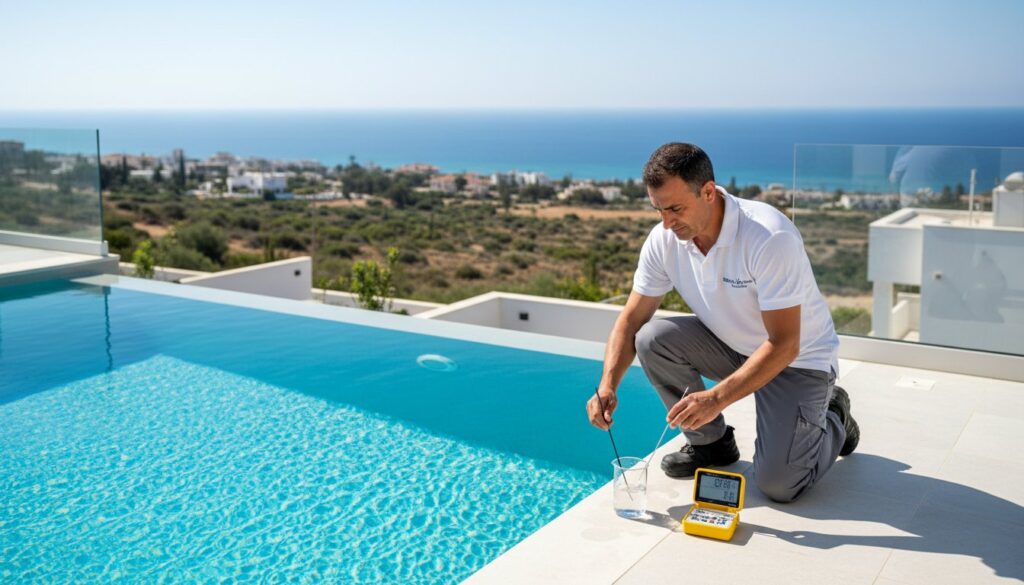
Last July, a villa owner in Chloraka discovered that just 48 hours of 38-degree Paphos heat was enough to deplete their chlorine levels to zero, turning a crystal clear pool into an algae-filled liability. You likely understand that maintaining a pristine swimming environment in this coastal microclimate is more than a simple weekend hobby. Professional Chloraka pool maintenance is a technical challenge that requires precision and consistency to combat the unique environmental pressures of the Mediterranean coast.
Between the salt-air corrosion that can reduce pump lifespans by 30% and the heavy limestone scaling caused by local hard water, the pressure to protect your investment is constant. This professional guide provides the precise technical framework you need to achieve “set it and forget it” reliability and full compliance with the latest 2026 Cyprus health and safety regulations for rental properties. We’ll detail the specific chemical balancing protocols, equipment protection strategies, and scaling solutions required to ensure your water remains safe and inviting throughout the year.
Key Takeaways
- Understand how Chloraka’s coastal proximity affects water chemistry and learn the technical methods to prevent salt-air corrosion on your pool’s mechanical parts.
- Master a professional routine for Chloraka pool maintenance that goes beyond basic skimming to include advanced water testing for long-term equipment protection.
- Discover how to manage the high calcium levels inherent in the local Paphos water supply to ensure your pool surfaces remain pristine and inviting.
- Learn why international health and safety standards, such as PHTA certification, are essential for protecting your investment and ensuring a stress-free swimming environment.
- Identify the hidden costs of amateur maintenance and how tailored professional packages provide the ultimate peace of mind for villa owners and complex managers.
Understanding the Fundamentals of Chloraka Pool Maintenance
Maintaining a swimming pool in Chloraka requires more than a net and a basic chlorine tablet. The Paphos coastal region experiences over 3,000 hours of sunshine per year, creating an environment where algae can bloom within hours if chemistry is neglected. Professional Chloraka pool maintenance is defined by a rigorous technical approach that goes beyond simple aesthetics. While a basic service might focus on surface debris, professional pool engineering monitors the entire life support system of your pool, ensuring every component functions at peak efficiency.
Chloraka’s proximity to the sea introduces unique challenges. Salt-laden air and high humidity levels can lead to accelerated corrosion of pump components and salt crystallization in filtration systems. Achieving the “crystal clear” standard expected in high-end Mediterranean villas requires a deep understanding of the fundamentals of pool sanitation. We focus on balancing the Langelier Saturation Index (LSI) to prevent scale or corrosion, ensuring the water is not just clear but chemically safe for every swimmer.
The Role of Professional Maintenance
Consistency is the foundation of pool longevity. Regular servicing by qualified technicians can extend the lifespan of a reinforced PVC liner by up to five years, preventing the premature brittleness caused by fluctuating pH levels. For Chloraka villa owners, a pristine pool is a critical asset; properties with professionally certified maintenance records often see higher valuation and increased rental demand. We transition our clients from a reactive repair mindset to a proactive schedule, providing the “peace of mind” that comes from knowing your investment is protected 52 weeks a year.
Health and Safety Standards in Cyprus
Safety in Cyprus pools is governed by strict European standards, specifically EN 16713 for domestic pools and EN 15288 for communal facilities. It’s vital to remember that clear water doesn’t always mean healthy water. Pathogens can survive in water that looks perfect to the naked eye if the oxidation-reduction potential is low. Our Chloraka pool maintenance protocols prioritize precise chemical dosing using only Cyprus-certified products approved by the Ministry of Health. This ensures that disinfection rates remain within the recommended limits of 1.0 to 3.0 ppm for free chlorine, protecting bathers from skin irritation and waterborne illnesses while maintaining the highest hygiene benchmarks.
The Technical Challenges of Coastal Pool Care in Paphos
Maintaining a swimming pool in Chloraka isn’t just about skimming leaves or checking chlorine levels. The coastal microclimate presents a specific set of environmental pressures that can degrade a pool’s structural integrity and water quality within a single season. Effective Chloraka pool maintenance requires a deep understanding of how the Mediterranean environment interacts with pool chemistry and mechanical systems.
The primary technical hurdles for local homeowners include:
- Salt-Air Oxidation: Properties within 1.5 kilometers of the Chloraka coastline face constant exposure to salt-laden breezes. This accelerates the corrosion of 304-grade stainless steel fixtures, often leading to “tea staining” or structural pitting.
- The Calima Effect: Saharan dust storms, known locally as Calima, can deposit up to 50 grams of fine sediment per square meter. These particles are often rich in phosphates, which act as a high-performance fertilizer for algae.
- Extreme UV Exposure: With over 3,000 hours of sunshine annually and UV indices frequently hitting 11+ in July, plastic components and solar covers become brittle 30% faster than in more temperate climates.
- High Evaporation Rates: Paphos summers can see water levels drop by 5cm to 8cm per week, leading to a rapid concentration of dissolved solids and minerals.
Managing Scaling and Hard Water
The water supply in Paphos is notoriously “hard,” typically containing between 250 and 450 mg/L of calcium carbonate. This limestone content is the primary enemy of pool heaters and salt cell plates. When the water temperature rises, calcium precipitates out of the solution, forming a rock-hard crust that reduces heater efficiency by roughly 12% for every millimeter of buildup. We focus on keeping pH levels strictly between 7.2 and 7.4 to prevent this mineral precipitation. If you notice white, sandpaper-like textures on your tiles, it’s often a sign of advanced scaling. In some cases, severe scaling can hide structural cracks. If your water levels drop faster than the standard evaporation rate, it’s time to book a pool leak detection Paphos service to ensure your shell remains watertight.
Coastal Corrosion Prevention
Standard pool hardware often fails in the humid, salty air of Chloraka. We recommend upgrading all visible metalwork to 316-grade marine-grade stainless steel to ensure longevity. Salt-water chlorination systems also require specific attention; while they’re excellent for bather comfort, the high humidity can cause the control boards in the pump room to corrode if not properly ventilated. Protecting your pump room involves more than just a locked door. It requires active airflow and regular “freshwater rinsing” of external mechanical parts to remove salt deposits. This level of technical oversight is what defines professional Chloraka pool maintenance and ensures your investment stays protected year-round. If you’re concerned about the impact of the coastal air on your equipment, The Pool People can provide a comprehensive technical audit of your filtration system.
A Professional Maintenance Routine for Chloraka Pools
Maintaining a swimming pool in the Mediterranean climate requires more than a casual glance. A professional Chloraka pool maintenance schedule starts with a rigorous weekly checklist designed to prevent problems before they manifest. You must skim the surface to remove organic debris before it sinks and begins to decay. Brushing the walls and floor is equally vital; this action breaks up invisible biofilm that protects algae from chlorine. Emptying skimmer and pump baskets ensures your hydraulic system operates without unnecessary strain, preserving the lifespan of your motor.
Relying on basic test strips often leads to inaccurate readings and chemical imbalances. For crystal clear results, we utilize DPD1 and DPD3 reagents or digital photometers to measure free and total chlorine precisely. This data allows for the exact calculation of combined chloramines, which are responsible for eye irritation and that distinct “chlorine smell.” During Paphos heatwaves, where temperatures frequently exceed 38°C, chlorine evaporates rapidly. We recommend a weekly shock treatment and a preventative dose of non-foaming algaecide to maintain a sanitization barrier when the bather load increases.
Effective circulation relies on a clean filter. You should monitor your pressure gauge at least twice a week. A rise of 8 to 10 PSI above the clean starting pressure indicates it is time to backwash. This process reverses the water flow to flush out trapped contaminants. Neglecting this step forces the pump to work harder, increasing your electricity costs and reducing water clarity.
Seasonal Adjustments for Your Pool
Chloraka experiences high rental demand from May through September. During this period, pools often face a 200% increase in organic load compared to the off-season. Daily checks become a necessity to keep water safe for guests. Conversely, as temperatures drop, don’t just “turn off” your pool. Stagnant water leads to costly calcium scaling and structural damage. Follow our winter pool care Paphos guide to ensure your investment remains protected through the cooler months.
Equipment Health Checks
Mechanical failure usually starts with a small, ignored sign. Conduct a monthly inspection of your pump and the pool equipment Paphos homeowners depend on for daily filtration. Check for leaks around the pump seal and inspect O-rings for cracking or flattening. If you use an automated dosing system, calibrate the probes every 30 days. An uncalibrated probe can lead to dangerously high or low chemical levels, compromising both safety and the lifespan of your pool liner.
DIY vs. Certified Professional Pool Management
Choosing between DIY care and professional Chloraka pool maintenance often comes down to a perceived saving in cost. However, the “cheap” pool boy model frequently results in hidden expenses that far outweigh a monthly service fee. Inaccurate chemical dosing leads to an estimated 25 percent waste of product annually; meanwhile, improper pH balance causes premature degradation of pump seals and heat exchangers. Replacing a high-end variable speed pump represents a significant capital outlay that often dwarfs the price of a year of expert oversight. When you factor in the lifespan of your pool liner and filtration hardware, professional management pays for itself through asset preservation.
Modern health and safety requirements have moved far beyond the capabilities of casual maintenance. The industry has shifted toward the PHTA (Pool & Hot Tub Alliance) and NSPF (National Swimming Pool Foundation) standards, which require rigorous technical knowledge. These certifications ensure that your technician isn’t just skimming leaves, but acting as a guardian of your family’s health. Professional service isn’t just an expense; it’s a commitment to a “peace of mind” philosophy where the safety of the water is never in question. We don’t just clean pools; we engineer a safe environment for your home.
Communal Complex Compliance
For Chloraka communal committees, the legal landscape is exceptionally rigorous. Under Cyprus Law 92(I)/1992, committee members can be held personally liable for accidents or health outbreaks in non-compliant pools. Ensuring that onsite staff have completed CPO training Cyprus is the only reliable way to guarantee that maintenance protocols meet international safety benchmarks. This certification transforms a basic caretaker into a qualified operator capable of managing complex filtration systems and mandatory public health logs. Without this level of certified expertise, committees face substantial liability risks and potential insurance invalidation.
The Science of Water Chemistry
Achieving crystal clear water requires a deep understanding of pool water chemistry that goes far beyond basic chlorine levels. Professionals utilize the Langelier Saturation Index (LSI) to determine if your water is corrosive or scale-forming. This mathematical formula considers calcium hardness, total alkalinity, and temperature to ensure water remains perfectly balanced. Without this precision, pools often suffer from “chlorine lock” caused by high cyanuric acid levels, leading to green water even when chlorine readings appear normal. Professional testing identifies these issues before they require a total water drain and refill, saving thousands of liters of water.
Experience the ultimate peace of mind with a maintenance plan designed by the industry’s leading experts. Contact The Pool People today to secure your professional service contract.
The Pool People: Expert Pool Services in Chloraka
Choosing a partner for Chloraka pool maintenance means looking beyond the surface of the water. At The Pool People, we’ve built our reputation on a foundation of international excellence, holding PHTA (Pool & Hot Tub Alliance) certifications that set us apart from casual laborers. Whether you own a secluded private villa near the Chloraka coastline or manage a sprawling 50-unit residential complex, our maintenance packages are engineered for your specific site requirements. We don’t believe in one-size-fits-all solutions. Instead, we provide tailored care that respects the unique hydraulic needs of your installation.
We understand that for many homeowners, the pool is a significant financial investment. We protect that investment through rigorous chemical balancing and preventative care that eliminates the common stresses of ownership. For absent homeowners and rental agents, we provide total peace of mind. Our team acts as your dedicated eyes and ears on the ground, ensuring your water is crystal clear, safe, and inviting for guests the moment they step through the door. If an issue arises, our emergency repair and leak detection services cover the entire Paphos region, providing rapid response times that prevent minor leaks from becoming structural disasters.
Comprehensive Engineering Solutions
Our engineering team handles more than just basic cleaning. We specialize in precision leak detection and high-performance liner replacements that can extend the life of your pool by 10 to 15 years. If you’re looking to modernize your setup for 2026, our technicians install advanced salt-water system upgrades that significantly reduce chemical dependency and skin irritation. Every technician undergoes hundreds of hours of specialized training, making them the most qualified professionals in Cyprus. We conduct “no-stone-unturned” health audits, checking every valve, pump, and seal to ensure your system operates at peak efficiency.
Getting Started with Your Maintenance Plan
Starting your professional Chloraka pool maintenance journey is a straightforward process designed to save you time. You can book an initial site visit where we perform a comprehensive 7-point water analysis and a full equipment diagnostic. During your first professional service visit, our team will map out a customized schedule that accounts for the high UV levels and dust typical of the Mediterranean climate. We also invite you to visit our Paphos storefront. This physical hub allows you to speak directly with our senior experts, browse the latest energy-efficient hardware, and receive professional advice on maintaining your pool’s health between our scheduled visits.
Secure Your Crystal Clear Oasis in 2026
Maintaining a swimming pool in the Mediterranean coastal climate requires more than basic skimming. With over 20 years of experience in the Paphos region, we’ve developed specialized protocols to combat the specific challenges of salt air and high UV exposure. Professional Chloraka pool maintenance ensures your water chemistry remains balanced and your equipment functions at peak efficiency. Our team of PHTA and NSPF Certified Pool Operators provides the technical expertise needed for complex tasks like precision leak detection and high quality liner replacement. These international standards aren’t just recommendations; they’re the foundation of a safe and sustainable swimming environment for your family.
By choosing a certified partner, you’re investing in the longevity of your property and the health of everyone who dives in. We take pride in our role as industry mentors who set the benchmark for excellence across Cyprus. Don’t leave your investment to chance when you can have total peace of mind. Contact The Pool People today for a professional maintenance quote in Chloraka and experience the difference that two decades of technical mastery brings to your doorstep. Your perfect, crystal clear pool is ready for the season ahead.
Frequently Asked Questions
How much does monthly pool maintenance cost in Chloraka?
Monthly costs for professional care depend on your pool size and the specific service frequency you choose. According to 2024 Cyprus property market benchmarks, standard residential pool services typically range from €80 to €150 per month. This investment in Chloraka pool maintenance covers expert labor and chemical balancing. It ensures your filtration equipment reaches its full 12 year lifespan while preventing expensive structural repairs caused by chemical neglect.
How often should my pool be serviced during the Paphos summer?
Your pool requires professional servicing at least twice per week during the peak summer months of June through September. High temperatures frequently exceeding 35 degrees Celsius accelerate chlorine evaporation and bacteria growth. These bi-weekly visits allow us to maintain a consistent free chlorine level of 1.0 to 3.0 ppm. This rigorous schedule protects your water quality against the heavy bather loads common during the Paphos holiday season.
Why does my pool water turn green so quickly in Cyprus?
Pool water turns green due to rapid algae blooms triggered by high phosphate levels and intense Mediterranean UV exposure. In the Paphos district, a drop in chlorine levels for just 24 hours during a heatwave can lead to visible algae growth. We use professional grade algaecides and phosphate removers to keep your water crystal clear. Proper chemical balancing is the only reliable way to prevent these sudden and unsightly transformations.
Is a salt-water pool better for the Chloraka coastal environment?
Salt-water chlorination systems are highly effective in Chloraka because they provide a constant, low level of natural chlorine that’s gentler on your skin and eyes. While the initial installation cost is higher, 85 percent of our new coastal clients choose salt systems for their superior water feel. You must ensure all poolside fixtures are 316-grade stainless steel to resist the 70 percent humidity levels common near the Chloraka coastline.
What are the legal requirements for communal pools in Paphos?
Communal pools in Cyprus must comply with the Public Swimming Pools Regulations of 1992 and 1996. These laws require a certified lifeguard to be on duty whenever the pool is accessible, along with a valid health certificate from the Paphos Municipality. We help complexes meet these 22 specific safety criteria. Failure to comply can result in significant fines or the immediate closure of your facility by local authorities.
Can I use tap water to fill my pool in Chloraka?
You can use tap water, but it’s essential to test for high mineral content and calcium hardness before you start the filling process. Chloraka mains water often shows calcium levels exceeding 250 ppm, which can lead to rapid scale buildup on your tiles and internal plumbing. We recommend using a metal sequestrant during the initial fill. This professional step prevents staining and protects your pool’s finish for years to come.
What should I do if my pool is losing water rapidly?
If you notice a water level drop of more than 5mm per day, you should immediately perform a bucket test to rule out natural evaporation. Rapid water loss often indicates a structural crack or a leak in the underground pipework. Our team utilizes specialized pressure testing equipment to pinpoint the exact location of the breach. Identifying a leak early can save you 1,000 liters of water per week and prevent foundation damage.
How do I know if my pool technician is properly certified?
A qualified technician should hold internationally recognized certifications such as those from the PHTA or SPATA. Ask to see their valid CPO credentials, which require renewal every five years to stay current with safety standards. As industry leaders, we train our staff to exceed these global benchmarks. Choosing a certified professional gives you peace of mind that your investment is being handled by a trained expert rather than an amateur.