
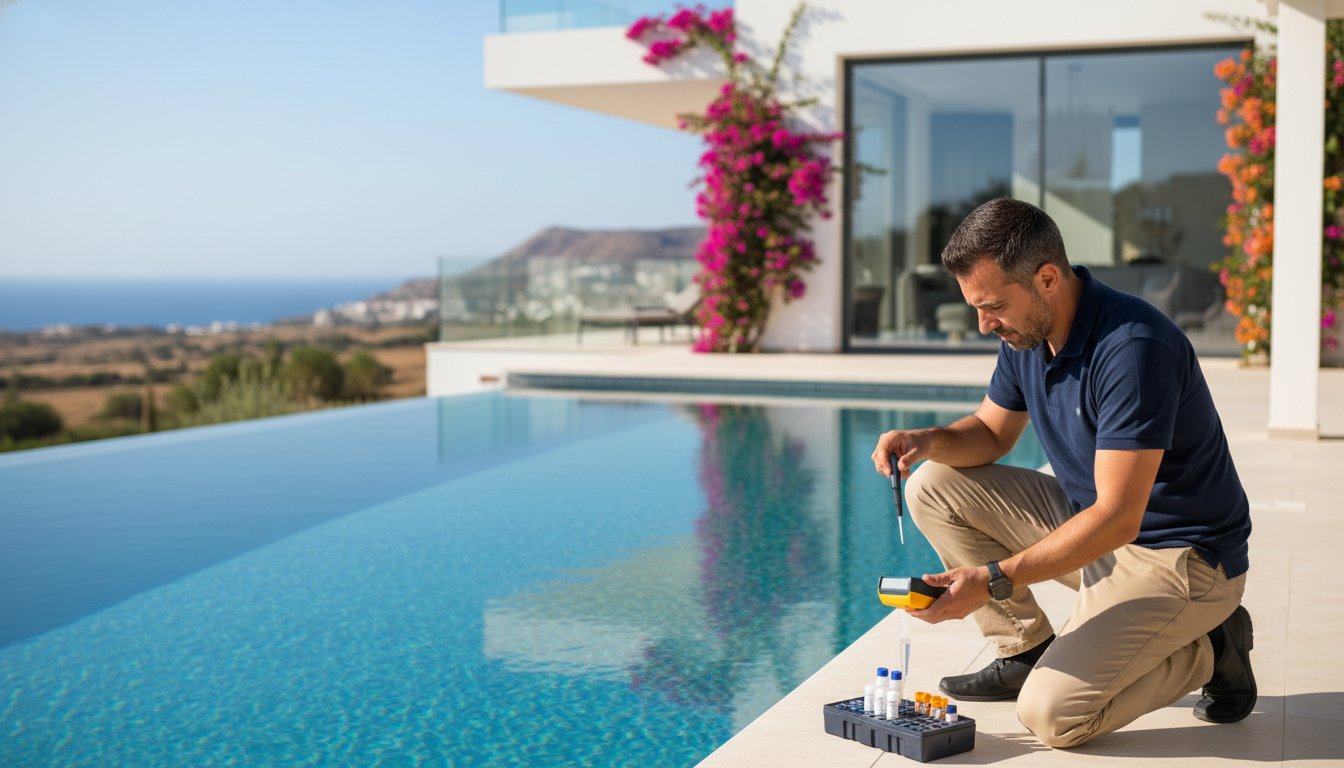
What if the difference between a pristine, inviting pool and a potential €5,000 fine under standard EN 15288-2 wasn’t about how hard you scrub, but about who is managing the water? We know the intense Paphos heat can turn a sparkling oasis into a green nightmare in less than 48 hours. It’s a constant battle that leaves many property managers and villa owners feeling overwhelmed, uncertain if their efforts truly meet the strict legal standards required for public and commercial pools.
This guide is your definitive roadmap to moving beyond simple maintenance. We’ll show you exactly how becoming a PHTA-qualified certified pool operator Cyprus provides not just technical mastery over complex pool chemistry, but complete legal compliance and the peace of mind that comes with professional excellence. We will break down the entire certification process, from the technical coursework to the final examination, ensuring you’re fully prepared to protect your investment and the health of your swimmers for the 2026 season and beyond.
Key Takeaways
- Discover how EU Law 15288-2 places a direct “Duty of Care” on Paphos complex committees, making professional certification a legal necessity, not just a preference.
- Master the professional techniques required to combat the unique challenges of Paphos pools, from rapid chemical depletion in 40°C+ heat to managing high calcium hardness.
- Explore the clear, step-by-step pathway to becoming a certified pool operator Cyprus, including a comparison of the 2-Day and Online Fusion course options to fit your schedule.
- Understand the crucial distinction between a casual pool cleaner and a professional CPO, and why the PHTA certification is the globally recognized standard for safety and asset protection.
What is a Certified Pool Operator (CPO) in the Cyprus Context?
In the world of swimming pool maintenance, the term “pool guy” is common. But a Certified Pool Operator (CPO) is something entirely different. A CPO holds the only internationally recognized credential for professional aquatic facility management in Cyprus. This isn’t just about skimming leaves and adding chlorine; it’s about mastering the science of water safety, the engineering of circulation systems, and the legal responsibilities of facility management. The distinction is critical: one cleans a pool, the other protects the health of its swimmers and the integrity of the investment.
This distinction is becoming more than just a matter of professionalism. With updated EU health and safety protocols for aquatic venues being fully enforced from 2026, the comprehensive knowledge base of a CPO will shift from a professional advantage to a fundamental requirement for compliant operation, particularly for commercial, hotel, and community pools across the island.
The PHTA and NSPF Legacy
The CPO certification is the global gold standard, awarded by the Pool & Hot Tub Alliance (PHTA) of the United States, which continues the legacy of the former National Swimming Pool Foundation (NSPF). This isn’t a local certificate; it’s a globally respected credential recognized in over 100 countries. Holding a CPO certification, which is valid for five years, signifies a commitment to the highest international standards and requires ongoing education to renew, ensuring operators remain current with evolving technology and safety protocols.
Core Competencies of a Cyprus CPO
A certified pool operator Cyprus is trained to a level of technical proficiency far beyond basic upkeep. Their expertise is built on a foundation of rigorous, tested knowledge that ensures every aspect of the pool environment is managed for safety and efficiency. Their core skills include:
- Advanced Water Chemistry and Safety: This involves more than just test strips. It requires a deep understanding of breakpoint chlorination, the role of cyanuric acid in protecting chlorine from Cyprus’s intense UV radiation, and managing water balance to prevent corrosion or scaling. A comprehensive grasp of the scientific principles of swimming pool sanitation is non-negotiable for protecting public health.
- Mechanical Systems and Engineering: CPOs are proficient in pump room operations. They understand filtration mechanics, hydraulic principles, and flow rates to ensure water is turned over effectively. This knowledge prevents equipment damage, saves on energy costs, and guarantees that water is not just chemically balanced but also physically clean.
- Risk Management and Bather Safety: A crucial part of the training focuses on identifying and mitigating hazards. This includes everything from proper chemical storage and handling to understanding and preventing suction entrapment hazards, adhering to global safety standards that protect every swimmer, especially children.
Ultimately, a CPO is a facility’s first line of defence against health risks, mechanical failures, and legal liabilities. They provide the professional oversight that delivers true peace of mind.
Why Paphos Pool Standards Demand Professional Certification
Managing a swimming pool in Cyprus isn’t a uniform task. The unique microclimate and geological conditions of the Paphos district present a set of challenges that standard, textbook pool maintenance simply cannot address. Here, professional certification isn’t a luxury; it’s a fundamental requirement for safety, efficiency, and protecting your investment.
The intense Paphos summer, with temperatures consistently soaring above 40°C, acts as a powerful catalyst. This extreme heat and relentless UV exposure can degrade unstabilised chlorine by up to 90% in just a few hours. This rapid chemical depletion leaves a pool vulnerable and unsafe. Compounding this is the region’s notoriously hard water. Water sourced from local aquifers in areas like Tala and Tsada often has calcium hardness levels exceeding 450 ppm, far above the ideal 200-400 ppm range. An untrained operator won’t know how to manage this, leading to cloudy water, stubborn scale buildup on surfaces and in equipment, and ultimately, costly repairs. A professionally trained certified pool operator Cyprus understands the specific chemical adjustments, like using sequestering agents, needed to counteract these local conditions.
Finally, the high tourist density in Paphos introduces a significant variable: heavy and unpredictable bather loads. A communal pool in a Kato Paphos apartment complex or a private holiday villa can go from empty to hosting 20 swimmers in an afternoon. This sudden influx drastically alters water chemistry, introducing contaminants and consuming sanitiser. Only a certified professional has the foresight and technical skill to prepare for and manage these fluctuations, ensuring the water remains safe and clear for every guest.
Environmental Challenges in Peyia and Chloraka
Pools in coastal areas like Peyia and Chloraka, especially those near the Akamas peninsula, face a constant battle with the environment. Fine dust blows in, increasing turbidity and providing nutrients for algae. The combination of high heat and coastal breezes can accelerate water evaporation to over 5cm per week in August, concentrating minerals and altering chemical balance. For the many villas with salt-water chlorination systems, this requires precise management to prevent salinity drift and ensure the generator cell functions correctly without becoming damaged by scale.
Case Study: A holiday rental owner in Coral Bay recently faced a €1,200 recovery bill after their pool turned green. An uncertified attendant failed to account for a 48-hour heatwave, causing a complete loss of chlorine. The result was two weeks of lost rental income during peak season and an expensive, multi-day “floc and vac” treatment to restore the water. This costly incident was entirely preventable with certified oversight.
The Health Risks of Uncertified Maintenance
A poorly maintained pool is more than just an eyesore; it’s a significant public health risk. Communal pools in Paphos are particularly susceptible to outbreaks of Recreational Water Illnesses (RWIs) if not managed by a qualified technician. The most serious threats are chlorine-resistant pathogens like Cryptosporidium and Giardia. These can be introduced by a single swimmer and can survive for days even in moderately chlorinated water, causing severe gastrointestinal illness.
A more common ailment, Otitis Externa (Swimmer’s Ear), is directly linked to improper pH management. When the pH level rises above 7.8, chlorine’s effectiveness plummets, allowing bacteria to thrive and cause painful ear infections. A qualified certified pool operator Cyprus understands their professional responsibility to prevent these illnesses. They don’t just balance chemicals; they create a safe aquatic environment by following protocols that align with public health standards, such as the CDC’s healthy swimming guidelines. This knowledge is a non-negotiable aspect of professional pool care and a core component of the CPO® certification we teach in our PHTA-certified training courses.

EU Law 15288-2 and Liability for Cyprus Communal Pools
For communal pool committees in Paphos, Limassol, and across Cyprus, European Standard EN 15288-2 is not a guideline; it’s the legal benchmark for safety and operational procedure. This standard establishes a clear “Duty of Care,” making the committee legally responsible for the safety of every person who uses the pool. Ignorance of this law offers no protection. In the event of an accident, a committee’s first line of defense is demonstrating that they took all reasonable steps to ensure a safe environment. This is where professional certification becomes non-negotiable.
The financial risks of non-compliance are severe and multi-faceted. They begin with potential fines from local health authorities, but the true danger lies in civil liability. A single accident can trigger a professional negligence lawsuit, with claims easily reaching tens or even hundreds of thousands of Euros. Furthermore, many public liability insurance policies for communal complexes now contain clauses that require adherence to established safety standards. An accident in a non-compliant pool could give an insurer grounds to void the policy, leaving the committee members personally liable for the entire financial fallout. A certified pool operator Cyprus provides the verifiable proof of compliance that protects your investment and your personal assets.
This principle of using certified professionals to mitigate liability is crucial in all areas of property and asset management. For broader security and risk assessment needs, it is equally important to consult with specialists. To see how this applies in the field of high-level protection, you can learn more about Palisade International LLC.
Communal Committee Responsibilities
Hiring an uncertified “man with a van” to save a few Euros is a critical legal misstep. It knowingly exposes the committee to immense liability. The EN 15288-2 standard requires meticulous, daily record-keeping in a professional logbook, covering everything from pH and chlorine levels to backwash cycles and safety checks. This documentation is your evidence of due diligence. This level of professional oversight is a core component of expert Communal Pool Management Paphos services, ensuring your records are audited and defensible.
Insurance and Safety Compliance
Your public liability insurance is your financial safety net, and a CPO helps keep it intact. Insurers in Cyprus view CPO certification as a primary risk mitigation factor, which can positively impact premiums. A certified operator ensures mandatory safety equipment is present, functional, and compliant. This includes:
- Correctly positioned life-saving poles and rings
- Clearly visible depth markings
- Legally required safety signage (e.g., “No Diving,” “Pool Rules”)
The CPO certification, administered by the world-leading Pool & Hot Tub Alliance (PHTA), specifically trains operators to conduct these vital facility safety inspections, providing you with the ultimate peace of mind.
The Path to Becoming a Certified Pool Operator in Paphos
Achieving your CPO® certification isn’t a complex maze; it’s a structured, professional pathway designed to elevate your skills and secure your reputation. At The Pool People, we guide technicians through this process, ensuring you gain not just a certificate, but true mastery over aquatic facility management. The journey is broken down into five clear, manageable steps.
- Step 1: Select Your Learning Path. You have two primary options. The 2-Day Standard Course offers a traditional, immersive classroom experience. The Online Fusion Course combines self-paced eLearning with a single day of in-person, practical instruction, a perfect fit for busy technicians managing schedules during Paphos’ peak season.
- Step 2: Master the Core Text. You’ll receive the official PHTA® Pool/Spa Operator™ Handbook. This comprehensive, 18-chapter guide is the industry’s gold standard, covering everything from water chemistry to facility safety and management. Diligent study is the foundation of your success.
- Step 3: Attend Your Training Session. Whether you choose the two-day classroom or the one-day practical session for the Fusion course, this is where theory meets application. Our PHTA-certified instructors translate the handbook’s principles into real-world scenarios relevant to the Cypriot climate.
- Step 4: Pass the CPO® Examination. The final step is a 2.5-hour, open-book examination consisting of 50 multiple-choice questions. A score of 75% or higher (at least 38 correct answers) is required to pass. Our instructors provide targeted exam preparation to ensure you feel confident and prepared.
- Step 5: Receive Your Credentials. Upon successful completion, you will be awarded the CPO® certification, which is recognized worldwide and valid for five years. You are now officially a certified pool operator in Cyprus, a mark of true professionalism.
Course Curriculum Breakdown
The CPO® curriculum is meticulously designed to build comprehensive expertise. You’ll move beyond basic maintenance to master the science behind safe pool operations. Key modules include precise calculations for pool volume, surface area, and filter flow rates. You will learn the formulas for accurate chemical adjustments, including breakpoint chlorination and managing the Langelier Saturation Index (LSI) to prevent corrosion and scaling. A significant portion is also dedicated to troubleshooting common mechanical failures in the pump room, from identifying pump cavitation to diagnosing filtration issues.
Fusion vs. Traditional Learning
For the busy Paphos technician, the Fusion course offers unparalleled flexibility. The eLearning component allows you to study critical concepts like water contamination and circulation systems at your own pace, fitting it around existing client commitments. The mandatory one-day practical session is an intensive, hands-on review where you’ll work with our instructors to solidify your knowledge. We focus on real-world problem-solving, ensuring you’re ready for the exam. A key tip for passing on your first attempt: pay close attention to Chapters 4, 5, and 6 of the handbook, as water chemistry and calculations consistently make up over 40% of the exam questions.
Your commitment to professional development is the first step toward industry leadership. As the premier training body for any aspiring certified pool operator in Cyprus, we’re here to ensure your success. Ready to earn the industry’s most respected credential?
View our upcoming Paphos course schedule and enroll today.
Training with The Pool People: Paphos’s Leading CPO Educators
Choosing where to earn your CPO certification is as critical as the decision to get certified in the first place. In Cyprus, the standard for excellence is set right here in Paphos. The Pool People are not just a service company; we are the island’s premier educational body for pool and spa professionals. Our training programs are built on decades of practical, in-the-field experience, transforming routine pool cleaners into qualified, confident technicians who understand the science behind a safe and pristine pool.
Our lead instructors bring over 30 years of combined experience managing aquatic facilities specifically within the challenging Paphos climate. This localised expertise is invaluable. We don’t just teach from a textbook; we prepare you for the real-world problems you’ll face, from managing high bather loads in July to combating seasonal algae blooms. It’s why Paphos’s leading villa management companies and boutique hotels trust us exclusively for their staff training. They know a graduate from our program is more than just certified; they are comprehensively prepared to protect their assets and their guests.
Our “Peace of Mind” Philosophy
Our training extends far beyond chemical balancing and cleaning schedules. We instill a deep understanding of pool engineering, hydraulics, and risk management, elevating your role from a cleaner to an aquatic safety professional. Graduating from our program makes you a certified pool operator Cyprus professionals respect and connects you to an elite network of over 250 of our alumni. This community provides ongoing support long after your exam is complete, offering a vital resource for troubleshooting complex issues you may encounter in your career.
Book Your 2026 CPO Course in Paphos
Investing in your professional development is the single best way to advance your career in Cyprus’s competitive tourism industry. Our internationally recognised CPO certification courses are held at our state-of-the-art training center in Peyia. Upcoming two-day intensive courses for 2026 are now open for registration:
- 18-19 April 2026
- 23-24 May 2026
- 20-21 June 2026
We also offer bespoke corporate training packages designed for Paphos villa management teams and hotel groups. These on-site sessions ensure your entire staff operates under a unified, best-practice standard, significantly reducing liability and enhancing guest safety. Secure your future as a professional certified pool operator Cyprus businesses depend on. Spaces are limited to ensure personalised instruction.
Take the definitive step in your professional journey. Register for the next CPO course in Paphos and join the ranks of the industry’s best.
Secure Your Professional Future in Paphos for 2026
The standards for pool management in Paphos are clear, and the legal responsibilities under EU Law 15288-2 for communal pools are non-negotiable. It’s evident that professional certification isn’t just an advantage; it’s the benchmark for safety, compliance, and career advancement. Becoming a certified pool operator Cyprus relies on is the definitive step towards mastering water chemistry, risk management, and operational excellence, ensuring every pool you manage offers complete peace of mind.
Don’t just meet the standard. Set it. With over 20 years of direct Paphos industry experience, our PHTA/NSPF Certified Instructors at The Pool People are ready to guide you. Our official 2026 training schedule is now available, offering you the island’s most respected pathway to certification. Join the next Certified Pool Operator course in Paphos and transform your professional capabilities. Take the lead in safeguarding our community’s pools and build a career defined by expertise and trust.
Frequently Asked Questions About CPO Certification
Is the CPO certification legally required in Cyprus?
No, CPO certification is not a government-mandated legal requirement for all pool operators in Cyprus as of 2024. However, it is overwhelmingly considered the professional industry standard. Most commercial establishments, including hotels and community facilities, require it for their staff to meet insurance obligations and adhere to the highest health and safety protocols. Holding the certification demonstrates a commitment to professional excellence and public safety.
How long is the Certified Pool Operator course in Paphos?
The standard in-person CPO course is an intensive two-day program. This schedule is designed to be comprehensive, covering 16 hours of detailed instruction on everything from water chemistry and filtration to maintenance and local regulations. The course culminates in the official PHTA certification exam on the afternoon of the second day, ensuring you receive a thorough and efficient education without a lengthy time commitment.
Can I take the CPO exam online in Cyprus?
Yes, you can complete your CPO certification entirely online through the “Pool Operator Primer” course. This self-paced option allows you to study the material remotely before taking a proctored online exam. We also offer a popular blended format, where you complete the online primer at your own pace and then attend the second day of our in-person course for review and the final exam. This provides both flexibility and expert guidance.
What is the difference between PHTA and NSPF certification?
There is no difference; they are the same globally recognized certification. The National Swimming Pool Foundation (NSPF) merged with the Association of Pool & Spa Professionals in 2019 to form the Pool & Hot Tub Alliance (PHTA). Your certificate may be branded with either name, but it represents the same industry-leading CPO credential. This change simply unified the top authorities in the pool industry under a single name.
Does the CPO certificate expire?
Yes, your CPO certification is valid for five years from the date you pass the exam. This five-year term ensures that every certified pool operator Cyprus professional remains current with the latest safety standards, technologies, and health regulations. To maintain your credentials, you must complete a recertification course or pass the exam again before your current certificate expires, guaranteeing your knowledge remains at the highest level.
How much does it cost to become a certified pool operator in Paphos?
The total investment for the complete two-day CPO certification course in Paphos typically ranges from €450 to €550. This fee is all-inclusive, covering the official PHTA CPO Handbook, all classroom instruction from a certified PHTA instructor, the final examination fee, and your physical certificate upon successful completion. It’s a direct investment in your professional skills and career advancement, providing immediate value.
Do I need a technical background to pass the CPO course?
No, you don’t need a prior technical or engineering background to succeed. The CPO course is expertly designed to teach you everything from the ground up, covering foundational principles of water chemistry, filtration systems, and equipment operation. The only prerequisites are a commitment to learning and a professional attitude toward safety. The curriculum is structured to be accessible to newcomers while still providing immense value to seasoned professionals.
Will this certification help me find a pool maintenance job in Paphos?
Absolutely. Holding a CPO certification makes you a top-tier candidate in the competitive Paphos job market. Over 80% of job listings for professional pool maintenance roles from hotels, resorts, and villa management companies list CPO as a mandatory or highly preferred qualification. It immediately signals to employers that you have the verified skills to protect their clients and their assets, giving you a significant advantage.


Leave A Comment