
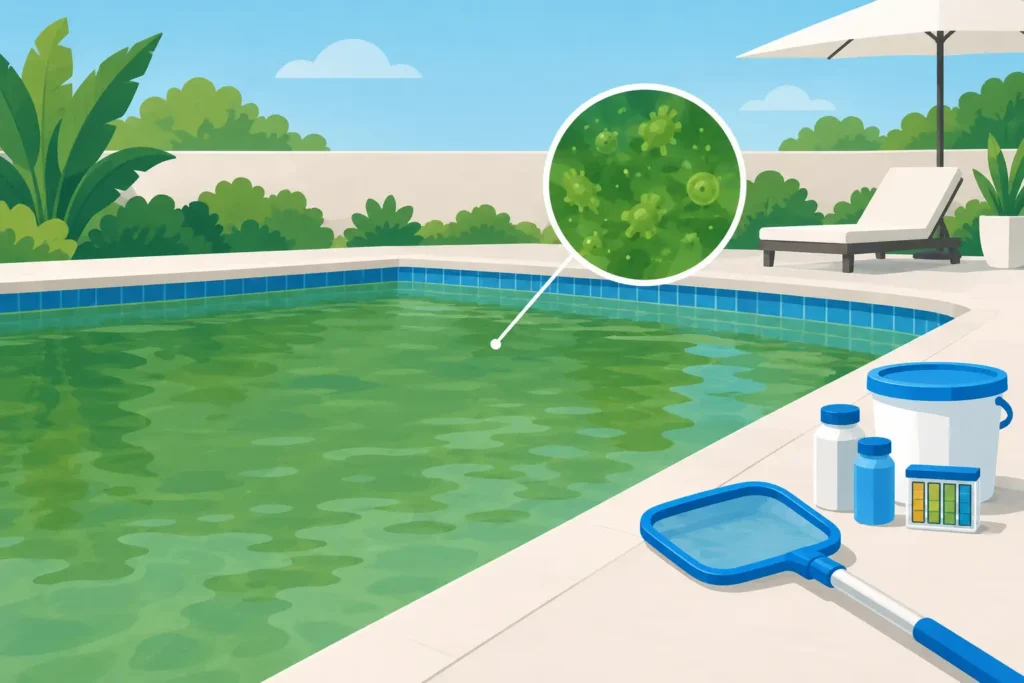
A pool can look perfectly acceptable on Friday and turn green by Monday afternoon. In Cyprus, intense sunshine, high bather loads, warm water and wind-blown debris can quickly overwhelm a pool that is only marginally balanced. If you are asking why is pool water green, treat it as a water-quality warning rather than a cosmetic inconvenience.
Green water most often indicates algae growth, but that is not the only cause. A clear green tint can also point to dissolved metals, while murky green water usually means the pool is losing the combined battle against contamination, poor circulation and inadequate sanitiser. The correct response depends on which of these is happening. Adding random chemicals may make the problem worse, damage equipment or leave the water unsuitable for swimmers.
Why Is Pool Water Green? The Main Causes
Algae has found the right conditions
Algae spores enter almost every outdoor pool through dust, rain, leaves, swimmers and the wind. They become visible only when conditions allow them to multiply faster than the sanitiser can control them. Warm water, insufficient free chlorine, poor circulation and a high pH all work in algae’s favour.
The first sign is often a faint green haze on the walls, steps or floor. Left untreated, the water becomes cloudy, surfaces feel slippery and the colour deepens. This is not simply a cleaning issue. Algae consumes chlorine, shelters other organisms and makes it harder to maintain hygienic water. In a holiday rental or communal pool, that can quickly become an operational and reputational problem.
A green pool after a period of heavy use may be short of effective sanitiser. One after several very hot days may have lost chlorine rapidly to sunlight or accumulated stabiliser that is reducing chlorine’s effectiveness. The test result that matters is not only whether chlorine is present, but whether there is enough active sanitiser for the actual pool conditions.
Filtration or circulation is not doing its job
Chemical treatment cannot compensate for water that is not moving properly through the system. A blocked skimmer basket, dirty filter, worn pump, stuck valve, air leak or inadequate daily run time can leave parts of the pool poorly circulated. Those areas become ideal for algae, particularly behind ladders, on steps and in dead corners.
In the Paphos region, filtration time often needs adjustment through the hottest months. A programme that was adequate in spring may not be sufficient during peak summer temperatures and frequent swimming. Equally, running a pump longer will not solve a mechanical fault or a filter that needs cleaning, backwashing or servicing.
Filter condition also matters. Sand, cartridge and glass-media filters all require correct maintenance. If the pressure is abnormal, the return flow is weak or fine debris returns to the pool, investigate the equipment before assuming the answer is more chemicals.
The water may be green because of metals
Not every green pool contains algae. If the water is transparent but has an emerald or blue-green cast, dissolved copper is a possible cause. Copper can enter water through source water, some algaecide products, corrosion of copper components or an imbalanced pool chemistry that attacks metal equipment.
Metal-related discolouration often appears after chlorination or a pH change. It may also leave staining on liners, tiles or fittings. Shocking a pool without first identifying excessive metals can intensify the colour or cause staining. A proper water test is the sensible starting point, followed by the correct metal-management treatment where required.
Why Green Water Can Be a Hygiene Issue
Clear water is not automatically safe water, and green water is certainly not a signal to carry on swimming. When visibility is poor, you cannot properly inspect the floor, drains or submerged fittings. More importantly, the conditions that support algae often indicate that disinfectant control has been compromised.
Pool operators have a responsibility to manage water that is clean, healthy and safe. For communal and commercial facilities, this is tied to documented operating procedures, testing records and the wider duties reflected in European pool safety and hygiene standards, including EN 15288-1 and EN 15288-2. For a private villa pool, the same principle still applies: water shared with family, guests or paying holidaymakers needs active management, not guesswork.
Do not rely on appearance alone. Test free chlorine, pH, total alkalinity and stabiliser, then assess water clarity, filter performance and circulation. If the water is green, cloudy or visibility is restricted, keep swimmers out until the cause is corrected and the water has returned to safe, balanced operating conditions.
How to Treat a Green Pool Properly
Start by testing the water with a reliable method. Test strips can provide a quick indication, but a professional photometer or properly conducted liquid test gives more dependable information when a pool has a serious problem. Check the pH before applying a chlorine treatment, because chlorine performs poorly when pH is too high.
Remove leaves and debris, brush the walls, steps and floor thoroughly, and empty skimmer and pump baskets. Brushing breaks up algae films so the sanitiser can reach them. Then inspect circulation. Confirm that the pump is priming correctly, water is returning strongly to the pool and the filter is operating at the correct pressure.
The next treatment depends on the readings and the diagnosis. An algae outbreak may require a measured shock chlorination treatment, followed by continuous filtration and repeat brushing. The dosage must account for pool volume, current chlorine level, pH, stabiliser level and the specific product being used. More is not automatically better. Excessive or poorly managed dosing can create further imbalance, bleach surfaces or place unnecessary stress on liners and equipment.
Vacuuming is often needed once dead algae has settled. If the pool remains cloudy after sanitising, fine particles may be passing through the filter or the filter media may need attention. Flocculation can be appropriate in some systems, but it is not a universal fix and must be used in a way that suits the filter and vacuum arrangement.
Where the water is clear green rather than cloudy, pause before treating it as algae. Test for metals and review recent products, source water and equipment condition. A metal sequestrant may be needed, alongside correction of the chemistry that allowed the metal to become visible.
Common Mistakes That Prolong the Problem
The most common mistake is adding algaecide to a pool with no effective chlorine residual and expecting a fast recovery. Algaecide can support a treatment plan, but it does not replace sanitisation, circulation and filtration. Another is repeatedly adding chlorine without testing pH or stabiliser. If the underlying balance is wrong, the pool can consume treatment while staying green.
Switching the pump off overnight during an algae bloom is also counterproductive. Treatment needs circulation to reach the full pool volume and filtration to remove the debris it kills. However, continuous running should be temporary and purposeful. Once the water is restored, the system should be set to an efficient schedule that suits the season, bather load and equipment design.
For rental properties and shared complexes, avoid treating green water as a last-minute turnover task. A reactive approach risks cancelled use, guest complaints and avoidable strain on plant equipment. Regular testing, recorded maintenance and early intervention cost less than recovering a neglected pool.
Preventing Green Water Through the Cyprus Summer
Prevention is based on consistency. Maintain the correct sanitiser residual, keep pH within its recommended operating range, run the circulation system for the conditions, and clean the filter before reduced flow becomes a problem. After dust storms, rainfall, parties or unusually heavy use, test again rather than waiting for the next routine visit.
Pay attention to the pool’s pattern. If it repeatedly turns green after two or three hot days, the issue may be inadequate filtration time, an undersized or failing pump, poor hydraulic design, high stabiliser or a salt-water chlorinator that is no longer producing as it should. Repeated algae is evidence to investigate, not a reason to keep buying more chemicals.
The Pool People approaches green-water recovery as both a water-quality and system-performance issue. A trained assessment can identify whether the real cause is chemistry, filtration, circulation, equipment wear or a combination of factors, then put the pool back into dependable operation.
A green pool can usually be recovered, but the safest solution is the one based on tested water, functioning equipment and a clear understanding of what changed. Restore those fundamentals promptly, and the pool is far more likely to stay ready for the people relying on it.