
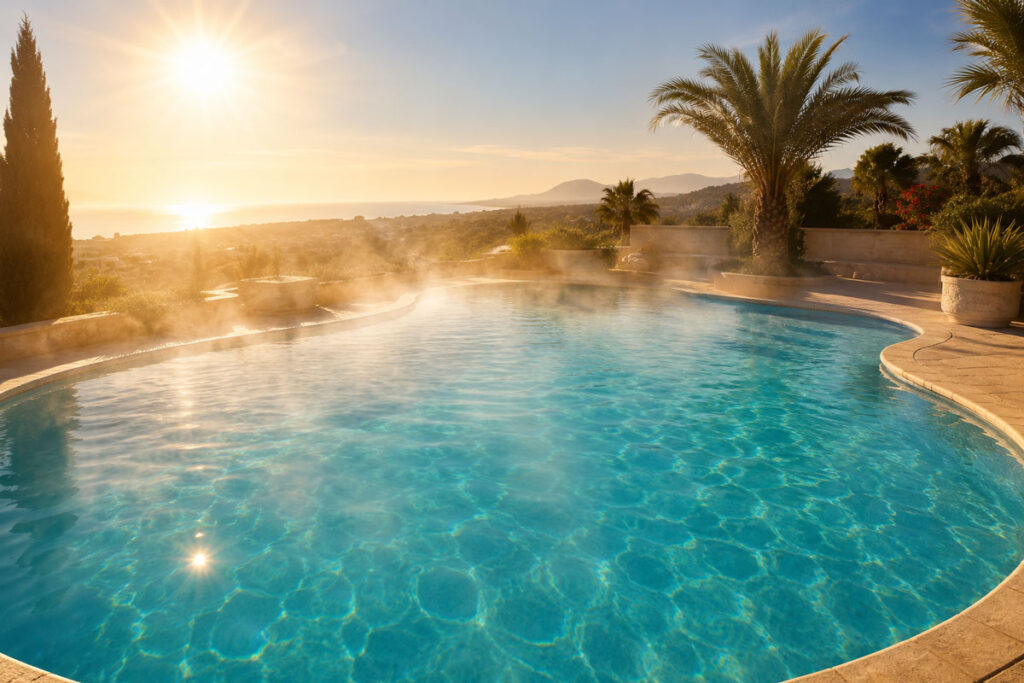
Treating a swimming pool in the extreme heat of Cyprus requires a proactive, chemical approach.
The intense UV radiation, high temperatures (often +40c) rapidly degrade chlorine, accelerates algae growth, and spike calcium levels. Here is your “Battle Plan”, focusing on Cyprus’s unique conditions.
The Chlorine War: Stabilise and Supplement
Chlorine demand is insatiable in this heat. You must protect it.
· Use Stabilised Chlorine: Always use chlorine tablets or granules containing cyanuric acid (CYA) . In the Cypriot sun, unstabilised chlorine can vanish in under two hours. CYA acts as sunscreen for your chlorine.
· The CYA Trap (Crucial): Many pools in Cyprus become over-stabilised. Pucks continuously add CYA, and if levels exceed 100 ppm, it “locks” the chlorine, rendering it ineffective. Drain and refill part of the pool if this happens. Aim for 30-50 ppm CYA.
· Weekly Shock Oxidation: The heat brings bather load and organic waste. Shock weekly with a non-chlorine shock (potassium monopersulfate) or a high dose of calcium hypochlorite to burn off chloramines. Do this at dusk so it works all night without sun interference.
Algae Control: The Dual Approach
Algae blooms explode overnight in July and August.
· Algaecide is Non-Negotiable: Use a quality, non-foaming polymer algaecide weekly. “No Mor Problems” type products are ideal. A copper-based algaecide is potent but monitor copper levels to avoid green hair.
· Phosphate Remover: Cyprus water, especially from boreholes, is often high in phosphates (algae food). Test for phosphates and use a lanthanum-based remover. Keeping them near zero starves algae before it starts.
Calcium and Water Balance
Heat accelerates evaporation, causing scale.
· The Hard Water Cycle: As water evaporates, calcium remains and concentrates. Topping up with hard Cypriot municipal or borehole water makes it worse.
· Aggressive pH Management: Heat drives pH up naturally. Test it daily. Keep Total Alkalinity on the low side (80-100 ppm) to buffer against this drift. If you allow pH to rise above 7.6 with high calcium levels, you will get sharp, rough calcium scaling on your pool walls and inside your heat pump or solar panels.
· LSI (Langelier Saturation Index): If your pool is tiled, use the LSI calculator. A high LSI in Cyprus heat means instant scaling.
Filtration Runtime
Don’t cut corners on electricity.
· Minimum 12-14 Hours: Run your pump during daylight hours. Split the run time—one block in the early morning and one late afternoon to evening. The moving water itself resists algae better than stagnant water.
Evaporation Management
A single dry, hot wind can lower your water level by 2-3 cm in a day.
· Use a Liquid Solar Cover: A liquid, biodegradable film (cetyl alcohol-based) reduces evaporation by up to 40% without heating the water like a physical cover does. Add it weekly.
· Mid-Season Drain & Refill: If you can’t manage scaling, a partial drain and refill with fresh (ideally treated and softened) water is common practice in Cyprus halfway through summer.

The Fires and Dust Factor
· Ash and Soot: If wildfires are nearby, close the skimmer valve and drain surface water from the overflow to stop oily soot from clogging your filter. Use a scum bug sponge in the skimmer.
· Dust Storms: A Sahara dust event will spike your pH instantly and turn the water cloudy. Run the pump 24/7, backwash when pressure rises 8-10 PSI and use a clarifier or flocculant to clear the fine suspended dust.
Daily Summer Check Routine for Cyprus:
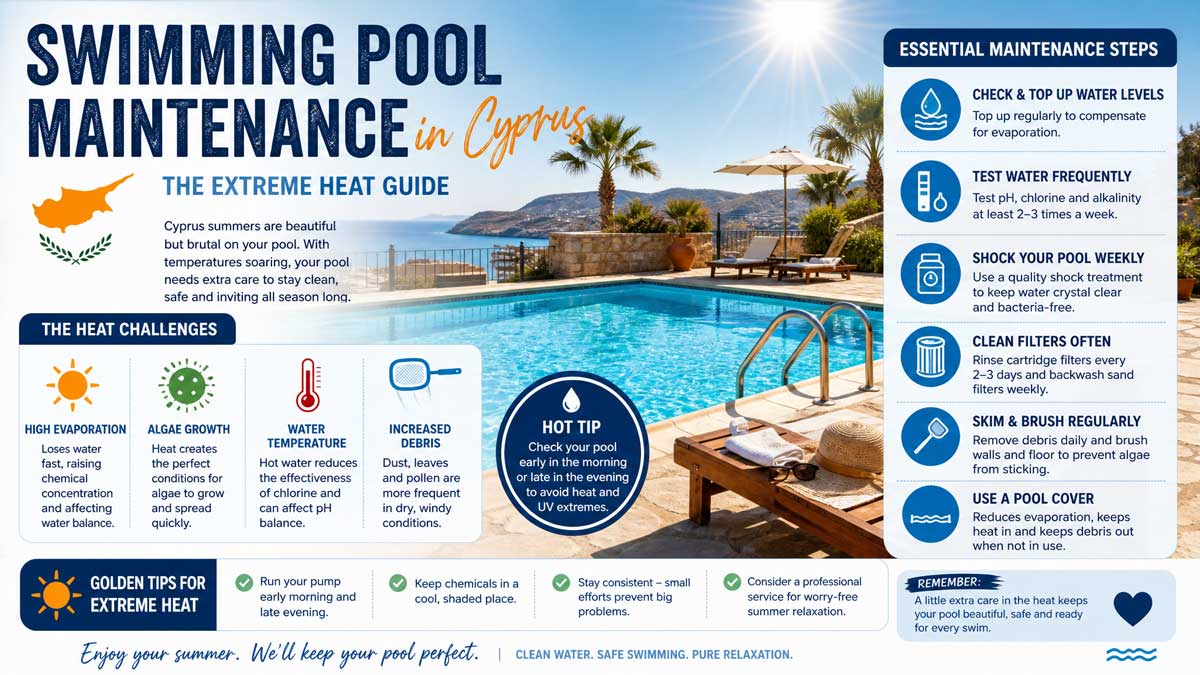
Test chlorine and pH (aim for pH 7.2-7.4). Top up water manually with a hose timer—never leave it on to forget, as hard water overflow damages coping stone. Empty skimmer baskets; leaves block flow, which kills circulation and breeds algae in one Cypriot afternoon.
If you need help identifying specific local products or calculating chemical doses for your exact pool volume, just let me know.
In Cyprus, dust and phosphates create a “perfect storm” for pool owners. The island’s arid climate, Saharan dust storms (Sirocco), hard water, and intense UV light amplify their combined effects dramatically.
Here is the breakdown of their specific impacts and how to manage them in a Cypriot pool:
The Dust Factor (Physical & Chemical)
Cypriot dust is primarily fine Sahara sand and limestone (calcium carbonate).
· Filtration overload: It clogs sand filters and D.E. grids rapidly, raising filter pressure and reducing circulation—often within hours during a Sirocco event.
· Staining & cloudiness: Limestone dust raises Total Alkalinity and Calcium Hardness, leading to calcium scaling on tiles and heat exchangers. Trace iron/manganese in the dust causes brown/rusty stains on white plaster.
· Chlorine demand: The organic matter and minerals in the dust consume free chlorine at a massive rate, leaving you with zero residual sanitizer quickly.
The Phosphate Factor (The Algae Fuel)
Phosphates enter via dust, agricultural runoff (common near citrus/olive groves), sunscreens, and even borehole water. In Cyprus, phosphates are the primary trigger for algae blooms. Because the island’s UV radiation degrades chlorine rapidly, your “free chlorine” is already fighting a losing battle; adding phosphates feeds algae, which then consume the remaining chlorine, causing a green pool within 24–48 hours of a dust storm.
The Synergistic “Cyprus Effect”
When dust meets phosphates in Cypriot water, two critical reactions occur:
· Calcium Phosphate Scale: Calcium from the dust binds with phosphates to form a white, cloudy scale that clings to the pool floor and walls. This isn’t just ugly; it traps algae spores and bacteria beneath it, making them immune to liquid chlorine.
· Chlorine “Lock”: High phosphates bind to free chlorine, creating chloramines (combined chlorine). This is why pools in Cyprus often smell heavily of chlorine and burn the eyes—even though there’s no active sanitizer left.
Consequences for Pool Equipment & Health
· Heat pump damage: Calcium phosphate scale coats the titanium heat exchangers, reducing efficiency and causing permanent overheating damage (very expensive in Cyprus).
· Filter “mudding”: The dust turns into a cement-like sludge in sand filters when mixed with high TDS (Total Dissolved Solids) from Cyprus’s hard water, requiring frequent backwashing that wastes precious water.
Practical Mitigation Strategy (Tailored for Cyprus)
· Skip the clarifier: It binds dust but leaves phosphates behind. Use a flocculant instead to sink dust to the floor, then vacuum to waste (do not send it back to the filter).
· Treat phosphates first: Use a lanthanum-based phosphate remover (not alum) weekly during summer. Aim for < 100 ppb (parts per billion). If you have a sand filter, run the pump 24/7 for 48 hours after adding it to get full precipitation.
· Top-up with reverse osmosis: If using borehole water, it’s often loaded with phosphates. Top up evaporation losses with RO-water or municipal water to minimize fresh phosphate input.
· CYA protection: Since UV destroys chlorine, maintain Cyanuric Acid (CYA) at 30–40 ppm to protect your chlorine, but never exceed 50 ppm—or it will lock the chlorine completely.
· Shock post-storm: After a Sirocco, shock with Calcium Hypochlorite (70%) instead of liquid chlorine, as it breaks down organic dust faster. Do this at dusk to avoid UV degradation.
A quick final tip:
If your pool turns cloudy without turning green, it’s likely dust-induced calcium carbonate (high pH). Lower the pH to 7.2 immediately to dissolve the calcium. If it turns green, your phosphate spike occurred first—dose with a phosphate remover, wait 24 hours, and then shock.
Do you use municipal water or a borehole to fill your pool? That will change how you treat the phosphate baseline.