
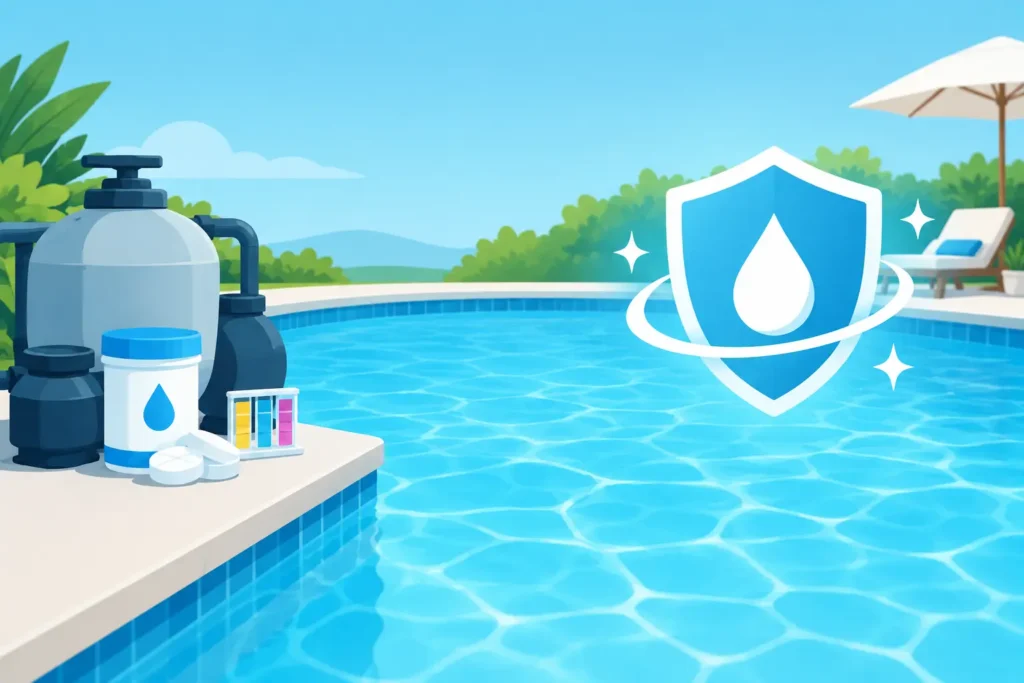
A pool can look clear at midday and still present a hygiene problem by evening. In Cyprus, high temperatures, intense sunlight, wind-blown dust and heavy holiday use can change water conditions quickly. Effective pool sanitation is therefore not a cosmetic task or a matter of adding chlorine when the water turns green. It is the controlled management of water chemistry, filtration, circulation and cleaning to keep swimmers safe and protect the pool system.
For private owners, the consequences of poor water management may begin with cloudy water, algae or eye irritation. For landlords, villa operators and communal-pool committees, the stakes are higher: unreliable water quality can affect guest confidence, create avoidable health risks and lead to costly equipment damage. Clean, healthy and safe water requires a planned routine, accurate testing and a system that is functioning as designed.
What pool sanitation actually involves
Disinfection is only one part of pool sanitation. Chlorine, bromine or a correctly managed salt-water chlorinator can control many harmful organisms, but sanitiser cannot do its job properly in poorly balanced or poorly circulated water. A pool also needs filtration to remove suspended debris, regular physical cleaning to reduce organic contamination, and chemical balance that allows disinfectant to remain effective.
Every swimmer introduces contaminants. These include skin cells, body oils, cosmetics, sunscreen and, in some cases, microorganisms. Leaves, pollen, dust and rainwater add a further burden, particularly in exposed pools around Paphos and coastal areas. When this load exceeds the system’s capacity, the water may lose clarity, algae may establish itself and disinfectant demand rises sharply.
Good sanitation is about preventing that chain of events rather than responding once the pool has become visibly unpleasant.
The four controls that keep pool water safe
1. Reliable disinfection
A sanitiser must be present at the right level for the pool’s conditions. Chlorine remains widely used because it is effective, economical and familiar, but it needs correct management. The useful measure is not simply how much chlorine has been added, but whether there is sufficient active disinfectant available after sunlight, bather load and contaminants have taken their share.
Salt-water pools still rely on chlorine. Their chlorinator produces it from dissolved salt, which can make routine dosing more convenient, but the pool still requires testing, balancing and periodic inspection. A salt system with scaled cells, incorrect output settings or inadequate circulation can leave water under-sanitised even if the pool appears normal.
Spas and hot tubs require particularly close attention. Their smaller water volume, warmer temperature and concentrated bather load cause water quality to change far more rapidly than in a swimming pool. A weekly visit may not be sufficient for a heavily used spa, especially in rental accommodation.
2. Correct pH and water balance
pH controls how comfortable the water feels and how efficiently chlorine works. When pH is too high, disinfectant becomes less effective and scale formation is more likely. When it is too low, water can become corrosive, uncomfortable for swimmers and damaging to metal components, grout and equipment.
Total alkalinity, calcium hardness and stabiliser levels also matter. They influence how stable the pH remains, whether surfaces are likely to scale or corrode, and how quickly sunlight consumes chlorine. There is no single setting that suits every installation. A tiled communal pool, a liner pool, a heated pool and a compact spa each have different operating pressures and equipment considerations.
This is why adding chemicals by guesswork is risky. The apparent fix for a green pool may create a second problem, such as excessive stabiliser, corrosive water or a filter overwhelmed by dead algae.
3. Circulation and filtration
Chemicals cannot sanitise water that does not reach the treatment system. The pump moves water through skimmers, drains, pipework and filters; the filter removes fine debris and contaminants that would otherwise remain available as food for algae or cloud the water.
A blocked skimmer basket, dirty filter, failing pump, air leak or closed valve can reduce circulation long before an owner notices a visible change. In summer, insufficient pump run time is a common cause of deteriorating water. Running a pump only during the coolest part of the day may reduce electricity use, but it can leave the pool without adequate treatment during peak use and intense sunlight.
The appropriate run time depends on pool volume, hydraulic design, pump performance, filter condition, bather load and weather. Energy-saving variable-speed pumps can reduce running costs, but they must still deliver the required circulation and turnover. Lower energy consumption is valuable only when water quality and filtration performance remain protected.
4. Physical cleaning and contamination control
Vacuuming, brushing walls and steps, emptying baskets and removing debris are sanitation tasks, not merely presentation work. Biofilm and algae can take hold in corners, behind fittings, on steps and along the waterline where circulation is weaker. Brushing disturbs these deposits so that treatment and filtration can remove them.
The waterline deserves particular attention. Oils, sunscreen and airborne dirt collect there, creating a visible ring and a surface where contamination can persist. Regular cleaning protects the finish as well as improving hygiene.
Why clear water is not always safe water
Clarity is a useful visual indicator, but it is not a laboratory result. Water can be crystal clear while disinfectant is inadequate, pH is outside its effective range or bacteria are present. Equally, cloudy water may result from fine particles, poor filtration, chemical imbalance or an emerging algae problem.
Testing should therefore be routine, not reserved for faults. During periods of high heat, heavy pool use, dust or after a storm, conditions can change within hours. Rain may dilute chemicals and wash debris into the pool, while hot, sunny weather accelerates chlorine loss and algae growth.
Professional testing looks beyond a single chlorine reading. It considers free and combined chlorine, pH, alkalinity, stabiliser, calcium hardness and the visible performance of the circulation and filtration system. Test results only become useful when they are interpreted alongside the pool’s use, equipment and recent weather conditions.
Pool sanitation for rental and communal properties
A family pool used by the same household has a different risk profile from a holiday villa, flat complex or hospitality facility. More users mean more contaminants, more variable behaviour and less certainty about how the pool has been used between service visits.
For shared facilities, a documented operating routine provides accountability. This should include water-test records, chemical handling procedures, cleaning schedules, equipment checks and a clear process for responding when readings fall outside acceptable operating limits. These controls support the principles set out in EN 15288-1 and EN 15288-2, which place hygiene, risk management and safe operation at the centre of public and semi-public pool management.
The practical benefit is simple: problems are found early. A falling disinfectant level, rising filter pressure or unusual water demand can be addressed before guests complain, algae spreads or equipment fails under pressure.
When a pool needs more than routine treatment
There are moments when normal dosing is not enough. Persistent cloudiness, recurrent algae, strong chemical odours, staining, rapid chlorine loss or poor water movement point to an underlying cause. It could be an overloaded filter, failing pump, incorrect valve arrangement, depleted filter media, a damaged chlorinator cell or water chemistry that has drifted beyond routine correction.
A strong chlorine smell is also not proof of cleanliness. It can indicate chloramines, compounds formed when chlorine reacts with contaminants. The right response depends on test results and the condition of the pool, not on adding more products blindly.
Qualified operators assess the whole installation. At The Pool People, this means looking at water quality alongside hydraulics, filtration, dosing, heating and the condition of the pool structure, using the disciplined approach expected of PHTA/NSPF Certified Pool & Spa Operators.
A safer routine starts before the water changes colour
Pool sanitation works best when it is uneventful: clear water, stable readings, clean surfaces and equipment operating without strain. Regular professional attention is not an extra for properties with demanding use or complex equipment. It is a practical safeguard for swimmers, your investment and the reputation of any property that welcomes guests.
If your pool’s water has become unpredictable, arrange an assessment before the next spell of heat or heavy use turns a manageable issue into a closure, repair or major chemical correction.