
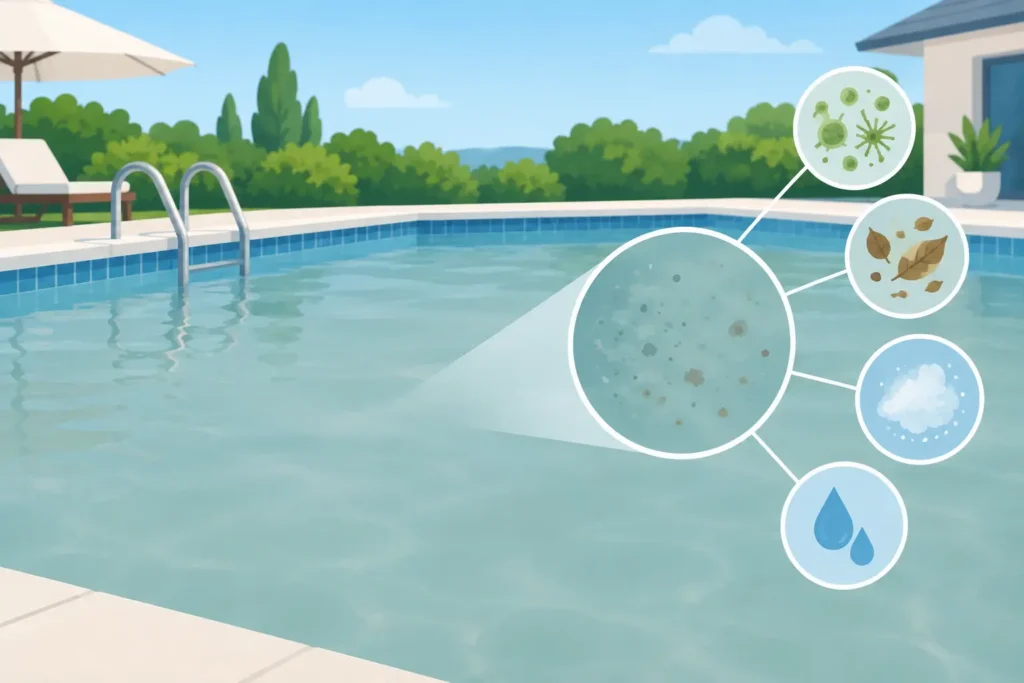
A pool can look only slightly hazy in the morning and become visibly milky by the afternoon. In Cyprus, strong sun, high bather loads, wind-blown dust and sudden rain can accelerate the problem quickly. Cloudy pool water causes are not merely cosmetic: unclear water can indicate ineffective disinfection, poor circulation or particles that the filtration system is failing to remove. Until the cause is identified, the pool should be treated as a water-quality concern rather than a cleaning inconvenience.
Why cloudy water needs prompt attention
Clear water is one of the simplest visible checks on whether a pool is being properly operated. When the water loses clarity, swimmers cannot easily see the floor, steps or drains. More importantly, the same conditions that create cloudiness can allow bacteria and other contaminants to persist.
For holiday villas, communal facilities and hospitality properties, this affects more than presentation. A guest complaint about milky water can become a hygiene issue, a cancelled booking or an unnecessary equipment repair if circulation and chemical problems are left unresolved. European operating principles, including those reflected in EN15288 pool safety guidance, place water quality and safe supervision at the centre of responsible pool management.
The main cloudy pool water causes
Poor filtration or inadequate circulation
A filter cannot remove contaminants if water is not reaching it effectively. A blocked skimmer basket, full pump basket, dirty filter media, damaged multiport valve or a pump running for too few hours can all leave fine debris suspended in the water.
This is especially common when a pool looks clear at the start of the season but turns dull during periods of intensive use. Fine dust, pollen, sunscreen residue and microscopic organic matter build up faster than the system can capture them. In hot Paphos weather, reducing pump run time simply to save electricity often creates a more expensive problem later.
The filter type matters. Sand filters require correctly timed backwashing, but excessive backwashing wastes water and can reduce filtration efficiency if it becomes a substitute for proper diagnosis. Cartridge filters need cleaning or replacement when flow is restricted. Glass media may improve fine-particle capture, yet it still depends on correct circulation, valve settings and maintenance.
A simple observation can help: if return jets feel weak, the pressure gauge has changed markedly, or the skimmer is not drawing surface debris properly, the issue may be mechanical rather than chemical. Do not add repeated doses of chemicals before confirming that the system can circulate and filter the water.
Incorrect pH and poor chlorine performance
Chlorine only works reliably within the appropriate pH range. When pH rises too high, a common occurrence in warm pools with heavy use, chlorine becomes less effective. The water may look flat or cloudy even where test strips appear to show chlorine present.
Conversely, adding large quantities of chemicals without accurate testing can create an unstable balance. High pH, low pH, insufficient free chlorine, excessive stabiliser and incorrect alkalinity can each affect water clarity in different ways. A pool needs a balanced treatment programme, not a cycle of reacting to appearance alone.
Salt-water pools are not chemical-free pools. A salt chlorinator produces chlorine, and the water still requires regular testing for pH, sanitiser level, alkalinity and stabiliser. Scale on the cell, poor flow or an incorrectly sized unit can reduce chlorine production just when demand is highest.
For a residential pool, a reliable test kit provides useful routine checks. For a communal pool, holiday rental or spa, professional water testing and recorded operating procedures are more appropriate. Higher use means contaminants enter the water faster, and the margin for error is smaller.
High bather load and organic contamination
Every swimmer brings contaminants into a pool: perspiration, cosmetics, sun cream, body oils, soil and traces of personal-care products. Chlorine is consumed as it reacts with this material. When many people use the pool over a short period, the sanitiser demand can rise sharply.
This is why water can become cloudy after a busy weekend even if the pool looked perfect beforehand. Children playing for hours, guests repeatedly entering after applying sun cream, and warm water temperatures all increase the treatment load. The answer may involve oxidation treatment, filtration support and a review of circulation time, but the correct response depends on measured water results.
Cloudiness accompanied by a strong chlorine smell should not be mistaken for a clean pool. That smell may be associated with combined chlorine compounds, which can form when chlorine is overworked. It is a sign to test properly, not a reason to add perfume-like products or ignore the water.
Algae, early microbial growth and fine particles
Green water is the obvious sign of algae, but algae do not always begin as a dramatic green bloom. The first indication can be a faint haze, slippery surfaces or dust-like deposits in corners and along the waterline. Warm temperatures and weak sanitiser levels create favourable conditions for growth.
Cloudiness can also be caused by dead algae after treatment. Once algae are killed, their fine particles must still be filtered out or removed by appropriate clarification methods. This is one reason a pool may remain cloudy after a shock treatment. Killing the contamination is only part of the job; circulation, filtration and rebalancing must follow.
In coastal and rural parts of Cyprus, airborne dust can also be significant. After high winds or a dust event, large quantities of fine particles may enter the pool. These particles can pass through a poorly maintained filter or remain suspended if the water chemistry does not support effective filtration.
Rainwater, storms and contaminated debris
Rain changes pool chemistry. It dilutes sanitiser, brings airborne contaminants into the water and can wash debris from surrounding hard surfaces into the pool. A short storm can therefore have a disproportionate effect, particularly where the pool was already near the edge of its operating range.
After rain, remove visible debris, check baskets and test the water before normal use resumes. If the water turns cloudy or green, avoid guessing. Measure the key parameters, inspect the equipment and allow enough filtration time for the system to recover. For properties left vacant between bookings, this check is particularly valuable because a small issue can develop unnoticed.
Calcium scale, metals and incorrect dosing
Some cloudy water has a pale, chalky appearance rather than an organic haze. This can be linked to calcium precipitation, often caused by high pH, high calcium hardness or unsuitable chemical dosing. Scale may also appear on tile lines, fittings and salt chlorinator cells.
Metals can create discolouration or unusual cloudiness, particularly after unsuitable source water is added or when corroding equipment introduces contaminants. These cases require careful testing. Adding more chlorine or clarifier without understanding the chemistry may worsen staining, scale or filter blockage.
How to respond without making the problem worse
First, stop treating clarity as a visual judgement alone. Test the water for free chlorine, pH, alkalinity and stabiliser, then assess circulation and filtration. Check whether the pump is running correctly, baskets are clear, valves are in the right position and the filter has been maintained according to its type.
Avoid swimming until the water is clear and the chemical readings are within the correct operating range. This is particularly necessary for young children, guests and communal-pool users, who may be less able to recognise poor conditions or avoid swallowing water.
Do not keep adding chlorine, algaecide, clarifier and pH chemicals one after another in the hope that something works. Some products are useful in the right circumstances, but unnecessary dosing can create secondary problems. Clarifier, for example, may help a filter capture very fine suspended particles, while excessive use can clog the filter media or produce further cloudiness.
If the water has remained cloudy after basic checks, or if the pump, filter, chlorinator or control equipment appears unreliable, a trained pool operator should investigate. The Pool People can assess water balance alongside hydraulic performance, filtration condition and equipment faults, rather than treating symptoms with a routine chemical dose.
Preventing recurring cloudiness
A consistently clear pool comes from a planned maintenance routine: regular testing, sufficient daily circulation, correct filter servicing, basket cleaning and prompt action after heavy use, wind or rain. Property managers should also keep clear service records, particularly where several people share responsibility for a communal facility.
The exact routine depends on pool volume, filter type, water temperature, usage and installed equipment. A quiet private pool in winter does not require the same operating approach as a busy holiday-rental pool in August. What does not change is the standard: water should be clean, healthy and clear enough for the pool floor to be seen without difficulty.
When cloudiness appears, acting early protects swimmers, preserves equipment and prevents a manageable adjustment from becoming a full recovery programme. Clear water is not a finishing touch for a well-kept pool. It is evidence that the system is being looked after properly.