
A pool that is crystal clear but too cold to use is not delivering the value owners expect from it. The right pool heating systems can extend the comfortable swimming season, improve guest experience at holiday lets and make a communal or private pool more practical outside peak summer. However, heating must be treated as an engineering decision, not simply an equipment purchase. In Cyprus, high summer temperatures help, but wind, cool evenings, exposed sites and heavy water evaporation can still make a significant difference to performance and running costs.
Start with the pool, not the heater
The first question is not which brand or type of heater to buy. It is how much heat the pool actually loses and how quickly you need to replace it. Pool volume matters, but it is only one part of the calculation. Surface area, depth, desired water temperature, prevailing wind, shade, the pool’s orientation and the months in which it will be used all affect the required output.
A small, sheltered villa pool used from April to October has very different requirements from a large communal pool expected to maintain reliable temperatures through the shoulder season. A pool in an exposed coastal location around Paphos or Coral Bay may lose heat faster than an inland pool of the same volume. If a heater is undersized, it may run continuously without reaching the required temperature. If it is oversized, the initial outlay may be unnecessarily high.
It also helps to set a realistic target. Many leisure pools are kept around 27-29°C, depending on who uses them and how actively they swim. Young children, older users and guests who expect a relaxed resort-style swim may prefer warmer water. Every degree above the natural temperature requires energy, so a sensible target is part of controlling long-term costs.
The main types of pool heating systems
Air-source heat pumps
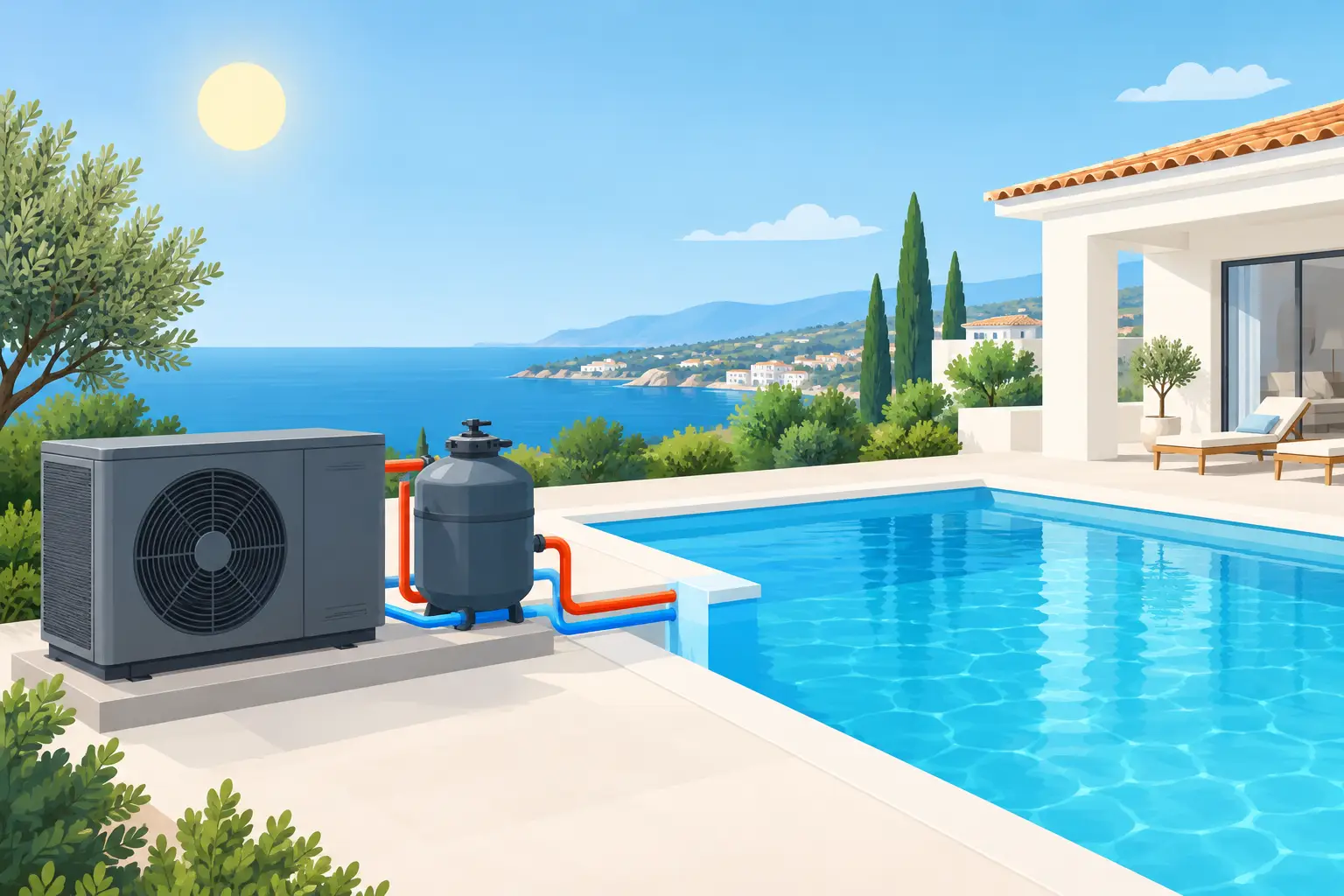
For many residential and communal pools, an air-source heat pump is the most balanced option. It draws heat from the outdoor air and transfers it into the pool water through a heat exchanger. Rather than generating all heat directly from electricity, it moves available heat, which can make it considerably more economical to operate than a conventional electric resistance heater.
Heat pumps work particularly well in Cyprus during the main swimming season, when air temperatures are favourable. Their efficiency falls as the air becomes cooler, so a system selected for early spring or late autumn use must be specified carefully. The published efficiency figure alone is not enough. Ask for performance at the expected air temperature and pool-water temperature, not only under ideal test conditions.
Correct installation is essential. A heat pump needs clear airflow, stable electrical supply, suitable drainage for condensate and enough room for future servicing. It must also be connected with proper hydraulic flow. A bypass arrangement allows the engineer to regulate how much water passes through the unit, helping it operate within its designed flow range.
Solar thermal heating
Solar thermal systems use panels or collectors to capture the sun’s heat and transfer it to the pool water. In Cyprus, where sunshine is abundant, solar can be an attractive way to support a longer season with low ongoing energy demand.
Its limitation is control. Solar output depends on sun exposure, collector area, weather and the time of day. It may provide excellent assistance in spring and autumn, yet it cannot guarantee a chosen pool temperature after a run of cloudy weather or during cooler nights. For that reason, solar thermal is often best considered as part of a wider heating strategy rather than the only heat source where consistent temperature is commercially important.
A good assessment will consider roof or ground space, pipe routes, shading, pump requirements and the impact of long pipe runs. Poor pipe insulation or badly planned circulation can give away a meaningful part of the heat collected.
Gas and propane heaters
Gas or propane pool heaters can raise water temperature quickly and may suit pools that are used intermittently, such as a holiday property with changing guest arrivals. They can also provide useful high-output heating where space for a large heat pump is limited or a rapid temperature recovery is required.
The trade-off is usually running cost. Fuel prices, fuel storage arrangements and the intended hours of operation need to be assessed before installation. Gas equipment also requires correct siting, ventilation, flue arrangements where applicable and installation by appropriately qualified professionals. It should never be treated as a simple replacement appliance.
Electric resistance heaters
Electric resistance heaters are compact and straightforward in principle, but they are generally expensive to run for anything beyond a small pool, spa or occasional supplementary use. They can be appropriate where the water volume is low, demand is limited and the electrical installation has adequate capacity. For a full-size swimming pool, a heat pump will often make better financial sense over time.
Heating performance depends on circulation
A heater cannot compensate for poor water circulation, a tired pump or a blocked filter. Water must pass through the heating circuit at the correct rate, with the filter clean enough to maintain flow and the pipework sized properly for the system. If flow is too low, the heater may shut down on a protection fault. If it is too high, heat transfer and equipment operation may be affected.
This is why the condition of the whole plant room matters. Pumps, filters, valves, electrical protection, automation controls and pipework should be reviewed together. Energy-efficient variable-speed pumps can be useful, but their programmed speeds must still provide enough circulation when the heater is operating. Reducing pump speed indiscriminately to save electricity can leave a heating system underperforming.
For commercial, communal and rental facilities, dependable circulation is also a hygiene issue. Heating increases bather comfort and can encourage more use, but warm water does not replace effective filtration, disinfection or water testing. Poorly controlled warm water can increase the consequences of inadequate chemical management. Clean, healthy and safe water remains the priority.
Water balance and heating equipment
Pool water chemistry directly affects the life of heating equipment. Unbalanced pH, excessive calcium hardness, corrosive water or unsuitable total alkalinity can damage heat exchangers, seals and pipework. Scale formation inside a heat exchanger reduces heat transfer, making the unit work harder for less result.
Salt-water pools need particular attention when a heater is added or replaced. A salt chlorinator and heating system can work very well together, but water balance and bonding arrangements must be checked as part of the installation. The same applies to pools with older plant equipment, where hidden corrosion or inconsistent electrical protection may become apparent only when new equipment is introduced.
Regular testing should cover more than free chlorine and pH. A professional maintenance programme can identify trends in calcium, alkalinity, stabiliser and salt level before they become equipment failures. This is less costly than discovering a restricted heat exchanger at the start of a busy holiday period.
Controls reduce waste without reducing comfort
A heater should not simply be switched on and left to work without a plan. Modern controllers allow owners and managers to set temperature targets, timer schedules and operating priorities. The most effective schedule depends on the site, the tariff, the pump programme and when swimmers use the pool.
For a holiday rental, maintaining a sensible base temperature before guest arrival may avoid a costly rush to heat cold water at short notice. For a communal pool, a programmed schedule can match expected use while allowing time for the water to recover. The best setting is rarely the highest available temperature. It is the lowest stable temperature that provides the intended user comfort.
Monitoring is valuable as well. A sudden rise in energy use, slower warm-up time or repeated fault messages can point to a blocked filter, failing circulation pump, refrigerant issue, scale build-up or a control problem. Early investigation protects both the equipment and the budget.
Installation and safety responsibilities
Any pool heating installation combines water, electricity and, in some cases, fuel combustion. That demands proper design, appropriate electrical protection and competent commissioning. Electrical work around pools must be assessed carefully, with suitable isolation, earthing and protective devices in place. Pipework connections must be secure, accessible for maintenance and arranged so that equipment can be isolated safely.
For flat complexes, hotels and other shared facilities, the duty is wider than equipment performance. Plant rooms require documented operating procedures, recorded water checks and responsible maintenance arrangements. European standards such as EN 15288-1 and EN 15288-2 provide a useful framework for safe pool design and operation in public and shared environments. A heating upgrade should support these responsibilities rather than create new maintenance risks.
Before selecting equipment, ask for a clear assessment of the pool’s volume, heat-loss conditions, electrical supply, circulation system and intended season of use. A qualified engineer should explain expected warm-up times and likely operating costs in practical terms, rather than promising a result that the site conditions cannot support.
A well-specified heating system should make the pool more enjoyable without compromising water quality, safety or operating discipline. When the heater, circulation plant and maintenance routine work together, owners gain more usable days in the water and fewer expensive surprises in the plant room.



Leave A Comment