
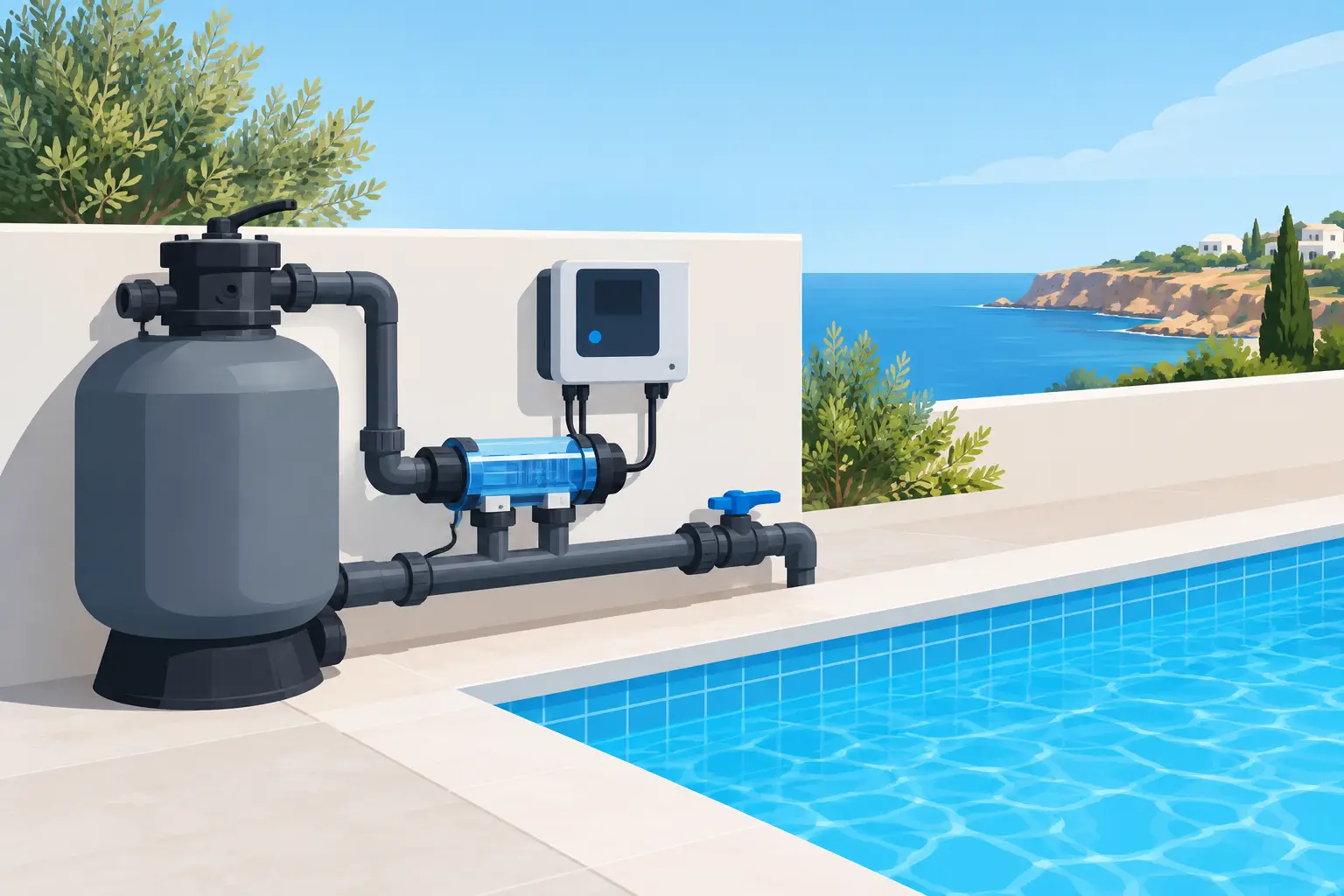
A salt pool should not smell strongly of chlorine, leave the water cloudy or give swimmers sore eyes. When it does, the issue is rarely that the pool needs more salt. It is usually an undersized, poorly positioned or incorrectly commissioned system. A professional salt chlorinator installation turns dissolved salt into a controlled chlorine supply, but only when the equipment, circulation and water chemistry work together.
For private villas, holiday lets and communal pools in Cyprus, that distinction matters. Long summer operating hours, high bather loads and very warm water place sustained demand on disinfection equipment. Salt chlorination can provide clean, healthy and safe water with less day-to-day handling of chlorine products, but it is not a fit-and-forget upgrade.
Is a salt chlorinator right for your pool?
A salt chlorinator uses electrolysis. Pool water containing a measured concentration of salt passes through an electrolytic cell, where the system produces chlorine. That chlorine sanitises the water, then returns largely to salt after completing its work. The process repeats while the circulation pump runs.
The practical appeal is clear: rather than relying entirely on manual dosing, the pool receives chlorine little and often during filtration. This can make chlorine levels more stable and reduce the sharp peaks and troughs associated with irregular treatment. It also removes the need to store as much conventional chlorine on site.
However, salt water is still chlorinated water. It requires testing, pH control, filter cleaning and correct circulation. It is also mildly corrosive, particularly where salt is allowed to accumulate on metal fittings, poor-quality fixings or vulnerable stonework. A site survey should assess the pool shell, pipework, existing heater, pump, filtration equipment and surrounding finishes before any recommendation is made.
Salt systems are often an excellent choice for a well-maintained residential pool. For a communal pool or busy holiday-rental property, sizing and monitoring become even more critical. A unit selected only by pool volume may struggle if the pool is heavily used, runs at elevated temperatures or has limited daily filtration time.
Salt chlorinator installation begins with correct sizing
The rating on a chlorinator refers to its maximum chlorine output, usually expressed in grams per hour. That figure must be matched to the pool’s real chlorine demand, not simply the number printed on an old pump-room drawing.
Pool volume is the starting point, but it is not the whole calculation. Direct sunlight, water temperature, the number of users, regular use by children, organic debris, whether the property is occupied year-round and the hours the pump operates all influence demand. In Paphos, a pool that is comfortable in spring can face a very different workload through July and August.
As a general rule, it is wiser to specify a unit with capacity in reserve than one that must run at maximum output every day. Constant full-power operation shortens cell life and leaves little margin after a busy weekend or a period of extreme heat. Oversizing should still be sensible, because excessive output can create its own water-balance problems if controls are not correctly set.
The pump must also provide sufficient flow for the chlorinator to operate safely. Low flow can prevent production, trigger error messages and indicate a blocked filter, closed valve or failing pump. High flow can be equally unsuitable for some equipment. The manufacturer’s flow requirements, pipe diameter and the rest of the plant layout need to be considered together.
Where the cell belongs in the pipework
The electrolytic cell is normally fitted on the return line after the filter and after other treatment equipment. If a heater is installed, the cell is generally positioned downstream of it, so highly chlorinated water does not pass directly through the heater. A correctly installed non-return valve may also be required, depending on the equipment arrangement.
The cell must be installed in the correct direction, with adequate straight pipe runs where specified and enough physical access for inspection and removal. It should never be squeezed into a pipe run simply because there is an empty section of wall nearby. Poor positioning makes servicing harder and can lead to inaccurate flow readings, trapped air or premature damage.
A properly designed bypass can be useful where the equipment needs isolation for servicing or where flow needs managing. It must not become an excuse for sending untreated water back to the pool. Every valve position should be clear to the person responsible for routine operation.
Electrical protection is part of the installation
A salt chlorinator combines water, electricity and corrosive conditions. Its electrical installation deserves the same professional attention as the plumbing.
The control unit should be mounted securely in a dry, ventilated location, protected from direct weather and positioned so its display can be read during routine checks. The supply should be appropriately protected and installed in accordance with applicable electrical requirements. Earthing and bonding must be checked as part of the wider pool installation, not assumed because the chlorinator powers on.
The chlorinator should be interlocked with the circulation pump. It must not produce chlorine when water is not moving through the cell. A flow switch provides an additional safeguard, but it is not a substitute for correct controls and sound hydraulic design. On many pools, synchronising the unit with the filtration timer is straightforward; on more complex plant rooms, it may require a more considered control arrangement.
For communal and commercial facilities, records of installation, settings, testing and ongoing maintenance support responsible operation. EN 15288-1 and EN 15288-2 place strong emphasis on safe design and operation of swimming pool facilities. Equipment choice alone does not establish compliance. The way the system is installed, monitored and maintained matters just as much.
Preparing the water before salt is added
Adding salt to green or unbalanced water does not solve the underlying problem. Before commissioning a chlorinator, the pool should be clean, filtered effectively and chemically balanced. Existing algae, high stabiliser levels, contaminated filter media or poor circulation should be addressed first.
The salt itself should be a suitable high-purity product intended for swimming pools, without anti-caking additives or contaminants that can affect water quality. It should be distributed evenly across the pool and allowed to dissolve fully with circulation running before the chlorinator is activated. Pouring salt directly into a skimmer, balance tank or onto sensitive surfaces can create concentrated pockets that cause avoidable damage.
The target salinity depends on the selected equipment, commonly around 3,000 to 5,000 parts per million. That is far below seawater concentration, but it is enough to affect materials and equipment. The level should be confirmed with a reliable test rather than judged from the number of bags used. Pool volume estimates are frequently inaccurate, particularly after refurbishment or changes to water depth.
Commissioning checks that protect water quality
Once the salt has dissolved, commissioning should verify more than a reassuring light on the controller. The following checks establish whether the system can maintain safe water in normal operation:
- actual salt concentration and chlorinator output
- free chlorine, pH, total alkalinity and stabiliser level
- pump flow, filter pressure and correct operation of the flow switch
- timer settings that provide enough daily production for anticipated use
pH deserves particular attention. Salt chlorination commonly causes pH to rise over time. If pH is allowed to climb, chlorine becomes less effective, scale forms more readily on the cell and water may look dull despite apparently adequate chlorine production. Regular testing and controlled acid dosing, whether manual or automated, are therefore central to reliable operation.
Maintaining a salt system through the Cyprus season
The cell is a consumable component, not a permanent fixture. Calcium scale can form on its plates, especially when pH and calcium hardness are poorly controlled. The cell should be inspected at the intervals recommended for the equipment and cleaned only when scale is present. Repeated acid cleaning without need can shorten its working life.
Heavy rain, dust, a busy rental changeover or a heatwave can all increase chlorine demand. After these events, the pool may require testing, adjustment or a temporary boost setting. The chlorinator cannot compensate for blocked filters, short pump run times or water that has already lost its chemical balance.
Owners should also check the display for low-salt, low-flow and cell-life warnings rather than treating alarms as minor inconveniences. A low-salt message may reflect dilution after backwashing or rainfall, but it can also be caused by a worn cell or an inaccurate sensor. Adding salt without testing can push salinity beyond the manufacturer’s recommended range.
For managed properties, professional routine visits provide a useful safeguard: water readings are checked, equipment performance is reviewed and emerging faults are dealt with before guests or residents face cloudy water or a closure. The Pool People approach salt systems as part of the complete circulation and hygiene programme, not as a replacement for it.
A well-planned salt chlorinator installation should make pool care more consistent, not less accountable. Choose capacity for the hardest weeks of the season, protect the electrical and hydraulic installation, and keep testing the water. That is how a salt pool remains inviting when it is used most.



Leave A Comment